


The growing impact of Climate Change for the industrial heritage sector was underlined by the impact of Storm Babet in October 2023. A rapid online survey of the immediate impact of the storm was undertaken in the last week of October and the first week of November 2023 for the IHSO project, indicating that it had the largest impact on industrial heritage sites in England since the flooding caused by storms Ciara and Dennis, both in February 2020.
Storm Babet, the second named storm of the 2023-24 autumn and winter season, was an intense cyclone that affected large parts of north-western and western Europe from the 16th October, when it was given a name, to the 22nd October 2023, when it dissipated. It crossed Britain from south-west England to north-east Scotland from the 18th to the 20th October. According to data gathered by the Met Office: ‘heavy, persistent and widespread rain…affected much of England, Wales and Northern Ireland from 18th to 20th, with 100mm falling fairly widely [double the average monthly rainfall for England]…Babet also brought some very strong winds, gusting at over 50Kt (58mph) across north-east England and much of Scotland’. (2023_08_storm_babet_v1.docx (metoffice.gov.uk).
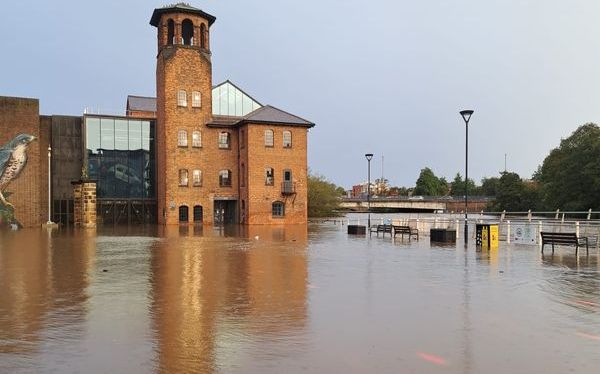
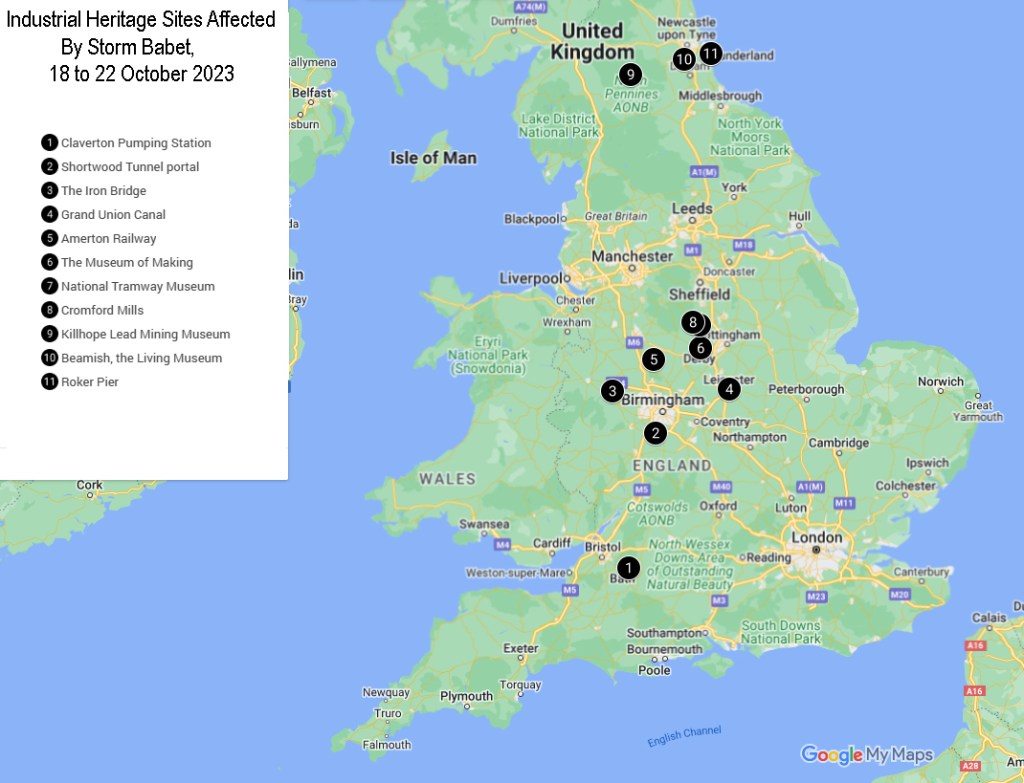
The impact in England and Wales was not as severe as north-east Scotland but was still extensive, with flooding across Yorkshire, the East Midlands, and the Humber area, as well in Suffolk, and around Stafford and Wrexham. Its impact on industrial heritage sites in England was felt in three ways. The most severe impact was through flooding episodes. The ground floor of the Grade II Listed Museum of Making (Derby Museums | Derby Museums) (the Old Silk Mill), in the centre of Derby, was flooded by the adjacent River Derwent on 21st October to between 0.5m and 0.7m. The redesign of the museum building at the beginning of the 2020s incorporated elements to protect the building and its archives from flooding by the adjacent River Derwent. Evenso, Derby Museum estimate that the damage runs into the tens of thousands of pounds, and the museum will not re-open until well into 2024. Other industrial heritage sites affected by flooding included the heritage narrow gauge Amerton Railway in Stafford, the National Tramway Museum at Crich in Derbyshire, and the Claverton Pumping Station near Bath, on the Kennet and Avon Canal. For the latter this was the third time this year that parts of the site had been flooded by the River Avon, from which water is pumped up to the canal.
Secondly, the impact of intense rainfall was also seen in several landslip events on the canal network. A landslide occurred on the Worcestershire & Birmingham Canal by the Shortwood Tunnel west portal (near the village of Tardebigge, Worcestershire), whilst a 50m of canal bank collapsed due to flooding along the Grand Union Canal in central Leicester from the adjacent river Soar (https://canalrivertrust.org.uk/news-and-views/news/counting-the-cost-of-climate-change).
Thirdly, the impact of winds was seen at several industrial heritage sites along the north-east coast of England. In South Shields, the storm dislodged the dome of the Tyne South Pier lighthouse and sections of railings and decking were also destroyed at Sunderland’s Rock Pier by large waves in conjunction with the high winds.
The IHSO project has been gathering data on the impact of climate change on Industrial Heritage sites and monuments since January 2020, and each winter and summer of this decade has brought notable weather extremes. Current Met Office projections down to 2050 suggest that there Britain will experience an increase in winter storm intensity, an increase in the length of dry spells, and an increase in temperature extremes as the climate continues to warm. Since many industrial heritage sites lie in areas vulnerable to flooding, such as river valleys or along the coast, these sites are most at risk. However, all industrial heritage sites need to develop further their disaster management plans, especially early warning of weather events, and to think in detail about adaption options.
 Industrial Heritage Networks