Welcome to the Industrial Heritage Networks and Support website. This site is maintained and updated by the Ironbridge Gorge Museum Trust who run the project and the networks. We aim to support industrial heritage in England through networking, information exchange, guidance, and training. Please explore the website and please contribute! For more information you can … Read more Welcome to the IHNs website!
The Institution of Mechanical Engineers (IMechE) has awarded Sandfields Pumping Station, run by the Lichfield Waterworks Trust, with one of its Heritage Engineering Awards. This prestigious honour celebrates Sandfields’ vital role in bringing clean water to the Black Country and advancing public health during Britain’s industrial period.
John Wood, chairman of the IMechE Heritage Awards committee noted that: “Sandfields Pumping Station is not just another pumping station”, whlst Katy Shore-Kapsis, chair of the Lichfield Waterworks Trust, added: “This award is a huge honour for Sandfields and for everyone who has dedicated time and passion to keeping its legacy alive.
The plaque, unveiled in October 2025 by Matt Garside President of the IMechE, reads: “The Sandfields Pumping Station was the first built for the South Staffordshire Waterworks Company to provide clean water to the industrial towns of the Black Country. The Cornish beam engine, operational from 1873 to 1927, could pump up to 2 million gallons of water per day.”
The Lichfield Waterworks Trust now cares for the site and its volunteers carry out restoration projects as well as running guided tours and educational programmes. They are currently raising funds to get the Cornish Pumping Engine working again. Further details here: https://lichfieldwaterworkstrust.co.uk/
Sandfields Pumping Station, Litchfield. Image courtesy of Litchfield Waterworks Trust.
Calderdale Industrial Museum is working to bring life back to its beautiful steam engines and is seeking to raise funds to complete this exciting steam project. These engines include the early beam engine, the vertical steam engine, the Newton Bean and Mitchell horizontal engine, and the Belliss & Morcom twin cylinder steam generator set. Using steam to power these engines again will add a fantastic dimension to the visitor experience at the museum.
The museum has been lucky to have some very generous support from individuals who have donated a considerable amount of money to help fund this, but they are now looking to widen their Appeal, as they still need to raise more money. With the launch of the ‘Full Steam Ahead Appeal’ they hope to raise the final amount of funding to complete the project, which will allow them to refurbish the engines, install a smaller, more efficient boiler and carry out the necessary safety and operation training.
Bringing steam back to the power gallery will be integral to showing how these amazing steam engines drove the development of the Industrial Revolution in this area. Visitors will be able to see how these magnificent workhorses powered the industry of Calderdale, and many could even enjoy specialist experiences and steam days, which will bring enthusiasts from around the country to this vibrant area of West Yorkshire. The introduction of steam to the museum should make a significant addition to the overall visitor experience, further cementing the museum’s place as a major contributor to local heritage and the economy and driving their efforts to reach a wider audience.
Calderdale Industrial Museum
Calderdale Industrial Museum, an Arts Council accredited museum, sits at the heart of the historical quarter of Halifax and makes a considerable contribution to the heritage engagement and economy of this region of West Yorkshire. It tells the story of how the industry of the past grew as a direct consequence of the particular physical landscape and ingenuity of its local people, resulting in the rich heritage and exciting story, relevant to the history of the Industrial Revolution in Great Britain.
Since the local authority had to close the museum due to a shortage of funds in 2000, local enthusiasts and industry specialists have fought hard to save this nationally and regionally significant collection of industrial heritage. From the museum’s re-opening in 2017, this group of enthusiasts has continued to grow and now works hard to bring their combined knowledge and experience to deliver one of our region’s most popular visitor attractions. Sitting next to Halifax’s amazing and unique Piece Hall, the museum is central to telling this story of the town of one hundred trades. The museum is now run for the most part by this unpaid volunteer workforce, with all maintenance and conservation work funded by open day takings. Any special projects require additional funding sourced from a wide range of donors.
It has always been the ambition of these dedicated volunteers to bring life back to as many of the collections machines as possible. Work has been going on in many areas of the museum to show looms, sock knitting machines, and many of the worsted industry machines, in working order.
The Horizontal Newton Bean and Mitchell Engine known as Enid part way through restoration and recommissioning. This is just one of the engines that fill soon be powered by steam. Image copyright Calder Industrial Museum.
The Industrial Heritage Support project is conducting research on the current state of stationary steam engines on industrial heritage sites and museums in England. In partnership with Keele University we are looking to establish how many sites in England run stationary steam engines, as op[posed to just static exhibits. We are also gathering data on the costs of maintenance, the types of fuel used to run these engines, and the skills required to keep them running.
Many sites have already been contacted individually to discuss how they run their machinery and this has helped to inform a questionaire which is now being emailed (early August 2023) to more than 30 sites. This research is a follow-up to the recent ‘Industrial Heritage and Climate Change’ seminar the project ran in July, where presentations from Claymills, Crofton Beam Engines, and The Arkwright Society showed how eco-fuels and water power are being used on industrial sites. This research will be published at a later date.
If you haven’t received a questionaire but think that your site could help with this research please email: mike.nevell@ironbridge.org.uk
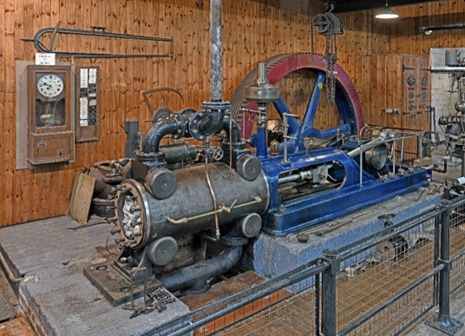
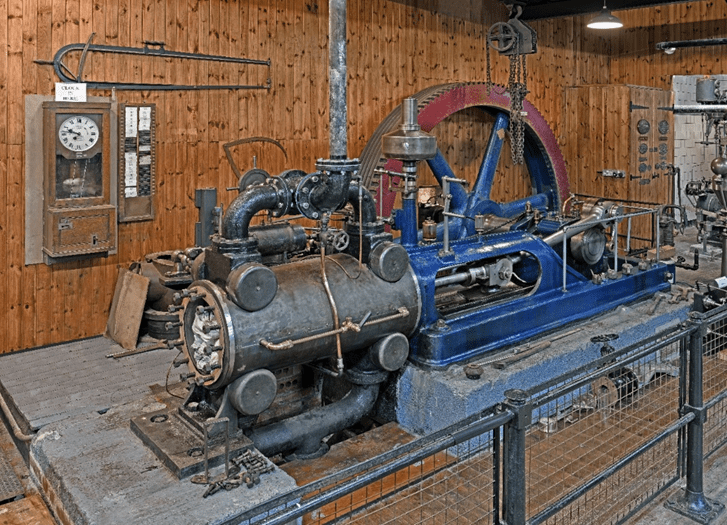
Horizontal steam engine at Cambridge Technology Museum
Crofton Beam Engines has received a grant of £27,760 from the National Lottery Heritage Fund for a project to develop and test ideas for increasing the number and range of people engaging with Crofton. The ‘Crofton 2030’ project will help Crofton Beam Engines retain its position as a premier heritage attraction, worthy of its Grade 1 listed status, and ensure that they can keep the engines operating to 2030 and beyond.
The grant is made possible by money raised by National Lottery players, and builds on a previous Heritage Fund grant in 2018 which funded repairs to the historic buildings, new visitor facilities such as accessible toilets and improved interpretation around the site. The project has four main elements:
• to review engagement and ‘value added’ activities at similar heritage sites; • to carry out market research on potential opportunities to broaden audiences and increase income; • to develop a Site Master Plan, making best use of our existing facilities and developing new facilities where needed and possible (given the limitations of the site); and • to develop a business strategy for Crofton running to 2030, and a more detailed three year forward plan.
Crofton have now appointed two heritage experts to assist us in this work, Riah Pryor and David Tucker. The project is being managed by a project group headed by Chris Bolt, Treasurer of The Kennet and Avon Canal Trust and Vice-Chairman of the Crofton Branch. Chris commented that: “Crofton Beam Engines is one of the most significant industrial heritage sites in the UK and a fascinating visitor attraction. We want to increase the number and range of people who can enjoy and learn from our unique site. We are very grateful for the support of the Heritage Fund to help us do that.”
Riah Pryor said: “I am excited to be working with Crofton Beam Engines. There is great potential to expand its activities and I want to help find the best ways of doing this so that the future of this special part of Britain’s industrial heritage can be assured.” David Tucker added: “Having carried out some initial work for the Trust last year about ways Crofton Beam Engines could increase its appeal to visitors further, I am looking forward to helping the team develop clear plans which turn their ideas into reality.”
The Crofton 2030 project will be completed in the autumn. Crofton Beam Engines is owned by The Kennet and Avon Canal Trust, registered charity no 209206 Website – https://www.croftonbeamengines.org/









 Industrial Heritage Networks