Welcome to the Industrial Heritage Networks and Support website. This site is maintained and updated by the Ironbridge Gorge Museum Trust who run the project and the networks. We aim to support industrial heritage in England through networking, information exchange, guidance, and training. Please explore the website and please contribute! For more information you can … Read more Welcome to the IHNs website!
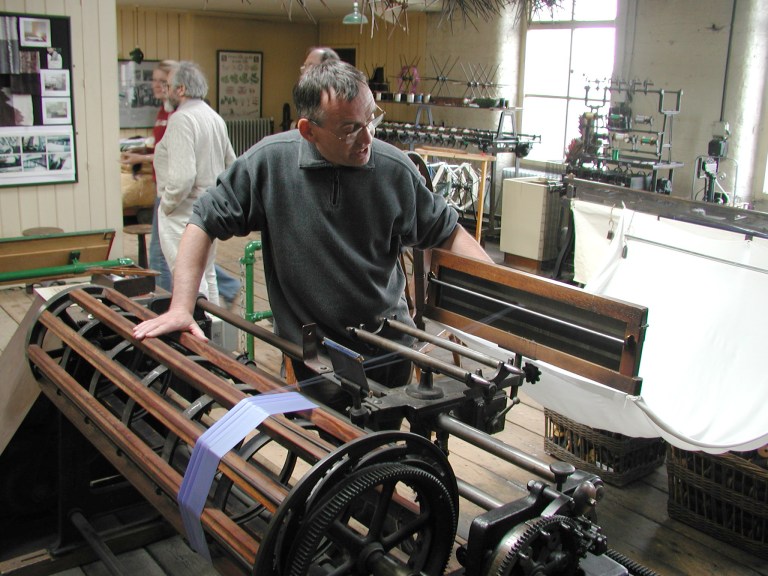
Silk macinery in operation, Paradsie Mill. Image courtesy of Paradise Mill.
This spring, the National Lottery Heritage Fund awarded £227,000 to The Silk Heritage Trust to develop Paradise Mill and the Silk Museum in Macclesfield into a vibrant campus of economic activity, skills development, and heritage participation. This grant will help keep alive the stories of Macclesfield as the centre of the nation’s silk heritage.
The three year project ‘A Stronger Future: Developing the Silk Heritage Trust’s vision for culture and heritage in Macclesfield’ aims to improve the training of the museum’s staff and volunteers. It also intends to help preserve endangered collections, the museum’s silk weaving skills, and extend the museum’s audience reach.
Paradise Mill, Macclesfield. Image copyright Dr Michael Nevell
On 13 September the Great Grimsby Ice Factory Trust (GGIFT) celebrated the completion of the Peterson’s Project on the Port of Grimsby. First conceived in 2017, the project was developed jointly by GGIFT, Associated British Ports (ABP), and North East Lincolnshire Council (NELC), and was instrumental in Great Grimsby becoming a Heritage Action Zone in 2018. Designed to be a catalyst for the regeneration of the historic dock, the Peterson’s Project has brought back into use two important buildings within the Kasbah Conservation Area.
The Grade II listed Peterson’s Smokehouse on Henderson Street had functioned as a kipper house since the 19th century, when the original building was first erected. By 2017 the building had been out of use for some time, and much of it was inaccessible. It will now have a new life as a fully functioning fish processing and smoking factory, using the unique cold smoking process that can only take place in a traditional smokehouse.
The second building, at 89 Wharncliffe Road, was most recently known as Fred’s Fisheries. Built by the Osborne family of fish merchants – again in the 19th century when the docks were developed following the arrival of the railway – it was in dire need of modernisation. Through the project the stunning architectural features, and the lovely proportions of the rooms have been revealed, and it awaits tenants for the offices and retail spaces that have been re-created.
The project has taken seven years to complete, including feasibility studies, appraisal and design, and has cost over £1.4 million. Thanks to National Lottery players, the majority of the funding was provided by The National Lottery Heritage Fund. Additional grant funding was from the Architectural Heritage Fund (AHF), Historic England (HE) and NELC.
As part of the National Lottery Heritage Fund’s Heritage 2033 strategy, their new 10-year strategy, they have increased the upper limit of their National Lottery Grants for Heritage supporting larger-scale heritage projects across the UK. The new strategy acknowledges that the old £5m grant threshold – which has been in place for over 20 years – was limiting opportunities for some potential initiatives.
NHLF want to invest in more ambitious heritage projects that share their belief in the power of heritage to bring people together, build pride in place and connection to the past. Therefore, 2023–2024 is a transition year ahead of full implementation of the new 10-year Heritage 2033 strategy. They will be making a series of changes as part of this transition, and the first change, from June 2023, is increasing the amount you can apply for to £10m.





 Industrial Heritage Networks