Welcome to the Industrial Heritage Networks and Support website. This site is maintained and updated by the Ironbridge Gorge Museum Trust who run the project and the networks. We aim to support industrial heritage in England through networking, information exchange, guidance, and training. Please explore the website and please contribute! For more information you can … Read more Welcome to the IHNs website!
Wigan Council have two heritage posts available at the Council, with closing dates for applications on the 8th May 2022 and 8th June 2022. Wigan has a long industrial history and the council has some extensive industrial heritage collections. Further details here:
Lead Officer Museums – temporary until 1 March 2024 – closing date 8th May 23:59 View Vacancy Details
Assistant Business Partner Archives – permanent – closing date 8th June 23:59 View Vacancy Details
Rebuilding Heritage have been expanding their online library of free digital resources for heritage organisations. These resources condense advice from dozens of expert consultants and are all publicly accessible from their website in the form of articles, case studies, webinars, and podcasts.
They are aimed specifically at heritage organisations emerging from Covid and cover the following topics:
• Business & Enterprise Planning • Fundraising • Leadership & Governance • Mission and Vision • Marketing & Communications • Equality, Diversity, Inclusion • Wellbeing at Work • Managing Change
The next round of Industrial Heritage Network meetings begins at the end of April 2022. The IHN networks are a chance to meet, online, those working, volunteering, or researching in the industrial heritage sector. There are ten regional groups and they are free to join. Members will have access to the latest Industrial Heritage news through the IHN e-bulletin (by-monthly), and will have the chance to promote their work through the IHN website and social media feeds, highlight initiatives and requests for help, or link up with similar sites in their region. Details on how to sign up are below.
This latest round of regional IHN meetings will look at how the post-COVID lockdown recovery is impacting industrial heritage sites, large and small. Is it business ‘as usual’ or has the COVID pandemic led to permanent changes in the way sites and organisations deal with the public and staff? How is your site coping with any maintenance backlog, recruiting volunteers, and reaching out to schools? We are keen to hear from individuals and sites about their experiences over the last six months.
To sign up to a regional IHN group email Dr Mike Nevell (IHSO officer) on: mike.nevell@ironbridge.org.uk
This year’s National Mills Weekend, organised by SPAB (the Society for the Protection of Ancient Buildings), will take place on 7th & 8th May 2022. The theme for the first in-person event since 2019 will be ‘New Life for Old Mills’, celebrating the repair of wind and watermills for future generations to enjoy.
The National Mills Weekend will take place at wind and watermills across the UK and online on YouTube and SPAB Mills Section social media channels. The SPAB Mills Section is inviting everyone to share images of their own mill repair project on their social media channels. Let SPAB know about recent and historic repairs to your mill that has helped to make it possible for people to see, appreciate, and enjoy today. Also let SPAB would like to know if your mill has been affected by recent storms or if you are planning to open your mill to the public during this year’s National Mills Weekend for the first time since the coronavirus pandemic.
For the first time this year SPAB Scotland and the Perth & Kinross Heritage Trust will be hosting a dedicated Mills Weekend in Scotland on 7th & 8th May 2022. The weekend will bring together the Scottish Milling Community and will include talks, lectures, and tours on all topics from re-use of textile mills to flour production and hydro-power.
For more information on how to take part in the SPAB National Mills Weekend you can find an information and support pack here and a poster that can be customized and displayed in your mill here.
Last year the Association for Industrial Archaeology (AIA) had to cancel or postpone most of its planned activities, including their annual conference, scheduled for Liverpool. However, AIA have announced a long weekend of tours in and around Liverpool from 17-19th June 2022, organised by the Merseyside Industrial Heritage Society. The event includes three days of tours and a Saturday evening dinner, at which AIA’s awards for the past two years will be presented.
The event costs £160 and includes the trips and dinner at the Liverpool Marriott Hotel, where delegates may book accommodation at a preferential rate; details will be provided at the time of booking. Alternatively, delegates may make their own accommodation arrangements. Places are limited so early booking is advised. The planned tours are as follows:
Friday 17th June – a day touring the dock area of Liverpool, including the Old Dock of 1716, Jesse Hartley’s magnificent Royal Albert Dock of 1846 and associated buildings, and many other historic docks and warehouses, including the Tate & Lyle reinforced concrete sugar silo of 1957.
Saturday 18th June – a day on transport, starting with a drive through the Mersey Tunnel to the Wirral Transport Museum for a tram ride to the Woodside Ferry terminal of 1861, moving on to the Hooton Park Trust with its Belfast Trusses and historic aircraft before returning via the 1938 terminal of Speke Aerodrome. That evening there will be a dinner at the Marriott Hotel, close to Lime Street Station.
Sunday 19th June – visiting Edge Hill on the way for evidence of the original 1830 Liverpool & Manchester Railway, its 1836 station, the cutting, and tunnels to the docks, the rest of the day will be spent at St Helens including parts of the Sankey Canal and the glassworks.
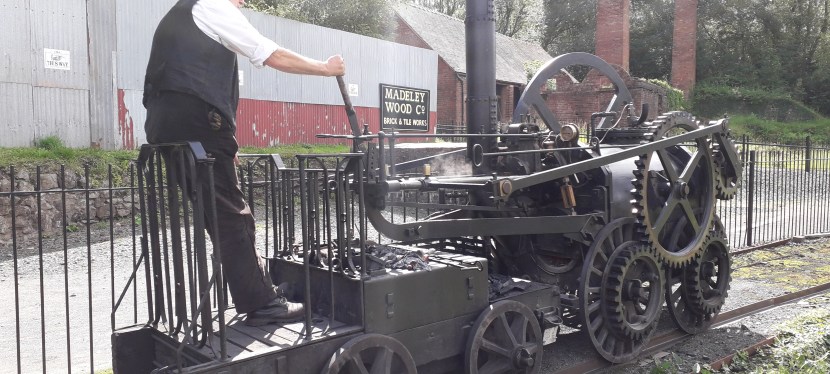
The replica of the Trevithick Locomotive at Blists Hills, Ironbridge
The Ironbridge Gorge Museum Trust has launched an online appeal to raise funds for conservation and repair work that is vitally needed on three iconic steam engines at Blists Hill Victorian Town. They are seeking to protect the Trevithick locomotive replica, ‘Billy’ the Road Roller, and the portable engine and stone crusher in the stonemason’s yard. They would be grateful for any level of donation you could make to their appeal for help towards this significant heritage conservation project.
The Trevithick locomotive is a replica of the world’s first steam railway locomotive, which was designed by Richard Trevithick (1771-1833) and constructed by the Coalbrookdale Company in 1802-1803. Billy is a 3-ton steam roller constructed by Wallis and Steevens in Basingstoke in 1903. The Portable is a stationary engine located in the stonemason’s yard at Blists Hill Victorian Town, and is constructed from a variety of sources, including a 1920s locomotive boiler and an 1880s engine.
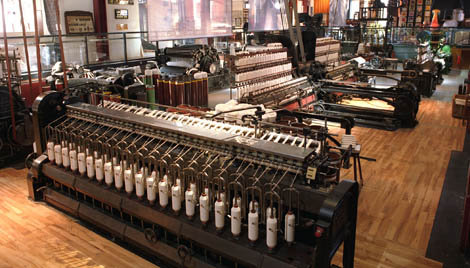
Written for the Science Museum Journal by Pippi Carty-Hornsby, ‘Preserving skills and knowledge in heritage machinery operations’, Science Museum Group Journal, Autumn 2021, Issue 16, details an approach to knowledge capture on a collection of working textile machinery at the Science and Industry Museum. The machinery collection dates between 1880 and 1955 and the knowledge capture process outlined in the case study was prompted by the retirement announcement of the last machine operator on staff with first-hand experience of the textile industry.
Heritage machinery demonstrations provide a unique opportunity for visitors to museums to experience the sights, smells and sounds of Britain’s industrial past. However, with many of the operating roles in the sector being staffed by an ageing population, heritage machinery demonstrations are at risk of substantial knowledge loss over the coming years. Without intervention, many of the tacit skills and knowledge that the operators hold will be lost, along with the opportunity for the public to learn from and experience the machinery first-hand.
The method outlined in this article includes a review of existing documentation, operation recording and interrogation of results, comparison and discussion with stakeholders, and production of documentation and resources. The results of this process included a set of documents that reflected both modern health and safety and conservation and collections care guidelines, as well as cross-media resources that can be used as a future training aid. Though the case study detailed here features textile machinery, it is applicable across many strands of heritage machinery and could provide a useful tool for similar ‘at-risk’ machinery operations in museums and other cultural institutions.
A new report from Historic England (November 2021) reviews the impact of COVID-19 on heritage railways and some of the valuable lessons learned which are relevant to the rest of the heritage sector.
Heritage railways experienced wide-ranging challenges due to the Covid-19 pandemic in 2020 and 2021. However, some have demonstrated notable resilience in face of these difficulties, benefiting from strategies that they have employed themselves or that have been implemented by the heritage railway sector at large.
The study draws upon primary evidence generated by interviews with seven representatives of heritage railways across England and a set of contextual secondary sources. The report highlights a selection of the approaches adopted during the pandemic in order to support individual railways and the sector as whole, from accessing public funds, fundraising through online donations, and philanthropy, to investment in IT infrastructure, outdoor opportunities and developing flexible revenue streams, effective crisis management, and engaging with supporters and volunteers.
Finally, the study discusses the wider applicability of these approaches across the heritage sector to support better resilience to known and unexpected challenges in the future.
Over the summer of 2021 many of the COVID restrictions introduced last year have been lifted oraltered. Below are some of the key points for those running industrial archaeology and industrial heritage sites in England to bear in mind, ahead of this year’s Heritage Open days (10-19 September: https://www.heritageopendays.org.uk/). Full details can be found on the UK Government’s website here: https://www.gov.uk/coronavirus
Test & Trace No Longer a Requirement
Although no longer a legal requirement in England, businesses are encouraged to display QR codes for visitors to check in using the NHS COVID app, to support Test and Trace.
Live Events
All restrictions on live events have been removed, including restrictions on the number of attendees. There is no requirement for table service, nor restrictions on singing or dancing.
Certification
The NHS COVID Pass on the NHS app demonstrates a person’s Covid-status. The UK Government is planning that, by the end of September when all over-18s have had the chance to be double-jabbed, full vaccination will be the condition of entry to venues where large crowds gather.
Workplaces
The UK Government recommends a gradual return to the workplace over the summer and into autumn. Businesses must not require a self-isolating worker to come to work, and workers and customers who feel unwell must not attend the setting. Businesses will be encouraged to ask staff and visitors to clean their hands regularly and clean surfaces that people touch regularly.
Cafes
In cafes the requirements for table service and distancing between tables have been lifted.
COVID restrictions and requirements are subject to change, so remember to check regularly the relevant sections of the UK Government’s Coronvirus webpages for the most up-to-date advice: https://www.gov.uk/coronavirus
The latest round of free online seminars and guidance from Heritage Digital is out and includes several items relevant for Industrial Heritage organisations and individuals. Heritage Digital is funded by the National Lottery Heritage Fund as part of the Digital Skills for Heritage initiative.
Webinar: Recruiting, retaining, and managing digital volunteers
Volunteers are often the bread and butter of heritage organisations – what would we do without them? Watch this webinar from Claire Sully at Community Makers who offers tips on how to create an engaged volunteer community.
Digital Guide: Digital Marketing Strategy Guide
Learn the key components of a digital marketing strategy that every organisation should know. Whether it’s attracting new audiences or telling your story digitally, this free guide is available for you to download and use within your marketing team.
Recording: How to use digital assets to support your strategy
Re-watch this session by Naomi Korn from 2020’s #HeritageDigitalNow event to find out how to make the most of digital assets to support your strategy.










 Industrial Heritage Networks