Welcome to the Industrial Heritage Networks and Support website. This site is maintained and updated by the Ironbridge Gorge Museum Trust who run the project and the networks. We aim to support industrial heritage in England through networking, information exchange, guidance, and training. Please explore the website and please contribute! For more information you can … Read more Welcome to the IHNs website!
Booking for the Association for Industrial Archaeology’s Annual Conference is now open via the AIA website: https://industrial-archaeology.org/Conference. This year’s Conference is to be held at the Mercure Hotel, Norwich, East of England, from the 4th to the 9th September.
The AIA Annual Conference was first established in the 1970s and you can book for in-person or online attendence for the weekend programme. This year’s event follows its traditional format, starting on Saturday with a day of talks on the Industrial Heritage of the area followed by the presentation of this year’s awards and the Conference Dinner. On Sunday morning there will be the AIA AGM followed by the Rolt Lecture. Who was Tom Rolt ?
On Sunday afternoon, Monday, Tuesday, and Wednesday morning there will be a series of tours and evening talks. The full itinerary, costs, and accommodation details can be found on the website here: Annual Conference – The Association for Industrial Archaeology
Thanks to the Patrick Nott bursary, there will be five free places for the entire event from Friday to Wednesday, including accommodation, and up to £100 for travel expenses. The places are intended for those who feel they would otherwise be unable to attend. Please send details to the Conference Secretary at conference@industrial-archaeology.org at least 30 days in advance.
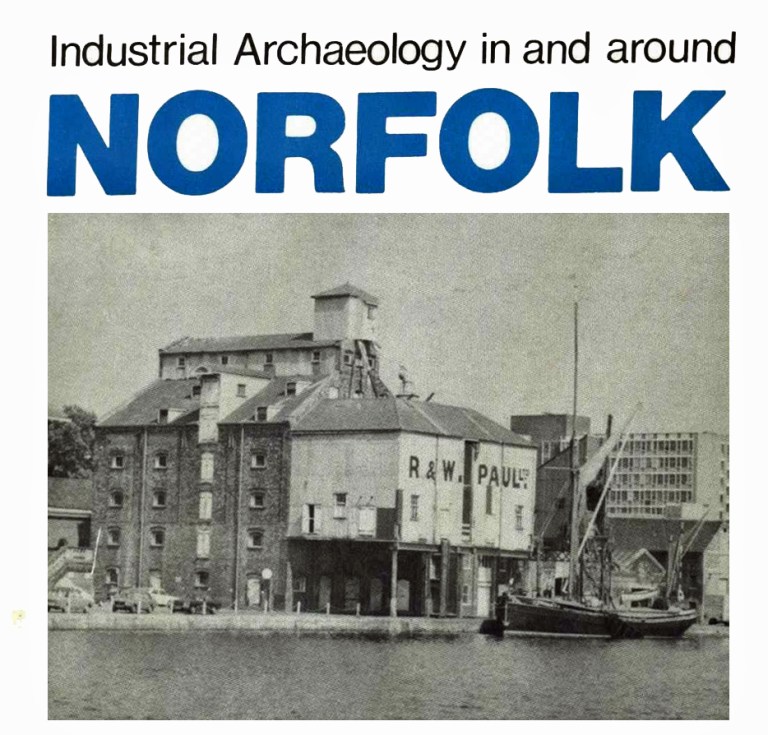
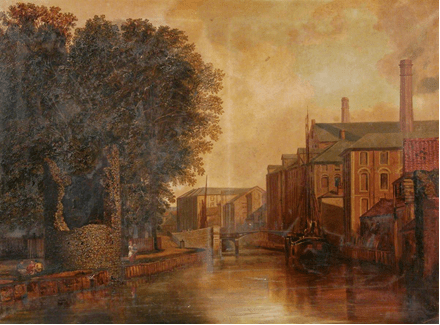
Front Cover of the IA Gazetteer from the 1981 AIA Norfolk Conference. Image copyright Association for Industrial Archaeology.
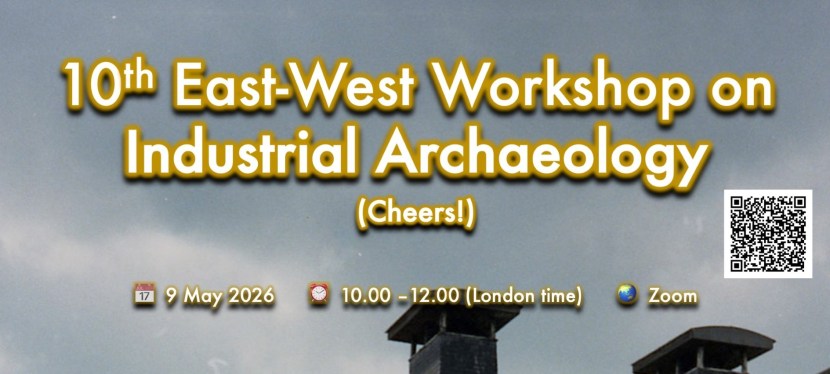
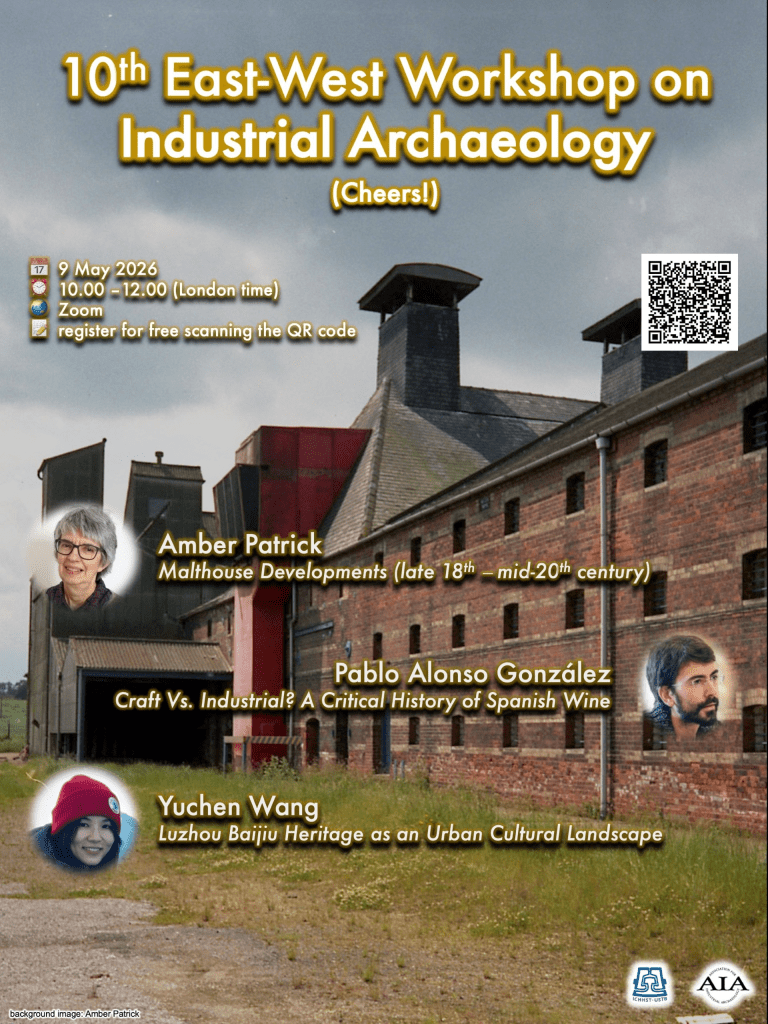
The next East-West Workshop on Industrial Archaeology, co-run by the Association for Industrial Archaeology (AIA), will be on the 9th May. This is 10th online, free, workshop in the series and takes place exactly five years after the AIA co-hosted the first edition in May 2021.
The East-West Workshops on Industrial Archaeology were not created to endure; at least, not in a purely virtual format. When the first workshop was held in May 2021, it was mainly a way to prevent the COVID pandemic from disrupting our academic activities and international exchanges. However, the experience exceeded expectations. Five years on, the AIA are launching the 10th edition of a series of workshops that has become increasingly popular in the West, the East, and beyond.
To mark this special occasion, this workshop focuses on the archaeology, heritage, and history of alcoholic beverages. The speakers will examine the architecture of malt production in Britain and continental Europe (a key component of beer, whiskey, and other spirits), the history of winemaking and wine consumption in Spain, and the landscape of baijiu production in China. While the workshop acknowledges the serious consequences of alcohol abuse, it also recognises it as a significant element in many cultures worldwide, their social practices, and their heritage.
The East-West workshop series aims to exchange ideas and knowledge between Western and Eastern colleagues to develop a more international and diverse industrial archaeology. The event is jointly organised by the Institute for Cultural Heritage and History of Science & Technology (USTB, China) and the UK Association for Industrial Archaeology.
SPEAKERS & TALKS
Amber PATRICK (Association for Industrial Archaeology, Britain): “Malthouse Developments – The Late 18th Century to the Mid-20th Century”
Pablo ALONSO GONZÁLEZ (Spanish National Research Council, Spain): “Craft Vs. Industrial? A Critical History of Spanish Wine”
Yuchen WANG (University of Science and Technology Beijing, China): “Symbiotic Cityscape: Luzhou Baijiu Cultural Heritage as an Urban Cultural Landscape”
DATE & TIME
9 May 2026, Saturday. 10.00-12.00 London time
PLACE
Zoom (online meeting). More info and free registration:
The Association for Industrial Archaeology’s (AIA) 2026 conference will be based at Norwich, England, from the 4th to 9th September. The East Anglian counties of Norfolk, Suffolk, and Cambridgeshire have a rich history of Industrial Heritage including wind and water mills, maritime and port industries, agriculture, and the associated manufacture of agricultural machinery and food processing.
The 2026 programme will follow the usual format, starting on the Friday evening with an informal dinner followed by a talk introducing the Industrial Heritage of East Anglia. On Saturday there will be a full day of talks on local topics, presentations to and by award winners, and the Conference Dinner. On Sunday morning there will be AIA’s AGM followed by the Rolt Lecture. From Sunday afternoon until Wednesday lunchtime there will be a number of site visits across the three counties. Lunches, informal evening dinners and talks are included. Full details and booking will be available on the conference pages of the AIA website in due course. Recordings of the 2025 Bradford Conference are now available on the AIA YouTube channel.
The Association for Industrial Archaeology have a variety of grants and awards for industrial archaeology and heritage available for 2026. These are to encourage improved standards of recording, research, conservation, and publication within the sector.
The grants support industrial heritage and archaeology conservation projects in the UK, and research projects on industrial archaeology. They are open to non-members as well as members of the Association.
The awards are presented to an individual or groups who have made a significant contribution to industrial archaeology, for example in research, publication, recording or conservation. The awards attract local and national publicity, and the recipients are encouraged to publish their projects. Most awards have cash prizes and are usually presented annually at the AIA Conference, at which winners will be encouraged to talk about their work and present posters or displays on it if appropriate.
The deadline for the following categories is 31st January 2026 (more details in the links):
The East-West series of workshops aims to exchange ideas and knowledge among Western and Eastern colleagues to build a more international and diverse industrial archaeology. The activity is organised jointly by the Institute for Cultural Heritage and History of Science & Technology (USTB, China), and the UK Association for Industrial Archaeology.
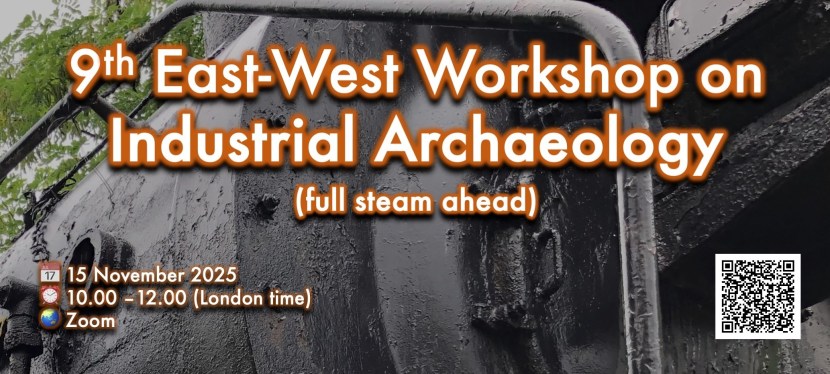
The 9th East-West Wiorkshop takes as its theme the industrial archaeology of railways. Modern railways were born in Britain 200 years ago in 1825 with the opening of the Stockton & Darlington Railway (although the concept of using rails to move bulk goods around the landscape is much older). From there, they spread to the rest of the world, reducing travel and transportation times, and fostering modernisation, industrialisation and urbanisation.
Facing both continuity and continuous change (including the expansion and contraction of networks, new traction technologies, and instances of nationalisation and privatisation), in the 21st century, the railway is the most efficient and sustainable mode of transport and, particularly in the East and Global South, is expanding its tracks into the future. To honour its 200th anniversary, the 9th East-West Workshop on Industrial Archaeology travels to the railway past to examine the international circulation of treaties, technologies, materials, and people that defined the early development of railways in Eurasia.
Speakers & Talks
Yibing FANG (Chinese Academy of Sciences, China): “A Review of Research on China’s Early Steel Rails Heritage”
Paulina ROMANOWICZ (Polish Academy of Sciences, Poland): “Rediscovery of a Brickworks Narrow-Gauge Industrial Railway Tunnel in Stołczyn, Poland”
Arida Fitriana YASMIN (University of Groningen, Netherlands): “Follow the Tracks: Railway Heritage Management at the Ombilin Coal Mining Heritage of Sawahlunto, Indonesia”
Juan Manuel CANO SANCHIZ (University of Science and Technology Beijing, China / Association for Industrial Archaeology, UK): “European Early Railway Architecture in Beijing: A Perspective from Building Archaeology”
Date & Time
15 November 2025, Saturday. 10.00-12.00 (London time)
This ia free online workshop via Zoom. For more information and to book for free follow the below link:
Conservation and restoration work at three windmills has been finished ahead of the winter. Heage Windmill in Derbyshire, Meopham Windmill in Kent, and the White Mill, also in Kent, have been undergoing programnmes of conservation and restoration work for several years.
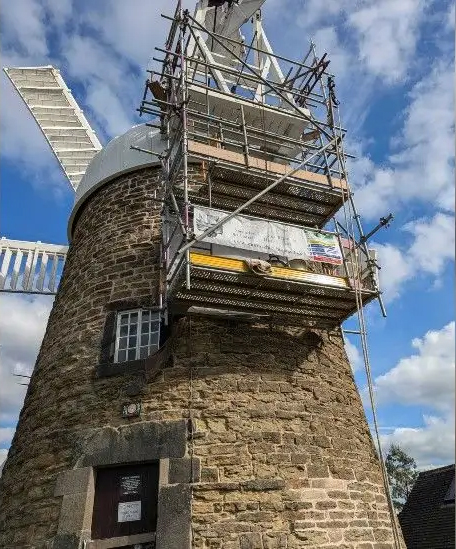
Heage Windmill was restored in 2002, but the Grade II* listed building required further work due to weather-related erosion to the exterior stonework and increased damp inside the building. Following consultation with Historic England, the Heage Windmill Society secured £30,000 in funding from the Association for Industrial Archaeology (AIA) and the Headley Trust for the works to go ahead. Work on the sails and caps was carried out in 2023, and now repair work on the stone tower has been completed.
Grade II* listed Meopham Windmill, which was built around 1820, had fallen into disrepair. Kent County Council purchased the mill, known for its rare six-sided design, in 1959. A £300,000 restoration programme has seen it reconstructed with new mechanisms, revitalised grounds, and its sweeps restored. The funding for the restoration came from a collaboration between KCC, Meopham Windmill Trust, Suffolk Millwrights, and the local community.
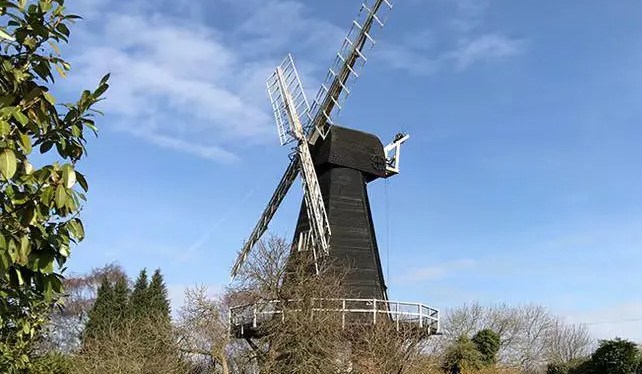
Finally, the Grade II listed White Mill in Sandwich, Kent, had its four sails restored and reinstated in September. The windmill was built in 1760 and served the community as a working mill until the 20th Century, before it became disused in 1957. The White Mill Rural Heritage Centre said the landmark was partly restored in the 1960s, but over the past five years it had undergone more extensive works, and that repairing the historic industrial machinery was a “major testament to the power of volunteering and the important role it plays in the community”.
Further details on these restoration projects can be found on these links:
AIA have realeased details of its annual conference which this year will be based in the historic Midland Hotel, Bradford, part of the rich railway heritage in the centre of this year’s host of the UK City of Culture. The conference returns to a more traditional format, of weekend talks and the AGM, followed by 3 days of tours, although the AIA are offering the oppportunity to book individual weekend days and online weekend access.
As usual, the weekend programme will include a number of lectures on the region’s industrial heritage and presentations by AIA’s award winners. On the Sunday morning, following a short AGM, the annual prestige lecture will be given by Dr Michael Bailey, marking the 200th anniversary of the birth of the modern railway, on the subject of the Archaeology of Early Locomotives.
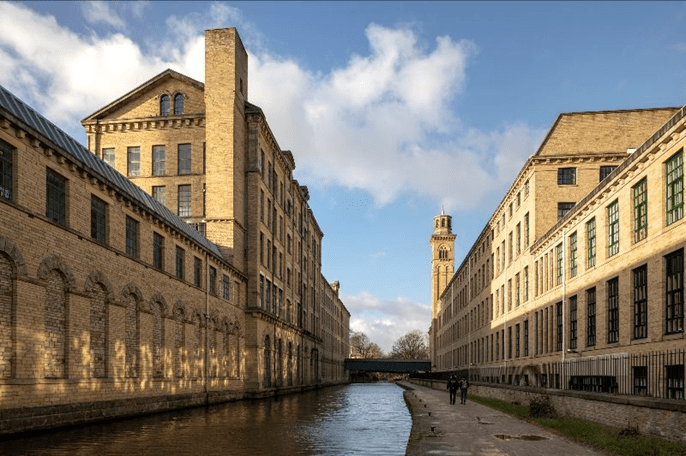
From Sunday afternoon to the morning of Wednesday 10 September there will be a varied programme of visits to important industrial sites in the area, including the Saltaire World Heritage Site. Delegates can opt to attend for just the weekend sessions or the whole five days, and online participation in the weekend programme is also possible.
There are free places available through the Patrick Nott bursary, which allows the AIA to offer some free places at Conference, including accommodation and tours.
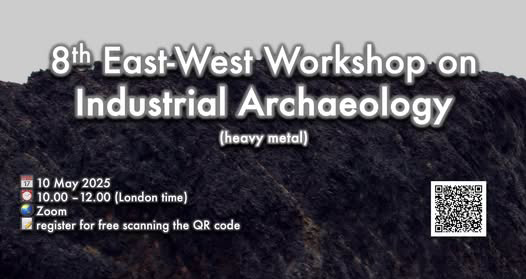
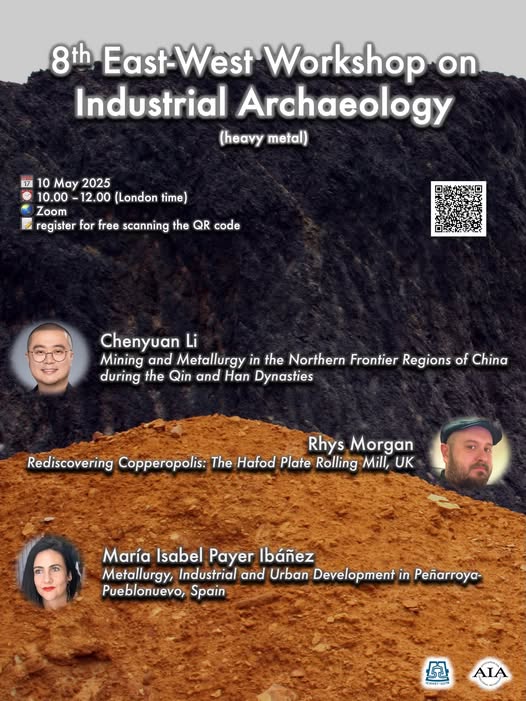
The East-West Workshops on Industrial Archaeology aim to exchange ideas and knowledge among Western and Eastern colleagues to build a more international and diverse industrial archaeology. The workshops are organised jointly by the Institute for Cultural Heritage and History of Science and Technology (USTB, China), and the UK Association for Industrial Archaeology (AIA). The 8th Workshop on 10 May will look at Heavy Metals.
Metallurgy is one of the oldest human activities and was one of the first sectors to embrace modern industrialisation. The production of metals and their alloys has strongly influenced the development of most societies throughout history, and played a key role in the construction of the modern world. The latest Workshop on Industrial Archaeology brings together archaeologists and architects to delve into the long history of metal production, its multiple contexts (technological, economic, social, and its heritage.
SPEAKERS
Chenyuan LI (University of Science and Technology Beijing, China): “The Evolution of Mining and Metallurgical Production Technologies in the Northern Frontier Regions of China during the Qin and Han Dynasties: A Perspective from Archaeometallurgy”
Rhys MORGAN (Black Mountains Archaeology, Britain): “Rediscovering Copperopolis: The Hafod Plate Rolling Mill, Swansea”
María Isabel PAYER IBÁÑEZ (Payer Arquitectura / University of Seville, Spain): “Metallurgy as Industrial and Urban Development in Peñarroya-Pueblonuevo, Spain”
DATE & TIME
10 May 2025, Saturday. 10.00-12.00 (London time)
BOOKING
Zoom (online meeting). More info and free registration:
Videos of all the workshops are available on the AIA’s YouTube Channel, including the latest event from November 2024 on ‘Weaving the Industrial Period’. Follow this link to view the workshops: https://www.youtube.com/channel/UCILr2TkRAOIfk_NKchshwZQ
The early new year is often a time for charities and musuems to undertake staff training and maintenance in the ‘off season’. Online, several organisation offer free training and briefing videos relevant for industrial heritage sites. Some of the recent offerings listed below provide an opportunity for armchair training.
The East-West Workshops on Industrial Archaeology aim to exchange ideas and knowledge among Western and Eastern colleagues to build a more international and diverse industrial archaeology. The workshops are organised jointly by the Institute for Cultural Heritage and History of Science and Technology (USTB, China), and the Association for Industrial Archaeology (AIA) together with its Young Members Board. Videos of all the workshops are available on the AIA’s YouTube Channel, including the latest event from November 2024 on ‘Weaving the Industrial Period’. Follow this link to view the workshops: https://www.youtube.com/channel/UCILr2TkRAOIfk_NKchshwZQ
On Thursday 21st November 2024 the ‘Craft of the Miller’ network held an online conference on ‘Managing Health & Safety Risks in Your Mill’. Jon Cook gave an introduction to highlight a number of key risks in a working mill, including hygiene, flour dust, vacuum equipment, and fire risks. Jippe Kreuning explored how to work with a stone crane and how to operate it safely to lift a set of millstones. You can catchup with the recordings from the conference here: https://network.molens.nl/
Finally, Historic England have a range of heritage webinars to watch with topics from flooding, embodied carbon, and renewabler energy, to heritage building skills, roofs, and windows. The Historic Environment Webinars strand includes a session on the role and work of the Canal & River Trust form November 2024. Follow this link to view the webinars: https://historicengland.org.uk/services-skills/training-skills/training/webinars/recordings/#technicaltuesdays
Applications are now open for the Association for Industrial Archaeology’s 2025 round of restoration, research, and other awards (including community, dissertaton, publication, and travel bursary). The deadline for most of these awards is the 31st Janaury 2025, although the deadline for the Restoration Grants is the 31st March 2025. Details and links can be found below.
Restoration Grants
The first of these grants were made in 2009, and from the initial modest beginnings we have, by 2024, been able to allocate nearly £1,500,000 since the scheme began. The industrial heritage sector, despite difficulties with volunteer projects during the Pandemic, has continued to be increasingly appreciative of this source of aid. A source which is entirely thanks to the continuing support of our anonymous donors. A brief history of the scheme and details of many of those projects can be found below. Regular updates on progress with these projects appear in I A News, our quarterly bulletin. From 2020 onwards the available Grants pot is divided into two categories:
Major projects where the maximum grant that can be awarded is £30,000. The grant from the AIA must be a significant part of the total project cost, not just a small contribution to a very large project, so that the AIA grant has real impact. The AIA would not normally fund projects where their grant represents less than 20% of the total project costs. Small projects where the grant limit is £10,000, for which the total cost of the project, excluding the value of volunteer labour, must not exceed £12,500.
The AIA research grant scheme underpins the study aim of the Association. It does that by:
Encouraging individual researchers to study industrial archaeology subjects
Encouraging the development of industrial archaeology skills within commercial units, the main repository of professional skills in the subject
Supporting local industrial archaeology and industrial heritage societies in exploring and understanding their local areas
Helping to develop the next generation of industrial archaeologists
The total fund available in any single year is £1,500 and multiple grants may be given up to this maximum in a single year. The AIA may consider part-funding a wider grant application or project as long as the AIA grant is a significant part of the larger application / project.
Click to download full details and an application form: (.pdf)(.docx)
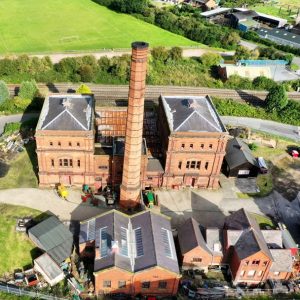
In 2024 Claymills Pumping Station received a major grant for the restoration of boiler No 1 to fully working condition. Image courtesy of Claymills Pumping Station Trust.




 Industrial Heritage Networks