Welcome to the Industrial Heritage Networks and Support website. This site is maintained and updated by the Ironbridge Gorge Museum Trust who run the project and the networks. We aim to support industrial heritage in England through networking, information exchange, guidance, and training. Please explore the website and please contribute! For more information you can … Read more Welcome to the IHNs website!
CIfA is working with DigVentures to develop guidance which supports and enables public benefit from archaeological projects, as part of a project funded by Historic England. This project aims to embed public participation and engagement firmly into sector practice, with an initial emphasis on archaeology projects delivered within the context of the planning system. The main target audience for the guidance is those who commission, facilitate, or deliver archaeology projects primarily driven by development led activities, but this also includes industrial archaeology and heritage sites.
This short survey forms part of a sector-wide consultation undertaken collaboratively with CIfA. Our aim is to understand the opportunities and challenges in implementing public benefit within development-led archaeology. The two surveys are aimed at two different audience groups; one for those who commission archaeology, including those who prepare project briefs, and the other directed towards project delivery teams.
If you are a practitioner involved in the delivery of archaeological projects, please take this survey.
The survey will be live until the end of January 2023. In the meantime, get in touch with the project team directly if you are interested in hearing more about the project.
Please get in touch with Harriet Tatton (DigVentures – harriet@digventures.com) if you have questions about the survey or have any technical difficulties. Please get in touch with Cara Jones (CIfA – cara.jones@archaeologists.net) if you have questions about the scope of the project
The next round of the AIA’s research grant scheme, for 2023, is now open for applications. These grants are one of the ways in which the Association looks to deliver its aims. The scheme is designed to: encourage individual researchers to study industrial archaeology subjects; encourage the development of industrial archaeology skills within commercial units, the main repository of professional skills in the subject; to support local industrial archaeology and industrial heritage societies in exploring and understanding their local areas; and help to develop the next generation of industrial archaeologists.
In previous years the AIA has supported local society and university researches studying subjects such as Caribbean plantations, 18th century workers’ grafitti, and lime kilns as ways of aiding the understanding, preserving, and presenting industrial archaeology and heritage. The latest round of applications is open until the 31st January 2023. The total fund available in any single year is £1,500 and multiple grants may be given up to this maximum in a single year. The AIA may consider part-funding a wider grant application or project as long as the AIA grant is a significant part of the larger application / project.
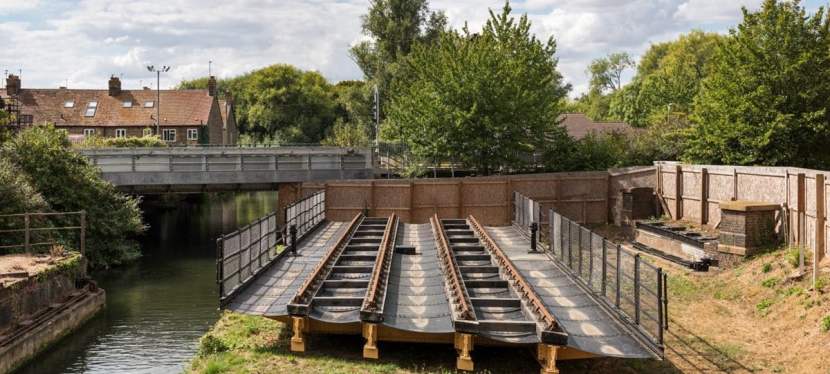
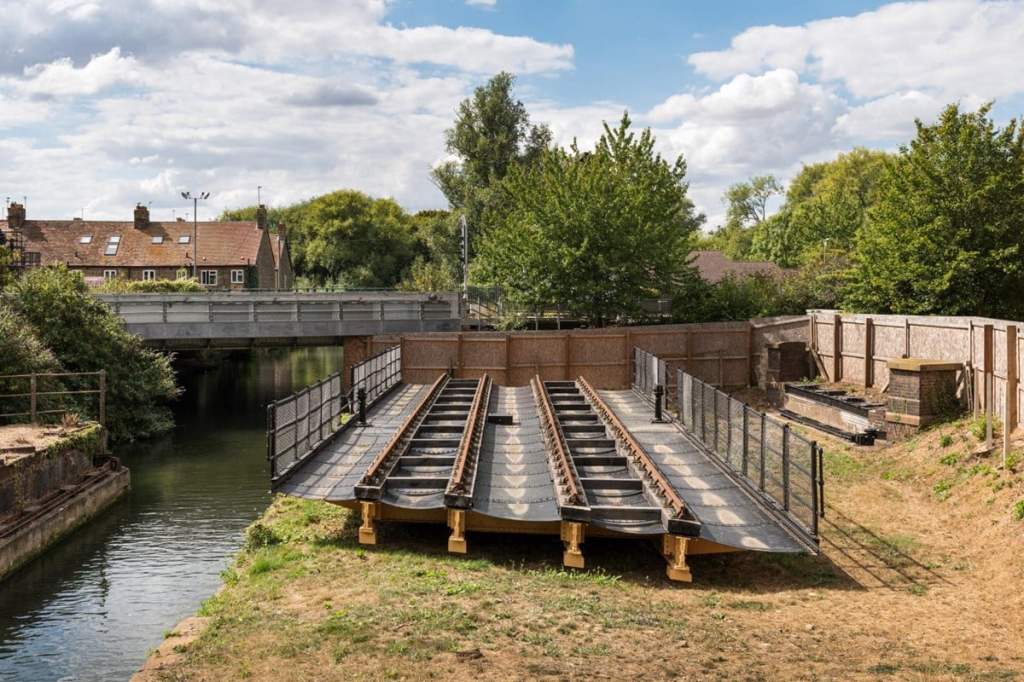
The London Midland and Scottish Swing Bridge after restoration. Image copyright Historic England DP325398
Amongst the industrial heritage sites successfully removed from this year’s Historic England Heritage at Risk Register is the scheduled London Midland and Scottish Railway Swing Bridge – also known as the Rewley Road swing bridge – crossing the Sheepwash Channel in west Oxford. This structure was suffering from severe decay affecting the plating and paint protecting its moving parts.
Designed by engineer Robert Stephenson the railway bridge was built in 1850-1 for the former Buckinghamshire Railway branch of the London Midland and Scottish Railway. It was reconstructed in 1890 and again in 1906. The bridge closed to passenger traffic in 1951 and to goods in 1984. It is one of only two moving bridges on the River Thames, the other being Tower Bridge, London. It is had been in the care of the Oxford Preservation Trust since 2019 who have overseen the restoration with funding from Historic England, Network Rail, and the Railway Heritage Trust and other sources.
The Thornton Education Trust has commended the ‘Look Draw Build@Reading Station’ schools project, a Reading Civic Society project to engage children in architecture, engineering, and railways, in their Inspire Future Generations Awards 2022. In May 2022, the project, which was aimed at children in Reading Primary Schools, reached approximately 450 children.
The Society worked with Gemma Solanellas, an architect and member of the Civic Society, to help with the project’s delivery, which was funded by the Great Western Railway Community Fund. Haslams Estate Agents were Gold Sponsors, and they, along with Stantec Engineers/Architects, Weston & Co Architects, and Reading Civic Society member Matt Andrews, all assisted the Civic Society in delivering project workshops to 15 classes of year 4-6 children from 9 schools, for a total of 450 children.
When the project was finished, the Civic Society decided to submit it to the Thornton Educational Trust for their “Inspire Future Generations Awards.” Thornton Education Trust (TET) is a charity dedicated to incorporating architecture and urban design into children’s education and providing young people with a voice in their community through youth-led design and community participation.
Shortlisting the award, Thornton Education Trust said: “The project helped the local Reading community allowing some 450 children to connect with architecture, engineering, and railway history. The broad approach of the project helped the children to think critically and creatively about their own communities and enhanced their learning journey outside the classroom. Additionally, the touring exhibition brought to a wider audience awareness of how children can learn through architecture and the public space which surrounds them and what they can achieve with simple materials”. The project was commended for its: ‘Excellent engagement with KS2 students, engaging with them through the means of a video to understand the history of the area and then model making. Students looked totally at ease and seem to enjoy the activity. The models were of a very high creative standard’.
Historic England is organising a number of online roundtable discussions with different parts of the heritage sector to discuss the impact of reaching Carbon Net Zero. The project lead, Dan Miles, will be runnign two sessions for Industrial Heritage sites to bring people together to talk about some of the key issues they are encountering. These include how to start measuring emissions, setting out how to write a plan, or covering concerns that are associated more specifically with industrial heritage sites. To join one of the discussions on the 12th or 14th December, please fill in the registration form linked here: https://forms.office.com/r/TN0KiyHN5e
In addition, Historic England’s survey to find out what support small and medium size heritage organisations need to help them on their journey towards reaching carbon net zero is still open. The survey is live until 11th December. Follow this link to fill in the survey: https://www.smartsurvey.co.uk/s/X8E3CQ/.
In November 2022 Historic England published their annual survey of Heritage at Risk. This year there are 4,919 entries on the Heritage at Risk Register. This identifies the listed or scheduled sites that are most at risk of being lost as a result of neglect, decay, or inappropriate development.Industrial archaeology and industrial heritage sites on this list include museums open to the public as well as privately owned buildings and monuments.
Three industrial sites have been saved from decay in the last 12 months and are no longer on the register: the Carriage Works, Bristol; lock and swingbridge on the Broadwater Estate, Greenwich; and the North Park furnace dam, Chichester.
Ten industrial heritage sites were newly added to the register in 2022: Alford Windmill, Lincolnshire; cementation furnace, Sheffield; coal drops, Sheldon; Cross-in-Hand Windmill, Bexhill; Elsecar Ironworks, Barnsley; Heage Windmill, Derbyshire (above); High Mill cornmill & foundry, Alston, Cumbria; Pakenham Windmill near Bury St Edmunds in Suffolk; Papplewick Pumping Station, Nottinghamshire; and Rockingham Kiln in Rotherham.
The Association for Industrial Archaeology’s East-West series of workshops aims to exchange ideas and knowledge among Western and Eastern colleagues to build a more international and diverse industrial archaeology. They are organised jointly with the Institute for Cultural Heritage and History of Science & Technology (USTB, China), together with AIA’s Young Members Board.
The third workshop aims to strengthen diversity within industrial archaeology by promoting diversity in a wide sense, considering, among others, its gender, generational, cultural, ethnic, racial, and geographical dimensions. More weight is given on this occasion to the work of women in industrial archaeology (which aims to counterbalance the majority of male speakers in our previous meetings), and the workshop also includes a contribution from Pakistan for the first time in an international IA event.
The speakers will be: Penelope FOREMAN (British Museum, UK); Dongdong WANG (University of Science and Technology Beijing, China); Florentina-Cristina MERCIU (University of Bucharest, Romania); and Sami ULLAH (The Urban Unit, Pakistan). They will discuss diversity and equality in industrial archaeology, the engagement of children and teenagers, the role of museums, and the chronological and geographical boundaries of the discipline. Book on Eventbrite by following this link: https://www.eventbrite.co.uk/e/3rd-east-west-workshop-on-industrial-archaeology-materialising-diversity-tickets-432486136677
Applications to take part in a unique fully-funded PhD research project to examine the links between art and industry in the West Midlands have opened this week with applications being welcomed from students across the world for the research project which will be based at the Ironbridge Gorge Museum Trust (IGMT) and Birmingham City University.
The Arts and Humanities Research Council-funded Midland4Cities Collaborative Doctoral Award, is a partnership between Birmingham City University and the Ironbridge Gorge Museum Trust. The project, entitled ‘Common printed things: intersections of art and industry, the Coalbrookdale Collection, 1850–1930’ will use the extensive Coalbrookdale Collection at IGMT to illustrate the development of industrial life in the Midlands and the role of print in the manufacture and sale of the ironware items that made the company a household name the world over.
Highlighting the integral role that the Ironbridge Gorge played in the development of the Industrial Revolution, the successful applicant will have unique access to hundreds of historic documents, artefacts and business ledgers still housed in the Trusts archive at the Coalbrookdale Company’s original headquarters in Coalbrookdale.
The project will merge methods used by both printing and social historians to study not only the materials themselves but processes required to produce them as well as the craftspeople who made them to better understand the relationship between the manufacturer, the artefacts, the catalogues and the consumer.
Working with experts at sites across the Ironbridge Gorge over the course of 4 years the successful applicant will study and audit 40 original printed catalogues, the physical ironware products advertised within them, as well as over 1,000 wood engravings used to print the promotional materials in order to build a clearer picture of how they were produced.
Project supervisor Nick Booth, Collections and Learning Director at the Ironbridge Gorge Museum Trust said: “Coalbrookdale and the extensive collection that is housed there offers a truly unique chance to delve into what is such an important part of our history, not only on a regional scale but a global one. The developments that happened within the Ironbridge Gorge and Coalbrookdale specifically were truly world changing and this research project offers the opportunity to unpick another integral piece of the puzzle to help us better understand the important role that print had in the wider industrial story.
“With ten sites across the Ironbridge Gorge, including Blists Hill Victorian Town which houses working facilities including our Victorian print shop, it means that as well as the academic side of the project, the researcher will be able to gain hands-on experience of the processes used during the period under realistic, historically accurate circumstances.”
The Award will be jointly supervised by Professor Caroline Archer-Parré, Co-Director of the Centre for Printing History and Culture (CPHC) at Birmingham City University who added: “This is a rare opportunity to research the materials and processes used to create the printed catalogues in the location in which they were originally manufactured, and to provide new insights into how the various industries involved in their creation interacted and collaborated.”
The SS Great Britian Trust is co-hosting the ‘Brunel: History, Conservation and Legacy’ conference on the 12th November 2022, organised by the Brunel Institute. This is the first major conference centred around I.K. Brunel and his legacy held since 2006.
This event is for transport and maritime historians and enthusiasts, engineers, researchers and anybody interested in architecture, design and the life and work of Brunel. Running from 9:30am to 5:00pm, it will feature contributions from Brunel historians, writers and engineers based around three themes:
New historical perspectives around the life and work of Isambard Kingdom Brunel
The ongoing conservation of Brunel’s architectural and engineering legacy
Transforming Futures: Brunel’s engineering legacy in the 21st century and beyond
The event will be held in the Brunel Institute, a collaboration between the SS Great Britain Trust and the University of Bristol. The Institute houses one of the most important Brunel-related collections in the world.
Since 2009, the Association for Industrial Archaeology has been supporting the industrial heritage sector through its Restoration Grants scheme. The £116,000 distributed this year brings the total amount of grants made since the scheme started in 2009 to almost £1.2million. The AIA is incredibly proud to be able to support the preservation and promotion of industrial heritage in this way.
13 applications were received for 2022 and as in most previous years, transport-related projects predominated. The recipients of the major grants for this year were:
Kent and Sussex Railway: 1930s GWR railcar
Mountsorrel and Rothley Community Heritage Centre (Leicestershire): 1834 Robert Stephenson lifting railway bridge
Canal and River Trust: Butter Brothers derrick crane, Worcester
Black Country Living Museum: steam-powered narrowboat President
Worcester Locomotive Society: Kitson saddle tank locomotive, Carnarvon
In addition, small grants were made for restoration work at Wingfield Station, Derbyshire, and for the lifeboats on the Dundee lightship North Carr.