Welcome to the Industrial Heritage Networks and Support website. This site is maintained and updated by the Ironbridge Gorge Museum Trust who run the project and the networks. We aim to support industrial heritage in England through networking, information exchange, guidance, and training. Please explore the website and please contribute! For more information you can … Read more Welcome to the IHNs website!
IHN North West member Port Sunlight Village Trust (PSVT) has received a Covid-19 Emergency Response Fund grant from Historic England to understand and document the impact of Covid-19 on Port Sunlight and to identify ways to mitigate the threats and maximise the opportunities for the village’s heritage and its community.
The main focus of the project is a programme of stakeholder research and engagement that includes the village’s residential community – of tenants, owner-occupiers and landlords – as well as businesses, clubs and societies. PSVT now wishes to commission this important piece of work, which must conclude no later than 1st March 2021. The deadline for tender submission is 10am Thursday 24 September, 2020. For further information and to view the full brief, click here:
The Heritage Alliance has launched, this September, a ‘Rebuilding Heritage’ support network. This is a free programme funded by the National Lottery Heritage Fund, and will provide support to heritage individuals and organisations to enable them to respond and adapt to the challenges of the COVID-19 pandemic. It will draw on expertise from the Clore Leadership, the Chartered Institute of Fundraising, Creative United, and Media Trust, to offer a programme of tailored support that will respond to sector feedback and changing circumstances.
The first round of support is themed ‘Ways Out Of Crisis’ and the details of the free webinars and support sessions will be announced at the end of September and available in October via the website at www.rebuildingheritage.org.uk. If you would like to receive updates on the programme development please sign up to the Rebuilding Heritage mailing list here.
The Berkshire Industrial Archaeology Group are holding a twitter conference on Tuesday 15 September 2020. This is part of the Heritage Open Day online events for 2020. This trail blazing event for local industrial archaeology groups, and HOD, starts at 4pm and runs to 7pm with seven papers on topics ranging from what is Industrial Archaeology to Berkshire’s Gas Industry. Our own Industrial Heritage Support Officer, Dr Mike Nevell, will be tweeting about the impact of the COVID-19 pandemic on Industrial Heritage site. #BIAG20
The Programme is as follows:
16.00 – I like it – tell me more: Getting into Industrial Archaeology– Jo
16.15 – Saving a Revolution: Industrial Heritage and the Impact of COVID-19 – Mike
16.45 – Surviving the Wrecking Ball: Industrial Buildings in Berkshire – Jo
17.15 – Funiculars: The Ups and Downs of a leisure Transport Phenomenon – Victoria
17.45 – Berkshire’s Gas Industry – Jo
18.15 – Reading Cemetery: The Industrialisation of Death – John
18.45 – The Conservation of Industrial Written Heritage – Jo
Historic England’s ‘Breaking New Ground’ project has now finished the digitisation of 10,000 images from the John Laing Photographic Collection, a project supported by the John Laing Charitable Trust. The project conserved, catalogued, and digitised the images from the company and made them freely available in the Historic England Archive online.
The John Laing building company began in 1848 when James Laing and his wife Ann, along with some employees, built a single house in Carlisle. It remained a family business until the construction side of the business was sold in 2001. John Laing constructed the UK’s first major motorway, the Second Severn Crossing, and Sizewell B power station. They also built a number of important post-war buildings such as Coventry Cathedral and the Preston Bus Station, and built much of Milton Keynes new town. Amongst the other industrial buildings they constructed are the Walls Ice Cream Factory in Gloucester, Patons and Baldwins Knitting Factory in Darlington, and the Shoreham Cement Works in West Sussex.
As well as highlighting the projects undertaken by the company, the images provide a valuable insight into the work and play of the lives of the workers and their families during the post-war 20th century building boom. Further information on the project, and how to view the images using an interactive map, can be found here – https://historicengland.org.uk/whats-new/news/foundations-laid-then-buckets-and-spades/
The cross-compound horizontal steam engine at Grane Mill, Haslingden, Lancashire, that used to power 11 looms. Open for HOD in 2020.
Each September, Heritage Open Days (HOD) highlights places of historical interest, providing free access or conducted tours to the public. This includes a significant number of industrial heritage sites. This year’s HOD is still going ahead but with many places providing online events, such as the Etruria Industrial Museum in Staffordshire and Stacey Arms drainage mill in Tunstall, Norfolk. For those sites still physically open constraints will be in place as a result of Covid-19.
Many industrial heritage sites not normally open to the public will be accessible, such as Bradwell Windmill in Buckinghamshire; Grane Textile Mill and Marsh Windmill both in Lancashire; Guns Mill in Gloucestershire; Newland Iron Furnace and Warwick Bridge corn mill, both in Cumbria; Stevens Windmill in Cambridgeshire; and Sunny Banks Mills in Leeds. Individual access details, booking directions, and appropriate COVID-19 protocols for each site can be found on the HOD website below.
The Heritage Alliance will be launching their ‘Heritage, Health and Wellbeing’ report on September 28th at a virtual event. The report explores the positive impact heritage can have on individual and community wellbeing, analysing existing work and several case studies, with recommendations.
With around a third of industrial heritage sites re-opening in July and more in August it’s a good time to highlight the National Museum Directors’ Council (NMDC) guidelines on re-opening museums. These have been compiled with support from DCMS and the Museums and Galleries Working Group. The guidelines are intended to help employers, employees, and the self-employed, and volunteers in the museum sector in England in understanding how to work safely during the COVID-19 pandemic.
The guidelines provide a set of practical considerations for museums to work through before reopening, which should be used in conjunction with COVID-safe guidelines published by HM Government. These are intended to enhance, not supplant, existing regulations and to sit alongside and inform the existing business practices and standards museums already consider when managing risk and conducting business planning activities.
The intention is to periodically update these as and when new Government guidance becomes available during the different steps of adjustment to lockdown. To download the guidelines follow this link:
NMDC has also produced a timeline of possible stages of reopening, since there will be no single date on which all museums reopen. Rather, there is a range of different approaches depending on the individual museum. The timeline can be found here:
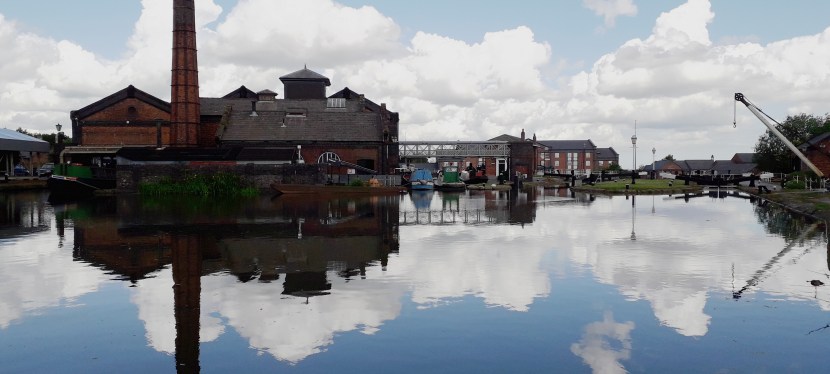
The Boat Museum at Ellesmere Port, Cheshire, run by the Canal and River Trust.
Over the summer of 2020 Historic England ran two industrial heritage training webinars. If you missed the two industrial heritage webinars run by Historic England earlier in thee summer no need to fret! Both are now available to listen to online, along with a host of other subjects.
The first of webinar provided an initial overview of Historic England’s developing Industrial Heritage Strategy from Shane Gould (Head of Industrial Heritage Strategy, Historic England). Norman Redhead (Greater Manchester Archaeological Advisory Service), described the work of a local authority archaeological officer in the identification, assessment and recording of industrial heritage sites through the planning process, as well as the assessment of public benefit regarding such sites. Finally, Dr Joanne O’Hara, (Somerset West and Taunton Council) considered the role of enforcement powers in tackling industrial listed buildings at risk drawing on a case study in Somerset.
In the second industrial heritage webinar Shane Gould considered in greater depth the topics and issues addressed by Historic England’s developing Industrial Heritage Strategy. These include planning & conservation, reuse, industrial sites as heritage attractions, knowledge & skills and research, whilst our own IHSO England officer, Dr Michael Nevell, provided an overview of the Industrial Heritage Support project.
There is still time (just) to join the online Mills Development Conference on 4th August from 9am to 2.30pm. Mills were one of the drivers of the industrial revolution within the UK – but now thousands of mills lay derelict and underutilised. This event will delve into the incredible opportunities they present to help drive economic growth and tackle the housing crisis. Mill owners, regional authorities, regeneration experts and major developers will all come together to discuss their future projects and how those in the audience can get involved.
As part of the government’s £1.57bn Culture Recovery Fund to support cultural, arts, and heritage organisations, two major funding programmes for museums, heritage sites, and heritage organisations were launched on 29th July 2020.
1) Arts Council England – Cultural Recovery Fund A grant fund of £500million is available to support museums which were financially sustainable before Covid-19 but are now at imminent risk of failure. The aim is to ensure that, by March 2021, successful applicants are either fully or partially reopened, or operating on a sustainable, cost efficient basis, so that they are able to reopen at a later date. All Accredited museums and those working towards accreditation are eligible to apply. Museums can apply for a minimum of £50,000 to a maximum of £3million of funding to be spent in the period October 2020 to March 2021; no match funding is required. Round one opens 10th August 2020 and closes for applications 12pm 21st August 2020. Round two opens 21st August 2020 and closes for applications 12pm 4th September 2020. Arts Council England expect to allocate 75% of the funding in the first round. The grants will fund costs incurred during the period October 2020 to March 2021 that enable a museum to: remain open, reopen, or partially reopen; costs to allow reduction of activity to preserve the museum; and costs to ensure value for money of a museum’s financial sustainability. For further details see here:
2) Historic England in partnership with National Lottery Heritage Fund – Culture Recovery Fund for Heritage A grant fund of £88million is available to help heritage organisations or businesses cover operating costs, assess and adapt their business models, and become financially viable. This may include the costs of reopening, operating, hibernation, mothballing, or recovery costs. An additional £4 million is being used to top up other support schemes for the sector.
Applications open across England on 30th July 2020 and close on Monday 17th August 2020. There will be one round with applicants being notified by the end of September. Those eligible are: not for profit organisations managing heritage sites, venues or attractions; local authorities, universities, and other public sector bodies managing heritage sites, venues or attractions; private owners of heritage sites, venues or attractions which are normally open to the public 28 days a year or more; heritage businesses including conservators, contractors, specialists, and suppliers; and organisations that manage culturally significant assets or collections.
Organisations can apply for a minimum of £10,000 to a maximum of £3million. Grants must be spent by the end of March 2021 and the deadline for applications is 12pm on the 17th August. Further details here: