Walking the Wandle Textile Trail Sunday 12th May 2024

Join textile artist and London National Park City Ranger Elly for a walk along South London’s River Wandle. The Wandle was a heavily industrialised river in the 18th and 19th centuries and was declared “dead” in the 1960s. It has been restored to life over the last 50 years and is now a beautiful chalk stream habitat and home to a wide variety of wildlife. 

Travel back in time as you travel along the Wandle Trail and find out about the Wandle’s rich history as a site of textile production, and how this history is a microcosm of the global textile industry today. Learn about the challenges that the Wandle faces from single use plastic pollution and wastewater discharges, and how local activists have been working to improve this environment for years. The walk will take you from restored chalk stream to culverted urban river, from new housing developments to National Trust gardens, from modern industry to the repurposed buildings of the Liberty Print Works.

Start at 11am at Hackbridge Community Gardens, Nightingale Road, Carshalton SM5 2EN. Nearest station: Hackbridge (Southern, Thameslink)

Finish 1pm at Merton Abbey Mills, Watermill Way, London SM19 2RD. Nearest Station: Colliers Wood (Northern Line)

Access: this walk is over flat terrain, and most of the footpaths have hard surfaces. There are some sections that haven’t been surfaced and these can become muddy in wet weather so please wear appropriate footwear. There are toilets at the LIDL opposite Hackbridge station, at Morden Hall Park and Merton Abbey Mills.

Historic England & Civic Voice Launch Survey on Blue Plaques

Historic England and Civic Voice are collaborating in the launch of a survey to understand the impact of different local plaque schemes across England and the organisations behind them. As Historic England receives nominations from the public as a part of a new blue plaque scheme, they are seeking views from civic organisations on how to set up and develop them. You can fill out the Blue Plaques survey here

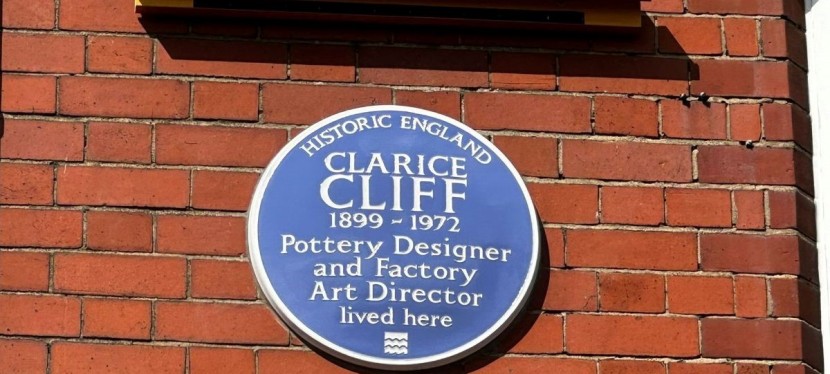
This survey comes as Historic England (HE) runs a new national blue plaque scheme on behalf of the Department for Culture, Media and Sport (DCMS). This summer, from mid-May to mid-July, you can submit your own nominations for a blue plaque. There will be advice on what HE are looking for in the nomination process, an online application form, and details on how it will be decided who gets a plaque. The unveiling of Historic England’s latest blue plaque, in April, to Clarice Cliff celebrated her enduring influence on the world of pottery. Born 125 years ago, Cliff’s journey from a young apprentice to a globally renowned ceramic artist is a testament to her talent and innovation. Her vibrant and unconventional “Bizarre-ware” designs captured the imagination of buyers worldwide, earning her a place among the most influential ceramic artists of the 20th century.

Further details on how to nominate here: https://historicengland.org.uk/listing/blue-plaque-scheme/

Greenwich Industrial History Society Online Talk on Steam Pumping Stations in the Victorian Sanitary Crisis, May 2024

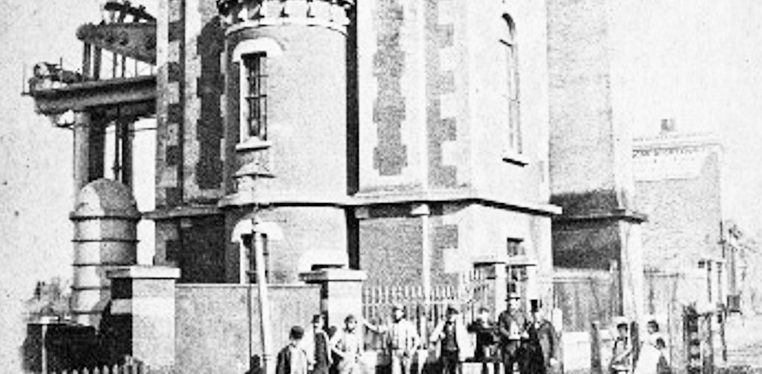
The May talk from the Greenwich Industrial History Society covers how Victorian engineers helped to solve the sanitary crisis in the nineteenth century, with a special focus on south-east London – the picture shows Charlton pumping station. The speaker is James Douet, an industrial archaeologist who was once with English Heritage listing division. Since 1996 he has been an exhibition curator based in Barcelona. He will he talking to GIHS via Zoom from Barcelona on Tuesday 14 May, starting at 19:15 for 19:30 UK time.

For details of how to register for your free place to see and hear James follow the instructions below. The free talk is open to members of Greenwich Industrial History Society and anyone else who is interested in the industrial history of our area. For this talk James will draw on his recent Historic England publication, The Architecture of Steam, published by Liverpool University Press, to reveal how sanitary engineers and steam engine builders worked out the technical and architectural solutions to the Victorian sanitary crisis. He shows how steam pumping stations were critical to pulling British cities back from the devastating living conditions caused by industrialisation, with pioneering developments in water supply and sewage disposal made in south London.

How to reserve your FREE place

·   This free talk will be by Zoom only in the evening of Tuesday 14 May, starting at 19:15 for 19:30 UK time.

·   You must book your free slot by sending an email to greenwichindustrial@gmail.com with the subject line “GIHS talk on 14 May” before 19:00 UK time on Tuesday 14 May.

·   GIHS will send you Zoom log-in details before the talk starts. (Don’t chase us; we have to wait until we have all the registrations.)

GIHS will record the meeting and plan to put the recording on their YouTube channel (https://www.youtube.com/@GreenwichIndustrialHistorySoc) – though this might take a few weeks. You can already see some of their other talks here, dating back to 2020.

Charlton Pumping Station

AIA 6th East-West Seminar 11 May 2024

The 6th East-West Workshop on Industrial Archaeology, sponsored by the Association for Industrial Archaeology, brings together historians and archaeologists from the UK, China, and Brazil to examine the ruins of industry as sources of information (archaeological evidence), inspiration and aesthetic experiences. The workshop delves into the ancient and modern ruins of industry as particular archaeological sites that allow, and demand, different explorations. It will take place online on 11 May 2024, 10.00-12.00 GMT.

The East-West series of workshops aims to exchange ideas and knowledge among Western and Eastern colleagues to build a more international and diverse industrial archaeology. The activity is organised jointly by the Institute for Cultural Heritage and History of Science & Technology (USTB, China), the UK Association for Industrial Archaeology, and its Young Members Board. The speakers will be:

  • Hilary ORANGE (Swansea University, Wales): “Stuff Kicked Underfoot – The Surfaces of Industrial Ruination”
  • Xianping GAO (University of Science and Technology Beijing, China): “Excavating the Ruins of the Chinese Porcelain Industry: The Luomachiao Kiln Site in Jingdezhen”
  • Guilherme POZZER (University of Sheffield, England): “Words in Ruins: Sensorial, Affective and Creative Approaches to the Ruins of Industry”

More info & free registration here: https://www.eventbrite.co.uk/e/6th-east-west-workshop-on-industrial-archaeology-industrial-ruins-tickets-888220470337?aff=oddtdtcreator

From Stars to Cells: The Life of Iron – New Free Ironbridge Exhibition Opens

The latest free exhibition at the Ironbridge Gorge Museum Trust (IGMT), ‘From Stars to Cells: The Life of Iron’, opened to the public on the 24 April in the Coalbrookdale Gallery. Running until December 2024, the exhibition explores the science of iron, taking you on a journey from iron’s origins in space billions of years ago through to its use by humankind and in the Ironbridge Gorge.

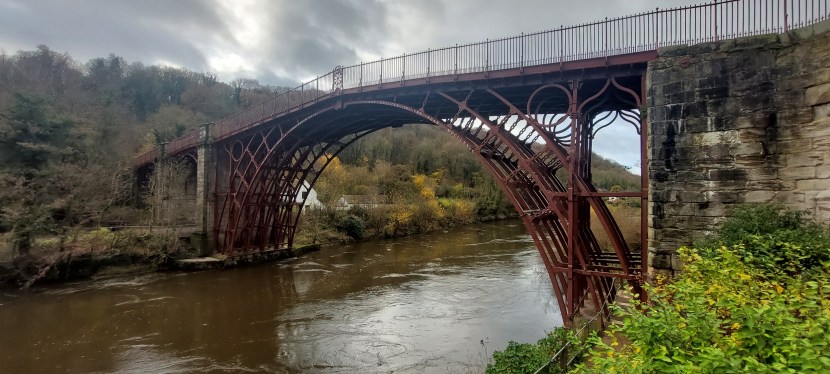
The story of iron is particularly important to the local area, where the pioneering Darby family revolutionised our lives with their innovations in the iron industry, a symbol of which is the Ironbridge. This exhibition will explore the formation of iron atoms in stars and supernovas. You will have the chance to see up close meteorites formed in space 4.5 billion years ago. Then you will be transported to the Iron Age and around 750 BCE, with a selection of objects on loan from Shropshire Museums. You will see Iron Age coins from the Claverley Hoard, unearthed in Shropshire; a gold decorative torc excavated in Telford; and a bronze sword found in the River Severn.

Months of work has gone on behind the scenes to do research, source objects from the collections of IGMT and other organisations, write the exhibition text, and doing the design. IGMT volunteers will staff the exhibition, welcoming visitors as they arrive. A highlight of the exhibition is a bead from a necklace (also on display) from ancient Egypt dating from approximately 3200 BCE, the earliest known manmade iron object in human history. It is a loan from the Petrie Museum of Egyptian and Sudanese Archaeology at University College London, and this is the first time it has been exhibited outside London.

IGMT are grateful to the Friends of Ironbridge Gorge Museum, who have paid for the case in which this bead will be displayed, and to Hiscox for insuring it. This free exhibition is curated in partnership with Keele University and supported by Arts Council England.

Museum Development North Open Grants

MD North has three grant schemes available for museums. The Open Grant programme is now open until 7 June. The grant is available to the following types of museums: museums in the north of England which are Accredited, hold provisional status, or are formally Working Towards Accreditation; museums that are not Accredited, or not formally Working Towards it, can be part of a project involving a partnership of museums, but an Accredited museum must be the lead partner.

Museum are invited to apply for grants of up to £5,000 for projects that help your organisation meet or go beyond the requirements of the Accreditation Standard and deliver against the Arts Council England’s Investment Principles:

  1. Ambition and Quality
  2. Dynamism
  3. Environmental Responsibility
  4. Inclusivity & Relevance

For details on how to apply for this grant and for other MD North grants follow this link: Open Grant

Industrial Heritage Sites in England Survey Form Now Live

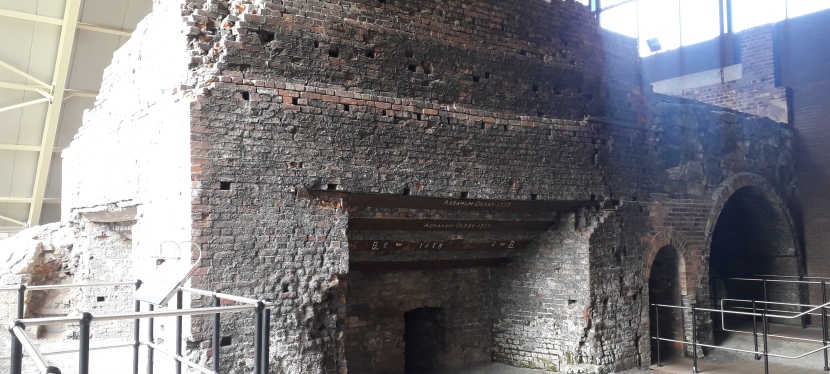
The Old Furnace, IGMT, Coalbrookdale

The Ironbridge Gorge Museum Trust and Heritage Innovation are undertaking a survey of the c.600 publicly accessible and protected industrial heritage sites in England. The ‘Designated Industrial Heritage Sites Open to the Public in England Project’ 2024 Survey is now live. It is open to all publically accessible Industrial Heritage Sites in England and the deadline is 10th May. 

Funded by Historic England, the 2024 survey will gather data on these sites which can be compared with the earlier reports. The main focus will be visitor numbers, conservation and maintenance, funding models, and community engagement. The survey will also consider how sites are responding to the challenges of Covid-19, the cost-of-living crisis and climate change. Any parties who receive an invitation to complete the survey are urged to do so where possible, as this will help to build a truer picture of the experience of sites and people and can inform the subsequent management recommendations.

The survey deadline is 10th May.  We want to hear from you – so if you haven’t received a link to the survey and wish to participate, please check your junk folder or email IHSO@ironbridge.org.uk for a direct link.

Wandle Industrial Heritage Walk, 19th April 2024

The Wandle Industrial Museum is organising an Industrial Heritage walk on 19th April 2024. The event is free and starts at 11am, meeting at Collliers Wood Station, and finishing around noon.

The walk will take in Miller’s Mead, Wandle Park, Merton Mill which was converted to flats having previously housed a flour mill, and then Connolly’s leather works, a housing estate where a calico printing works. The walk will then head to where Paxton’s patent leather factory once stood, Wandle Bank, William Morris’s works, and end at Merton Abbey Mills, where refreshments will be available in the former Liberty textile printing buildings. 

Although the walk is free any donations to the Wandle Industrial Museum are most welcome. To book email: john.sheridan08@gmail.com

Ironbridge Gorge Museum & AIA to Take Part in 2024 Festival of Archaeology

The Ironbridge Gorge Museum Trust will once more be taking part in the Council for British Archaeology (CBA) Festival of Archaeology. The 2024 event will run from the 13-28 July across the UK. The CBA is celebrating its 80th anniversary in 2024 – the perfect opportunity for us all to celebrate the incredible grassroots groups, societies, and individuals that share a passion for archaeology across the UK.  So this year’s Festival theme is Archaeology and Community.

Following on from the success of last year’s Festival of Archaeology at Coalbrookdale, the Association for Industrial Archaeology (AIA) will again be partnering with the Ironbridge Gorge Museum Trust to sponsor free entry to the Coalbrookdale Museum of Iron for all visitors on Saturday 27th July 2024. This is a great opportunity to chat with history and heritage organisations from the region and find out more about the brilliant community work happening every day. Lectures, walking tours and family activities will be hosted throughout the day. For further details follow this link:

https://www.archaeologyuk.org/festival/festival-event-listing/festival-of-archaeology-at-coalbrookdale-sponsored-by-the-association-for-industrial-archaeology.html

Furthermore, you can visit the Festival area of the CBA website to browse all the event listings which are now available. Find out what is happening in your local area and see which other industrial sites are taking part: https://www.archaeologyuk.org/festival.html. Or, if you can’t wait until July why not visit the CBA resources area where you’ll find talks, craft activities, self-guided walks, and much more available on-demand.  

If you would like to host your own Festival event visit the CBA event organiser area to find out more. 

ERIH 2024 Summer School “Shaping Sustainability in Industrial Heritage” Now Booking

 For the second time, ERIH, the Berlin Centre for Industrial Heritage and the Department of Culture and Design at the Berlin University of Applied Sciences (HTW Berlin) are hosting the European Industrial Heritage Summer School from 10 to 25 August 2024 in Berlin. The intense 14-day programme, which was recognised with the “Best Practice Award” of the Cultural Routes of the Council of Europe in 2023, is a unique combination of academic discussions, site visits and workshops and offers a holistic learning experience.

This year, the focus is on the question of how industrial heritage sites can become places of sustainable development. The programme is aimed at 18- to 30-year-old international students from various disciplines, including museum studies, cultural studies, history, industrial archaeology, cultural and tourism management, sociology, architecture and urban planning as well as conservation, sustainability and communication studies. Students from other disciplines are also welcome. Eligible are all bachelor, master or doctoral/PhD students who have completed at least their 2nd semester and who are enrolled at a university.

Applications are now open. From 5 April, admissions will be granted on a weekly basis until all 22 places have been filled. Follow this link for booking details:

European Industrial Heritage Summer School