Welcome to the Industrial Heritage Networks and Support website. This site is maintained and updated by the Ironbridge Gorge Museum Trust who run the project and the networks. We aim to support industrial heritage in England through networking, information exchange, guidance, and training. Please explore the website and please contribute! For more information you can … Read more Welcome to the IHNs website!
Sunderland City Council is seeking to appoint a design team for a £2.2 million upgrade of Washington’s F-Pit Museum. Following a consultation on regeneration plans for Washington F-Pit Museum and Albany Park in 2022, the Council has now developed a draft outline Masterplan for improvements to the Park and a concept sketch proposals for a new Heritage Centre and Café to enhance the heritage offer and visitor appeal of this unique site for residents and visitors.
The successful architect-led multi-disciplinary design team will oversee the details of the upgrade. Due for completion in 2027, the project aims to boost visitor numbers to the museum and to secure a ‘viable and sustainable long-term future’ for the site, drawing new visitors to Washington and Sunderland. The museum is currently on Historic England’s Heritage At Risk Register and only receives around 1,000 visitors a year
The F-Pit Engine House and attached headgear are a Scheduled Ancient Monument, and are the only surviving structures of New Washington Colliery. The Engine House was presented by the National Coal Board to the people of Washington as a monument, following its closure in 1968, and it has operated as a Museum since 1976. Albany Park was formed from land reclaimed from the former colliery.
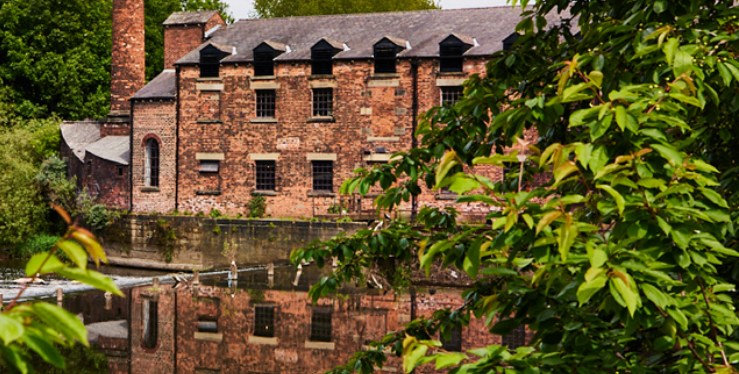
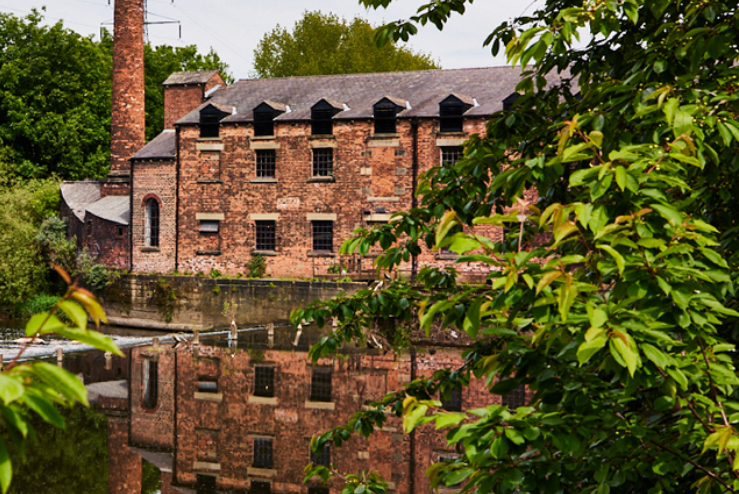
Thwaite Watermill Museum, in Leeds, may be faced with closure. The museum of Leeds’ milling industry is set in a former mill on an island in the River Aire. The site is owned by the Canal and River Trust, and run by Leeds City Council museums and galleries. The lease on the site is currently due to end in 2030, but as part of proposed budget cuts Leeds City Council is considering a proposal to end the lease in 2025.
The CRT confirmed that if the lease ends, it would not be able to afford to take over the running of the museum. A spokesperson said: “We are sorry to hear this update. If the council terminates the lease and closes their museum, we will have to look for alternative viable options for the use of the property that will help safeguard its future. In this difficult economic climate, our charity is facing the same financial challenges with the day-in day-out task of looking after and keeping open our 2,000 miles of waterways, including the hundreds of centuries-old locks, bridges, tunnels and aqueducts here in Yorkshire. Unfortunately, we do not have the funding to take on the council’s running of the Thwaite Watermill museum.”
As part of the Association for Industrial Archaeology’s refreshment of its membership and events offering, the AIA are creating a new ‘online-only’, membership category. From January 2024the AIA are offering this new ‘online-only’ option for all categories of membership (except Affiliated Society).
The ‘online-only’ option gives all the great benefits of being a member except you will no longer receive printed copies of Industrial Archaeology Review, IA News, and other member correspondence (such as the AGM papers). All members will continue to receive online access to Industrial Archaeology Review via Taylor & Francis Online and access to electronic editions of IA News and other important documents via the AIA website. Membership is open to individuals (sole, joint or student) and to societies. It will be backdated to the beginning of the year in which you join and all publications for that year will be sent either in paper or electronically, depending on the membership category.
The support AIA members give enables the Association to continue its work in supporting and encouraging all aspects relating to our industrial heritage and archaeology. The AIA cannot do all they do, promoting IA at all levels (national and local), encouraging research, recording, conservation, and preservation, without their members’ help and support.
2024 marks the 80th anniversary of the Council for British Archaeology (CBA), the UK’s leading archaeology charity. In the run up to the anniversary they are conducting a survey of the current state of grass roots archaeology in Britain.
The CBA were instrumental in promoting and developing industrial archaeology in Britain, staging the first regional and national conferences on the subject in 1959 and campaigning for the saving of important national industrial sites in the 1960s and 1970s. Its support for industrial archaeology and heritage continues into the 21st century, through its listed building case work, publications, and wider advocacy. With its 80th anniversary imminent, the CBA is thinking about the communities that make up the archaeology and heritage sector today.
They have put together a survey for archaeological/historical groups, so that they can build a picture of community and grassroots archaeology in the Britain. This includes, of course industrial archaeology and heritage societies and groups, and volunteers running industrial heritage sites. If you belong to such a group or help run an industrial site, then please fill in the survey and send it on to anyone else you think might be interested. You’ll play a huge part in helping the CBA better understand grassroots archaeology – and you’ll be in with a chance to win £100 for your society!
Historic England released its annual Heritage at Risk Register in November 2023, marking the 25th anniversary of publicly recording neglected or imperilled heritage sites. In total, there are 4,871 entries on the 2023 register, 44 fewer than in 2022. However, heritage sites continue to be added to the Register every year. In 2023 there were 159 new entries, made up of 44 buildings and structures, 53 places of worship, 55 archaeology entries, 3 parks and gardens and 4 conservation areas.
Hunslet Mill, Leeds. Image courtesy of Historic England
Amongst those heritage sites conserved and so removed from the list are 13 industrial heritage sites. These are:
Bourn Mill, Caxton end, Bourn, Cambridgeshire, LB I, 1162375
Electricity Substation at junction with Sunnyside Passage, Sunnyside SW19, LB II*, 1358028
Lambeth uncovered coal store including tower and attached tunnels, Portsmouth Road, Surbiton, Greater London, LB II*, 1031864
Remains of iron works and gun foundry at North Park Furnace, Linchmere / Fernhurst, Chichester, West Sussex, SAM, 1021403
Surrey Iron Railway embankment, approximately 130m south west of Lion Green Road, Coulsdon, SAM, 1021441
Upminster Windmill, St Mary’s Lane, Upminster, LB II*, 1079878
Westlink House, Great West Road, Hounslow, LB II*, 1255218
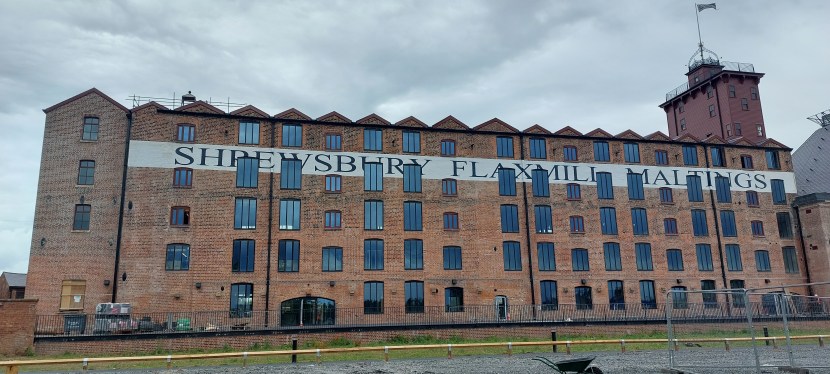
Ditherington Flax Mill: Spinning Mill, Shrewsbury, LB I, 1270576
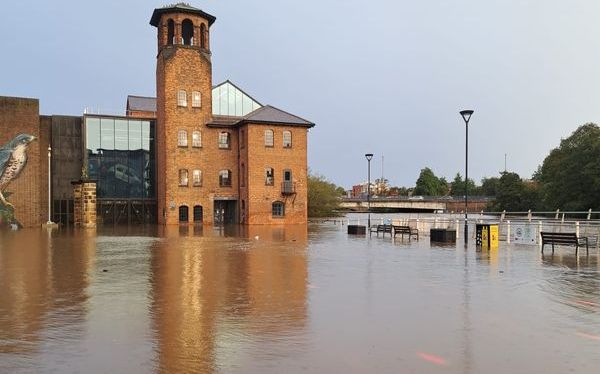
Flooding outside the Museum of Making (Derby Old Silk Mill), Derby, October 2023. Image courtesy of Derby Museums.
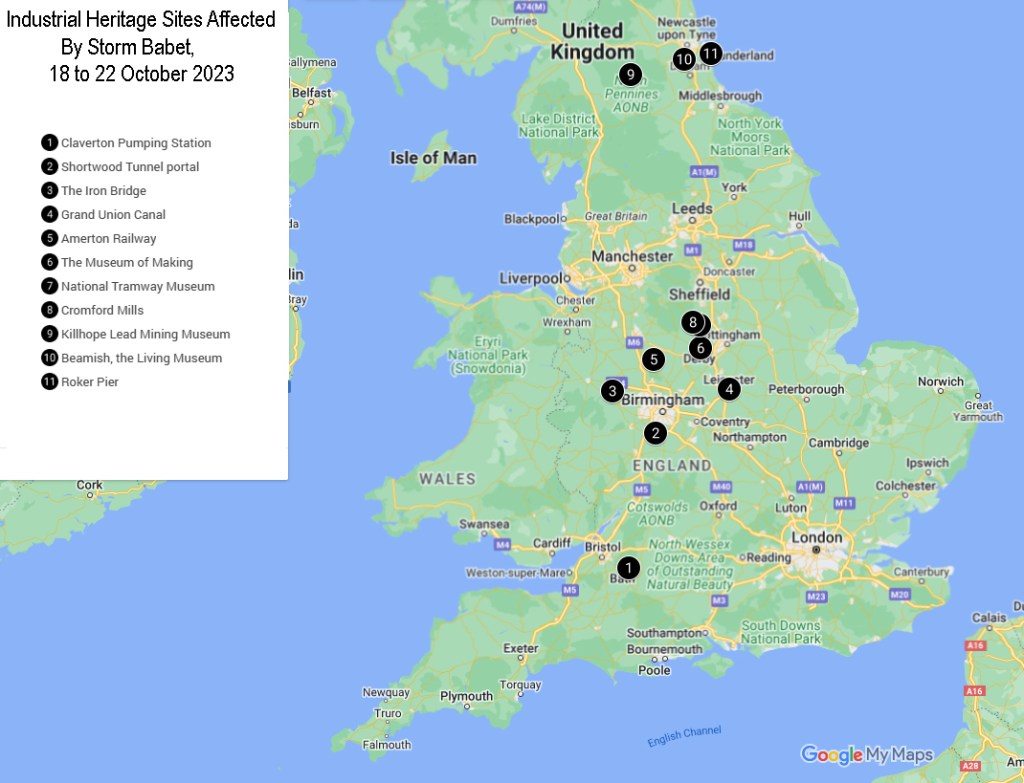
The growing impact of Climate Change for the industrial heritage sector was underlined by the impact of Storm Babet in October 2023. A rapid online survey of the immediate impact of the storm was undertaken in the last week of October and the first week of November 2023 for the IHSO project, indicating that it had the largest impact on industrial heritage sites in England since the flooding caused by storms Ciara and Dennis, both in February 2020.
Storm Babet, the second named storm of the 2023-24 autumn and winter season, was an intense cyclone that affected large parts of north-western and western Europe from the 16th October, when it was given a name, to the 22nd October 2023, when it dissipated. It crossed Britain from south-west England to north-east Scotland from the 18th to the 20th October. According to data gathered by the Met Office: ‘heavy, persistent and widespread rain…affected much of England, Wales and Northern Ireland from 18th to 20th, with 100mm falling fairly widely [double the average monthly rainfall for England]…Babet also brought some very strong winds, gusting at over 50Kt (58mph) across north-east England and much of Scotland’. (2023_08_storm_babet_v1.docx (metoffice.gov.uk).
The impact in England and Wales was not as severe as north-east Scotland but was still extensive, with flooding across Yorkshire, the East Midlands, and the Humber area, as well in Suffolk, and around Stafford and Wrexham. Its impact on industrial heritage sites in England was felt in three ways. The most severe impact was through flooding episodes. The ground floor of the Grade II Listed Museum of Making (Derby Museums | Derby Museums) (the Old Silk Mill), in the centre of Derby, was flooded by the adjacent River Derwent on 21st October to between 0.5m and 0.7m. The redesign of the museum building at the beginning of the 2020s incorporated elements to protect the building and its archives from flooding by the adjacent River Derwent. Evenso, Derby Museum estimate that the damage runs into the tens of thousands of pounds, and the museum will not re-open until well into 2024. Other industrial heritage sites affected by flooding included the heritage narrow gauge Amerton Railway in Stafford, the National Tramway Museum at Crich in Derbyshire, and the Claverton Pumping Station near Bath, on the Kennet and Avon Canal. For the latter this was the third time this year that parts of the site had been flooded by the River Avon, from which water is pumped up to the canal.
Secondly, the impact of intense rainfall was also seen in several landslip events on the canal network. A landslide occurred on the Worcestershire & Birmingham Canal by the Shortwood Tunnel west portal (near the village of Tardebigge, Worcestershire), whilst a 50m of canal bank collapsed due to flooding along the Grand Union Canal in central Leicester from the adjacent river Soar (https://canalrivertrust.org.uk/news-and-views/news/counting-the-cost-of-climate-change).
Thirdly, the impact of winds was seen at several industrial heritage sites along the north-east coast of England. In South Shields, the storm dislodged the dome of the Tyne South Pier lighthouse and sections of railings and decking were also destroyed at Sunderland’s Rock Pier by large waves in conjunction with the high winds.
The IHSO project has been gathering data on the impact of climate change on Industrial Heritage sites and monuments since January 2020, and each winter and summer of this decade has brought notable weather extremes. Current Met Office projections down to 2050 suggest that there Britain will experience an increase in winter storm intensity, an increase in the length of dry spells, and an increase in temperature extremes as the climate continues to warm. Since many industrial heritage sites lie in areas vulnerable to flooding, such as river valleys or along the coast, these sites are most at risk. However, all industrial heritage sites need to develop further their disaster management plans, especially early warning of weather events, and to think in detail about adaption options.
Historic England has published (November 2023) a draft Advice Note that aims to provide clear and consistent advice on balancing climate action with building adaptation.Primarily aimed at local planning authorities, heritage consultants, and those involved in the planning process, the Historic England Advice Note (HEAN) is now open for consultation to ensure everyone can comment on the final advice.
Historic England has produced this Advice Note to provide clarity and to support consistent decision-making for proposals to reduce carbon emissions and improve the energy efficiency of historic buildings, whilst conserving their significance and ensuring they remain viable places to live in the future. It reflects current national planning policy, and whilst the Advice Note will largely be for a specialist audience, it will also be useful to building owners/occupiers once the final version is published, and so relevant to all organisations that run and/or own industrial heritage sites.
Amongst other points, the draft advice note states that solar panels and heat pumps can be fitted to listed buildings so long is it is done discreetly. Listed building consent will always be required for the installation of photovoltaic and solar thermal panels, but they will generally be acceptable on non-principal roofs. Likewise, the installation of heat pumps will possible, and will also require listed building consent, provided that they are sympathetically sited. Loft insulation, as long as not sprayed, and insulation under or between floors will also be usually acceptable.
Ian Morrison, Director of Policy and Evidence at Historic England, said: “The new Advice Note we are consulting on demonstrates how historic buildings can become more energy efficient and help to reduce carbon emissions in England. It’s not a question of ‘if’ change can happen, it’s a question of ‘how’, and this new advice will make it clearer for us all to ensure historic buildings are adapted appropriately to respond to the climate crisis. We welcome feedback on how the Advice Note will enable decision making to be more consistent.”
The next three in-person meetings of the Industrial Heritage Networks will be taking place on the 16 and 30 November, and on 13 December 2023. These will be for the London, North East England, and North West England networks. These free events will be the first in-person meetings for these networks since the COVID pandemic, and are being held at the Museum of Docklands in London, Land of Iron at the Cleveland Ironstone Mining, and the Lion Saltworks in Cheshire.
Like the other seven IHN groups in England, these in-person events are designed to bring together those industrial heritage sites open to the public in each region, and local groups and individuals working or volunteering on industrial archaeology and heritage subjects and sites in the area. The format will be a round-table discussion in the morning with a tour of the site in the afternoon.
Details on how to book these free events on Eventbrite can be found here:
Barnsley Museums and Barnsley Council have launched their new vision for the historic Elsecar Ironworks site, including the re-establishment of a heritage railway and much more. They would like to thank everyone who has shared ideas and thoughts already about this very special historic site with a proud history, which is now a Scheduled Ancient Monument, thanks to our Heritage Action Zone Partnership with Historic England.
The future vision for the former ironworks includes:
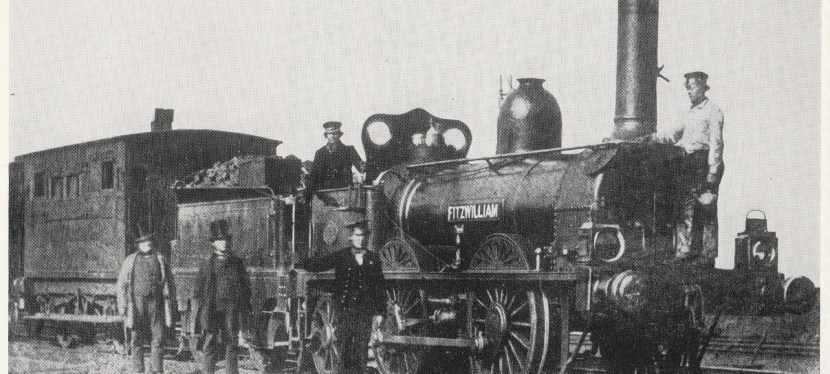
New heritage railway destination, including a reconstructed 1849 Fitzwilliam locomotive, powered by sustainable fuels
New rail college and rail technology test track, training more than 400 students each year
Advanced engineering workshops showcasing the region’s innovation
New ‘Cultural Canteen’ and outdoor events and performance area, against the spectacular backdrop of the ironworks furnaces and restored blast wall
Active Travel Hub and Cycle Hire, to enable families and visitors to travel to Elsecar, and explore the Elsecar Valley, on foot and by bike
Barnsley Museums and Barnsley Council look forward to inviting everyone, starting with local residents, to special events, activities and tours in the New Year to discuss how this vision could be taken forward. It will take time to make the new development a reality and to secure funding to make it happen, but they are confident of being able to do so, and all the positive benefits it will mean for our region.
The proposed development is in addition to works due to start in Spring 2024 to The New Yard and The Ironworks events building, for which funding has already been secured from the Cultural Development Fund.
For more information, to watch a film about these proposals, and read a vision document and frequently-asked questions, please see: www.elsecar-heritage.com/forging-ahead
In October 2023 the UK Government secured the final changes to the Levelling-up and Regeneration Bill, after 16 months of debate and drafting in Parliament. This means that several heritage provisions have now become law. The most significant for industrial archaeology and heritage sites, and archaeology in general, is a provision that secures statutory status for Historic Environment Records (HER).
Historic England describes HERs as ‘sources of, and signposts to, information relating to landscapes, buildings, monuments, sites, places, areas and archaeological finds spanning more than 700,000 years of human endeavour. Based mainly in local authorities, they are used for planning and development control but they also fulfil an educational role.’ The Levelling-up and Regeneration Act makes it a legal requirement that each local authorities in England maintains an HER for its area. Further detail can be found here: https://historicengland.org.uk/advice/hpg/heritage-assets/hers/
The passing of the Act concludes a long advocacy campaign by many archaeological bodies, including the Chartered Institute for Archaeologists (CIfA), Association of Local Government Archaeological Officers, and the Council for British Archaeology, supported by many others, such as the Association for Industrial Archaeology, to secure statutory HERs. This provision was first proposed in the failed 2008 Heritage Protection Bill. HERs were made statutory in Wales in 2016.
Thanks must be given to Historic England, who have advised Government on the relevance of HERs to levelling-up and the establishment of a more digital planning system during the Bill’s development.
You can read more about this story on the CIfA website: here.













 Industrial Heritage Networks