Welcome to the Industrial Heritage Networks and Support website. This site is maintained and updated by the Ironbridge Gorge Museum Trust who run the project and the networks. We aim to support industrial heritage in England through networking, information exchange, guidance, and training. Please explore the website and please contribute! For more information you can … Read more Welcome to the IHNs website!
Brew Up! brings together people who work with industrial collections in the North of England, from mill engines to computers, from agricultural to glass; a chance to learn and share. Join us to connect with colleagues across the region, discuss issues unique to industrial collections and find key advice and insight from experienced professionals.
Run by Museum Development North, this session at the Lion Salt Works in Northwich will focus on the theme of environmental responsibility. Covering topics from green fuels to greening your site, this day will be especially useful for industrial heritage and archaeology sites and groups. It runs from 10:00–15:30. To book follow this link:
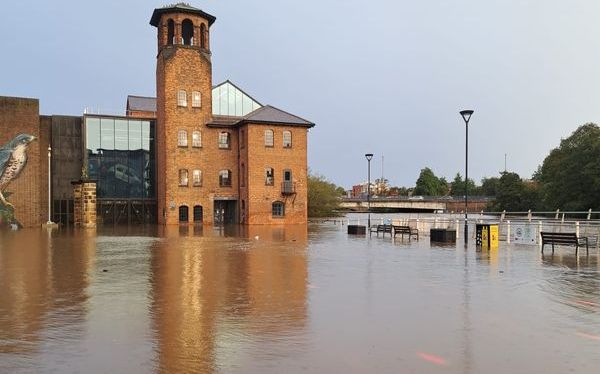
Flooding outside the Museum of Making (Derby Old Silk Mill), Derby, October 2023. Image courtesy of Derby Museums.
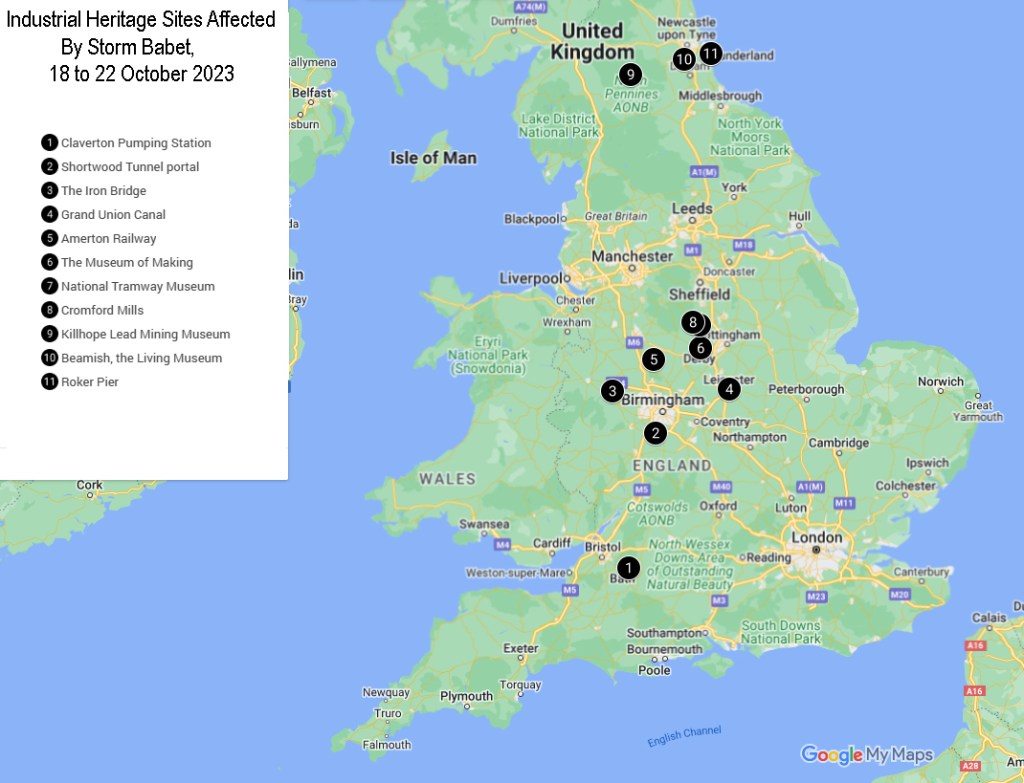
The growing impact of Climate Change for the industrial heritage sector was underlined by the impact of Storm Babet in October 2023. A rapid online survey of the immediate impact of the storm was undertaken in the last week of October and the first week of November 2023 for the IHSO project, indicating that it had the largest impact on industrial heritage sites in England since the flooding caused by storms Ciara and Dennis, both in February 2020.
Storm Babet, the second named storm of the 2023-24 autumn and winter season, was an intense cyclone that affected large parts of north-western and western Europe from the 16th October, when it was given a name, to the 22nd October 2023, when it dissipated. It crossed Britain from south-west England to north-east Scotland from the 18th to the 20th October. According to data gathered by the Met Office: ‘heavy, persistent and widespread rain…affected much of England, Wales and Northern Ireland from 18th to 20th, with 100mm falling fairly widely [double the average monthly rainfall for England]…Babet also brought some very strong winds, gusting at over 50Kt (58mph) across north-east England and much of Scotland’. (2023_08_storm_babet_v1.docx (metoffice.gov.uk).
The impact in England and Wales was not as severe as north-east Scotland but was still extensive, with flooding across Yorkshire, the East Midlands, and the Humber area, as well in Suffolk, and around Stafford and Wrexham. Its impact on industrial heritage sites in England was felt in three ways. The most severe impact was through flooding episodes. The ground floor of the Grade II Listed Museum of Making (Derby Museums | Derby Museums) (the Old Silk Mill), in the centre of Derby, was flooded by the adjacent River Derwent on 21st October to between 0.5m and 0.7m. The redesign of the museum building at the beginning of the 2020s incorporated elements to protect the building and its archives from flooding by the adjacent River Derwent. Evenso, Derby Museum estimate that the damage runs into the tens of thousands of pounds, and the museum will not re-open until well into 2024. Other industrial heritage sites affected by flooding included the heritage narrow gauge Amerton Railway in Stafford, the National Tramway Museum at Crich in Derbyshire, and the Claverton Pumping Station near Bath, on the Kennet and Avon Canal. For the latter this was the third time this year that parts of the site had been flooded by the River Avon, from which water is pumped up to the canal.
Secondly, the impact of intense rainfall was also seen in several landslip events on the canal network. A landslide occurred on the Worcestershire & Birmingham Canal by the Shortwood Tunnel west portal (near the village of Tardebigge, Worcestershire), whilst a 50m of canal bank collapsed due to flooding along the Grand Union Canal in central Leicester from the adjacent river Soar (https://canalrivertrust.org.uk/news-and-views/news/counting-the-cost-of-climate-change).
Thirdly, the impact of winds was seen at several industrial heritage sites along the north-east coast of England. In South Shields, the storm dislodged the dome of the Tyne South Pier lighthouse and sections of railings and decking were also destroyed at Sunderland’s Rock Pier by large waves in conjunction with the high winds.
The IHSO project has been gathering data on the impact of climate change on Industrial Heritage sites and monuments since January 2020, and each winter and summer of this decade has brought notable weather extremes. Current Met Office projections down to 2050 suggest that there Britain will experience an increase in winter storm intensity, an increase in the length of dry spells, and an increase in temperature extremes as the climate continues to warm. Since many industrial heritage sites lie in areas vulnerable to flooding, such as river valleys or along the coast, these sites are most at risk. However, all industrial heritage sites need to develop further their disaster management plans, especially early warning of weather events, and to think in detail about adaption options.
Historic England has published (November 2023) a draft Advice Note that aims to provide clear and consistent advice on balancing climate action with building adaptation.Primarily aimed at local planning authorities, heritage consultants, and those involved in the planning process, the Historic England Advice Note (HEAN) is now open for consultation to ensure everyone can comment on the final advice.
Historic England has produced this Advice Note to provide clarity and to support consistent decision-making for proposals to reduce carbon emissions and improve the energy efficiency of historic buildings, whilst conserving their significance and ensuring they remain viable places to live in the future. It reflects current national planning policy, and whilst the Advice Note will largely be for a specialist audience, it will also be useful to building owners/occupiers once the final version is published, and so relevant to all organisations that run and/or own industrial heritage sites.
Amongst other points, the draft advice note states that solar panels and heat pumps can be fitted to listed buildings so long is it is done discreetly. Listed building consent will always be required for the installation of photovoltaic and solar thermal panels, but they will generally be acceptable on non-principal roofs. Likewise, the installation of heat pumps will possible, and will also require listed building consent, provided that they are sympathetically sited. Loft insulation, as long as not sprayed, and insulation under or between floors will also be usually acceptable.
Ian Morrison, Director of Policy and Evidence at Historic England, said: “The new Advice Note we are consulting on demonstrates how historic buildings can become more energy efficient and help to reduce carbon emissions in England. It’s not a question of ‘if’ change can happen, it’s a question of ‘how’, and this new advice will make it clearer for us all to ensure historic buildings are adapted appropriately to respond to the climate crisis. We welcome feedback on how the Advice Note will enable decision making to be more consistent.”
Historic England is seeking heritage sector partners to help them create a digital case study resource. They are looking for case studies under a range of themes relevant to industrial heritage sites and organisations, including climate change and heritage, retrofitting, reuse and regeneration, design and communities.
The case studies will be used within Historic England’s e-learning courses to support learners within the sector to develop knowledge and confidence in the management of the historic environment through the planning system. If you have worked on a case or project that you feel demonstrates good practice and could help others, please take a look at the procurement information by following this link:
Historic England is organising a number of online roundtable discussions with different parts of the heritage sector to discuss the impact of reaching Carbon Net Zero. The project lead, Dan Miles, will be runnign two sessions for Industrial Heritage sites to bring people together to talk about some of the key issues they are encountering. These include how to start measuring emissions, setting out how to write a plan, or covering concerns that are associated more specifically with industrial heritage sites. To join one of the discussions on the 12th or 14th December, please fill in the registration form linked here: https://forms.office.com/r/TN0KiyHN5e
In addition, Historic England’s survey to find out what support small and medium size heritage organisations need to help them on their journey towards reaching carbon net zero is still open. The survey is live until 11th December. Follow this link to fill in the survey: https://www.smartsurvey.co.uk/s/X8E3CQ/.
The use of water from abandoned coal mines to heat homes and historic sites has taken a further step forward. The Welsh government has agreed to spend £450,000 on a project which it hopes will help cut Welsh energy bills and Wales’ carbon footprint. The money will be used by the Coal Authority, who manage disused pits in Britain, to locate the best areas in Wales for such a project.
Potential sites will be tested for the effectiveness of extracting water from disused mines and putting it through a heat exchanger, where some heat is recovered, before it is amplified by a heat pump. This can then be used to heat homes and/or industrial heritage sites. Mine water heating is low-carbon, but not carbon-free because the water has to be further warmed using a heat pump, which operates like a fridge in reverse. A similar programme in Gateshead, England, developed by the Coal Authority at a cost of £9m, has become the largest mine water heat scheme in the UK.
Historic England have a range of free-to-watch webinars and one of the themes this autumn is climate change and cultural heritage. A growing number of industrial heritage sites are threatened not just by heavier rainfall, floods, and the consequent erosion, but by storms, heat waves, drought, and vegetation change.
‘Climate Friday’ is a series of webinars beginning 9th October focussing on the impact of climate change on heritage. Hosted by Historic England’s Environmental Strategy team, in collaboration with the Climate Heritage Network, they will provide delegates with an in-depth look at a range of topics related to climate change and cultural heritage presented by international experts in heritage and climate change research, policy and practice.
The first one is entitled ‘Thinking about interrelationships between the climate crisis and heritage’. Sign up here:










 Industrial Heritage Networks