Welcome to the Industrial Heritage Networks and Support website. This site is maintained and updated by the Ironbridge Gorge Museum Trust who run the project and the networks. We aim to support industrial heritage in England through networking, information exchange, guidance, and training. Please explore the website and please contribute! For more information you can … Read more Welcome to the IHNs website!
In late 2023 the Arts Council England (ACE) commissioned a report on public investment in English museums. The report, published in January 2024, shows that local authority funding per capita in museums during the 14 years from 2009-10 to 2022-23 reduced by 23%. It also shows that the East of England has above average spend per capita, whilst Northern and South West England have the highest levels of local authority funding for museums.
The research was commissioned with the aim of producing a comprehensive set of data that can support museums, local authorities, and stakeholders with budget planning, and encourage a strategic and collaborative approach to considering the funding challenges facing both museums and local government. The report concludes with a set of potential actions in response to changes in local authority funding, highly relevant to industrial heritage museums and sites, focussing on:
Keele University and Ironbridge Gorge Museum Trust have joined forces in a new partnership that will develop student opportunities and open doors for new research into 300 years of industrialisation. To find out more, go online and watch a short video, which includes a few words from Nick Booth, IGMT Collections and Learning Director, and Dr Mike Nevell, Industrial Heritage Support Officer for England.
To coincide with the launch, a roundtable discussion will take place on the evening of Monday 3 July to discuss the lessons that our industrial heritage might hold for the world’s transition to a zero-carbon economy. It will be chaired by Professor David Amigoni, Professor of Victorian Literature, Director of the Keele Institute for Social Inclusion and a member of Ironbridge Gorge Museum Trusts Collections and Learning Committee; Abbie King, IGMT’s Chief Operating Officer, will be one of the speakers.
To attend the roundtable discussion online use the link below. Please register no later than 4.00pm on the day of the event.
Ironbridge, Innovation, and Imagination: Industrial Memory as Global Challenge Monday 3 July 2023 6.00 – 7.00pm Online only via Microsoft Teams
Digital Works is running a project collecting oral histories relating to London’s holiday camps. The ‘Hello Campers!’ project, funded by the National Lottery Heritage Fund, is looking for project volunteers and for people to be interviewed regarding their reminiscences on this subject.
Oral history specialists Digital Works are working at The British Film Institute to explore the history of Londoner’s experiences at places such as Butlins and Pontins from the 1950s until now. No previous experience is required for volunteering, as full support and training will be on offer. Digital Works have previously work on a very successful project collecting oral history of Wimbledon Football Club and the origins of AFC Wimbledon, culminating in the release of an associated film. All training is free and will be at the BFI Southbank. You will need to be available on the week beginning May 22nd 2023.
The latest in the Association for Industrial Archaeology’s joint international seminar series takes place online on 27th May. The East-West series of workshops aims to exchange ideas and knowledge among Western and Eastern colleagues to build a more international and diverse industrial archaeology. The activity is organised jointly by the Institute for Cultural Heritage and History of Science & Technology (USTB, China), and the UK Association for Industrial Archaeology together with its Young Members Board.
From underground to outer space, from the 14th to the 21st century, the 4th E-W Workshop on Industrial Archaeology explores the interlinkages of archaeology, technology, science and industry with cases from Australia, Asia, Europe and the Universe! This edition of the workshop revisits the original focus of industrial archaeology on the research and conservation of technology, which is expanded and revised with new geographies, chronologies, methodologies and questions.
The speakers will be:
Alice GORMAN (Flinders University, Australia): Beyond the rocket: the archaeological study of space technology.
Shujing FENG (National Academy of Innovation Strategy & Tsinghua University, China): Wenzhou Alum Mine from the perspective of the archaeology of technology.
Geoffrey WALLIS (GW Conservation/Dorothea Restorations & AIA, UK): Developments in practical engineering conservation. The works of Dorothea Restorations Ltd.
Applications to take part in a unique fully-funded PhD research project to examine the links between art and industry in the West Midlands have opened this week with applications being welcomed from students across the world for the research project which will be based at the Ironbridge Gorge Museum Trust (IGMT) and Birmingham City University.
The Arts and Humanities Research Council-funded Midland4Cities Collaborative Doctoral Award, is a partnership between Birmingham City University and the Ironbridge Gorge Museum Trust. The project, entitled ‘Common printed things: intersections of art and industry, the Coalbrookdale Collection, 1850–1930’ will use the extensive Coalbrookdale Collection at IGMT to illustrate the development of industrial life in the Midlands and the role of print in the manufacture and sale of the ironware items that made the company a household name the world over.
Highlighting the integral role that the Ironbridge Gorge played in the development of the Industrial Revolution, the successful applicant will have unique access to hundreds of historic documents, artefacts and business ledgers still housed in the Trusts archive at the Coalbrookdale Company’s original headquarters in Coalbrookdale.
The project will merge methods used by both printing and social historians to study not only the materials themselves but processes required to produce them as well as the craftspeople who made them to better understand the relationship between the manufacturer, the artefacts, the catalogues and the consumer.
Working with experts at sites across the Ironbridge Gorge over the course of 4 years the successful applicant will study and audit 40 original printed catalogues, the physical ironware products advertised within them, as well as over 1,000 wood engravings used to print the promotional materials in order to build a clearer picture of how they were produced.
Project supervisor Nick Booth, Collections and Learning Director at the Ironbridge Gorge Museum Trust said: “Coalbrookdale and the extensive collection that is housed there offers a truly unique chance to delve into what is such an important part of our history, not only on a regional scale but a global one. The developments that happened within the Ironbridge Gorge and Coalbrookdale specifically were truly world changing and this research project offers the opportunity to unpick another integral piece of the puzzle to help us better understand the important role that print had in the wider industrial story.
“With ten sites across the Ironbridge Gorge, including Blists Hill Victorian Town which houses working facilities including our Victorian print shop, it means that as well as the academic side of the project, the researcher will be able to gain hands-on experience of the processes used during the period under realistic, historically accurate circumstances.”
The Award will be jointly supervised by Professor Caroline Archer-Parré, Co-Director of the Centre for Printing History and Culture (CPHC) at Birmingham City University who added: “This is a rare opportunity to research the materials and processes used to create the printed catalogues in the location in which they were originally manufactured, and to provide new insights into how the various industries involved in their creation interacted and collaborated.”
Applications for the 2022 Association for Industrial Archaeology Research Grants scheme is now open. The AIA exists to promote the study, preservation and presentation of Britain’s industrial archaeology and heritage, and the research grant scheme underpins key aims of the Association. It does that by:
Encouraging individual researchers to study industrial archaeology subjects
Encouraging the development of industrial archaeology skills within commercial units, the main repository of professional skills in the subject
Supporting local industrial archaeology and industrial heritage societies in exploring and understanding their local areas
Helping to develop the next generation of industrial archaeologists
The total fund available in any single year is £1,500 and multiple grants may be given up to this maximum in a single year. The AIA may consider part-funding a wider grant application or project as long as the AIA grant is a significant part of the larger application / project.
Applicant Requirements:
· Anyone working in industrial archaeology in the UK – volunteer, student, academic or professional.
· Societies or organisations can apply but need to nominate an individual as the lead.
· The kind of work supported includes excavation, field survey, and documentary analysis but does NOT include conference attendance (we have separate funds for such support).
· The grant must form a significant part of the overall research funding being sought or must support a distinct and discrete element of a wider research project.
· The researcher must acknowledge the role of the AIA in supporting their work in any publicity.
Mining spoil heaps in North Yorkshire. Copyright Historic England.
For the first time ever, Historic England has made the results of over30 years of aerial photograph mapping projects freely available online. The public can use the new research tool to explore heritage from ancient settlements to secret Cold War military installations, or to see the complex archaeological landscapes of Hadrian’s Wall, Stonehenge, and industrial landscapes.
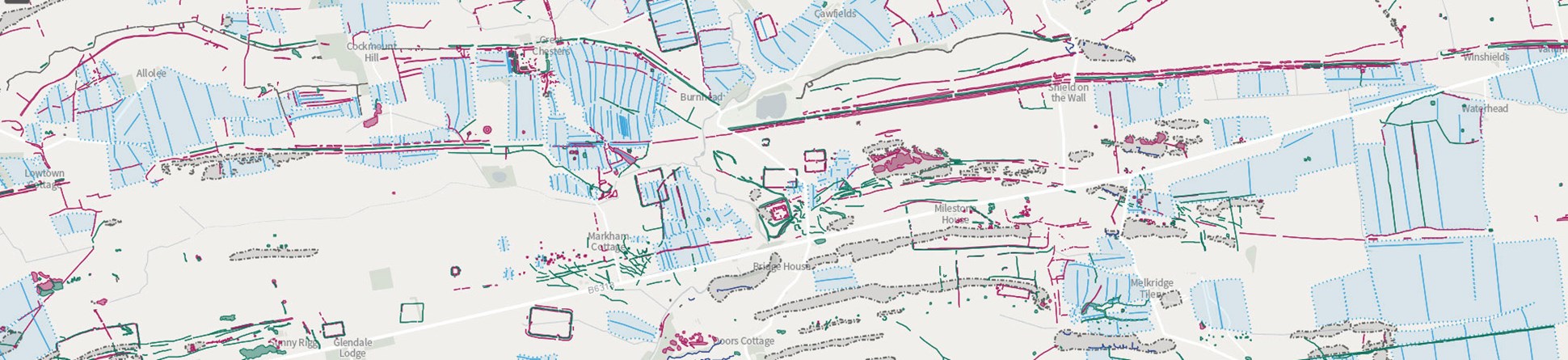
The Aerial Archaeology Mapping Explorer lets you explore the layers of archaeology in and around your local place. You can browse the map and zoom in to the location you’re interested in or search by postcode, address or place name. Follow this link to explore the website: https://historicengland.org.uk/research/results/aerial-archaeology-mapping-explorer/
The map brings together the results of numerous projects undertaken by specialists at Historic England and its predecessor organisations since the late 1980s, as well as many partner organisations. Hundreds of thousands of aerial photographs, ranging in date from the 1920s to the present, have been studied. More recently, innovative technologies such as lidar – airborne laser scanning – and web-based sources, such as Google Earth, have been added to the sources used. Every site has a simple description with links to the full Historic Environment records held online. For most of the areas there is also a free report detailing the highlights and new discoveries encountered in each project.
The Aerial Archaeology Mapping Explorer, alongside complementary resources such as Historic Environment Records available via Heritage Gateway, offers a springboard to further investigation, whether for research purposes or simply curiosity about the area where you live. It should be especially useful for researching industrial archaeology and heritage sites.
An example of how the aerial photographs and LIDAR data are interpreted on the new Historic England mapping explorer.













 Industrial Heritage Networks