Welcome to the Industrial Heritage Networks and Support website. This site is maintained and updated by the Ironbridge Gorge Museum Trust who run the project and the networks. We aim to support industrial heritage in England through networking, information exchange, guidance, and training. Please explore the website and please contribute! For more information you can … Read more Welcome to the IHNs website!
The Association of Independent Museums’ Brighter Day Grant Scheme, funded by the Arts Scholars Trust, is now open for applications from AIM members. The priority for this round of funding is ensuring that museums at risk of closure, losing vital skills and knowledge, or unable to provide effective collections care, are supported to ensure future viability. The scheme has a special focus on small museums and others that have found it difficult to access support.This is particularly relevant to Industrial Heritage Sites who are members of AIM.
The fund will support education, training, curation, and exhibition projects that address collections care and sustainability of historic and decorative arts collections. Grants can be applied for at a minimum of £1,500 and maximum of £8,000. Museums can only apply for one grant per round. Match funding is not required.
AIM and Historic England are hosting a roundtable discussion on Wednesday 25 Jan, 11-12.30 to understand what issues different orgs may be facing and what type of support they may need around working towards net zero.
Historic England is undertaking a piece of work to find out what stage organisations are at on their journey towards carbon net zero, what issues they may be facing and what type of support they may need. And they want to hear from you. Join AIM and Dan Miles, project lead for Historic England for this online roundtable to dive a bit deeper into some of the issues that may be affecting different parts of the sector.
This roundtable is open to non-members as well as AIM members, and is ideal for those with operational decision making at your museum.
To book your place on the Roundtable on 11am Wednesday 25 January click here>>
Sector net zero survey
A survey is also running to capture your feedback on the issues affecting your journey to net zero. If you can’t make the roundtable, you may want to share your input here instead.
This is a great opportunity to for organisations to learn and chat with each other, as well as helping AIM and Historic England understand how industrial heritage sites can be better support them.
The Canal & River Trust has been awarded a £574,000 grant from The National Lottery Heritage Fund to support the development of a major repair and refurbishment project and extensive community engagement plan for the Anderton Boat Lift, near Northwich. The Scheduled Historic Monument, which each year carries around 3,000 boats between the Trent & Mersey Canal and the River Weaver Navigation, needs a major upgrade to keep it operational. The whole iron structure requires blast cleaning, repairing and re-painting, the timber control cabin replacing, and IT operating system updating.
Daniel Greenhalgh, Canal & River Trust North West director, said: “We are grateful to The National Lottery Heritage Fund for allowing us to take a first vital step in securing the future of this unique boat lift, one of the seven wonders of the waterways. Since the Anderton Boat Lift reopened as a major visitor attraction in 2002, it has become a firm favourite on the tourist trail, as well as bringing a significant boost for the local economy.”
This is the first stage in a major programme of restoration and includes plans to replace the large marquee, which is used to host school groups and events, with an alternative flexible building, including new toilets, plus updates to the visitor centre and grounds to improve the visitor experience, as well as the development of new learning, skills and outreach programmes. This will enable more visitors to enjoy the unique attraction and delve deeper into the site’s fascinating history.
“The essential repair and upgrade work is critically important to maintaining the lift as an operational structure. Constructed in 1875, it holds a unique place in waterway history as the world’s first commercially-operated boat lift and our mission is to ensure that it continues to delight and engage future generations.”
Over the next 14 months Canal & River Trustwill be developing a comprehensive plan for ‘Engineering the Future’, with the intention of applying for a further grant from The National Lottery Heritage Fund towards the entire £13.4 million project. If the bid is successful, the plan will be to start an 18-month programme of works at the end of the 2024 boating season.
As a foretaste of the urgent necessity for major repair work, the lift has been closed since early August due to the failure of a safety mechanism in one of the lift gates. An emergency £450,000 repair work package is now on course to be completed this winter to ensure Anderton Boat Lift reopens to boaters and the Trust’s Edwin Clark public trip boat in time for Easter 2023.
The work features two key projects. Two giant hydraulic ram cylinders, which each propel a caisson transporting boats up and down, are being given a much-needed overhaul. The large metal tank caissons will be detached from the rams and propped up about two metres above ground level to allow the 20-year-old cylinder seals to be replaced, the ceramic rams re-polished and re-set, and 12,000 litres of hydraulic oil to be changed.
Each of the lift’s ten sets of gates will also have two new ‘fall and arrest’ safety systems installed, which act like a giant seat belt in an emergency. Following the identification of the safety issue in the summer, new designs have been engineered, approved by Historic England and manufactured. Once the repairs have been carried out, the lift will have a short recommissioning period of about two to four weeks before it is once again available to carry boats.
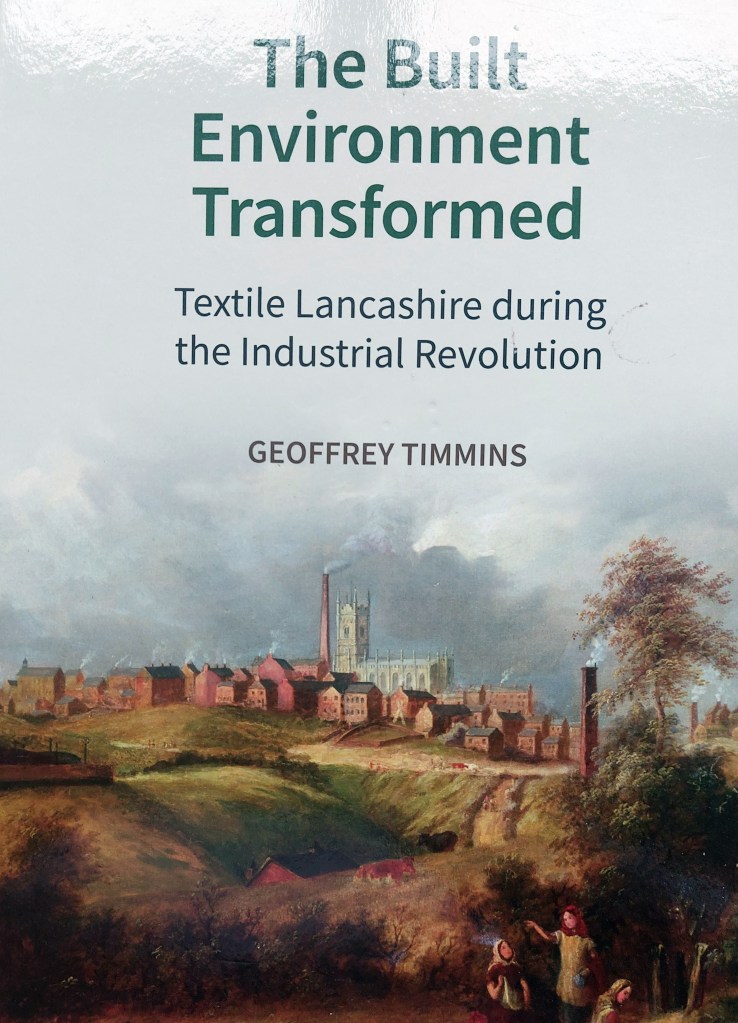
Geoffrey Timmins’ recent Historic England / Liverpool University Press publication ‘The Built Environment Transformed: Textile Lancashire during the Industrial Revolution’ has been announced as the 2022 joint winner of the Association for Industrial Archaeology’s prestigious Peter Neaverson Award for outstanding scholarship in industrial archaeology.
Focussing on Lancashire’s textile district during c.1780 – c.1850, the book adopts a case-study based approach with chapters on the mill remains in the Cheesden Valley near Rochdale; Barrow Bridge factory village near Bolton; the former handloom weavers’ colony at Club Houses, Horwich; Preston’s Winckley Square; Eanam Wharf at Blackburn; and the road between Bromley Cross and Edgworth to the north of Bolton. It will be of interest to all those with an interest in England’s industrial heritage and how the resulting changes impacted on the historic environment. Further details can be found here – https://www.liverpooluniversitypress.co.uk/doi/book/10.3828/9781800856530
CIfA is working with DigVentures to develop guidance which supports and enables public benefit from archaeological projects, as part of a project funded by Historic England. This project aims to embed public participation and engagement firmly into sector practice, with an initial emphasis on archaeology projects delivered within the context of the planning system. The main target audience for the guidance is those who commission, facilitate, or deliver archaeology projects primarily driven by development led activities, but this also includes industrial archaeology and heritage sites.
This short survey forms part of a sector-wide consultation undertaken collaboratively with CIfA. Our aim is to understand the opportunities and challenges in implementing public benefit within development-led archaeology. The two surveys are aimed at two different audience groups; one for those who commission archaeology, including those who prepare project briefs, and the other directed towards project delivery teams.
If you are a practitioner involved in the delivery of archaeological projects, please take this survey.
The survey will be live until the end of January 2023. In the meantime, get in touch with the project team directly if you are interested in hearing more about the project.
Please get in touch with Harriet Tatton (DigVentures – harriet@digventures.com) if you have questions about the survey or have any technical difficulties. Please get in touch with Cara Jones (CIfA – cara.jones@archaeologists.net) if you have questions about the scope of the project
The next round of the AIA’s research grant scheme, for 2023, is now open for applications. These grants are one of the ways in which the Association looks to deliver its aims. The scheme is designed to: encourage individual researchers to study industrial archaeology subjects; encourage the development of industrial archaeology skills within commercial units, the main repository of professional skills in the subject; to support local industrial archaeology and industrial heritage societies in exploring and understanding their local areas; and help to develop the next generation of industrial archaeologists.
In previous years the AIA has supported local society and university researches studying subjects such as Caribbean plantations, 18th century workers’ grafitti, and lime kilns as ways of aiding the understanding, preserving, and presenting industrial archaeology and heritage. The latest round of applications is open until the 31st January 2023. The total fund available in any single year is £1,500 and multiple grants may be given up to this maximum in a single year. The AIA may consider part-funding a wider grant application or project as long as the AIA grant is a significant part of the larger application / project.
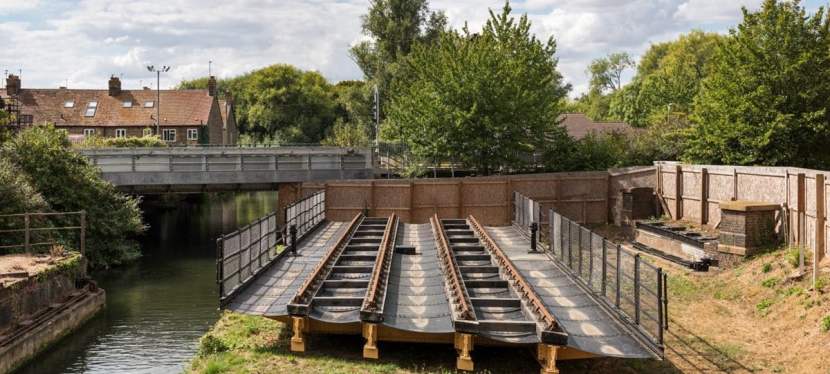
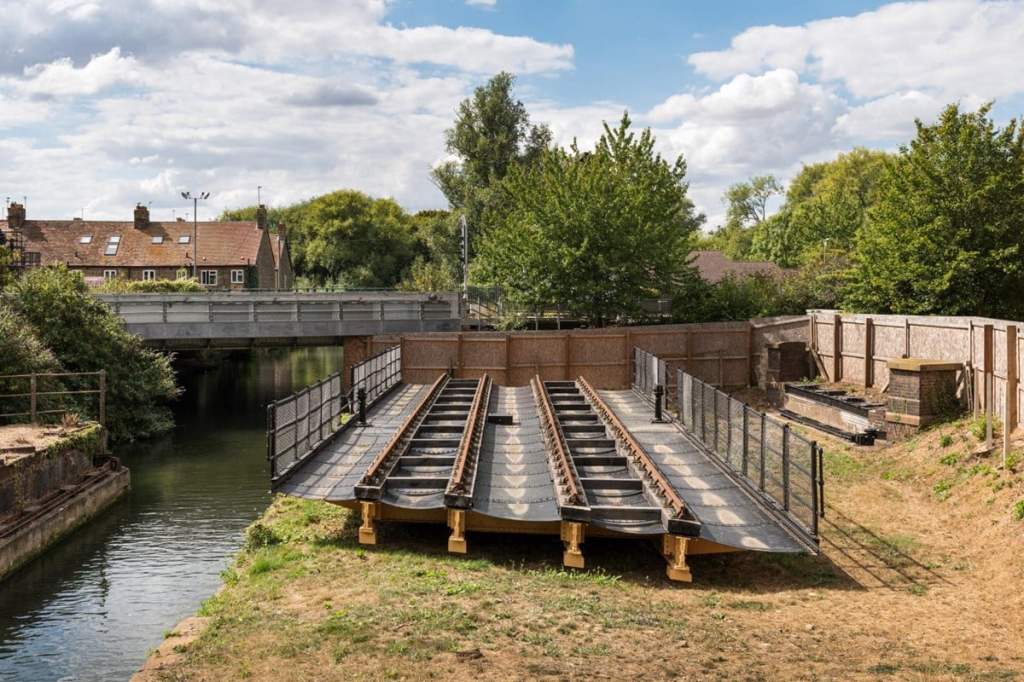
The London Midland and Scottish Swing Bridge after restoration. Image copyright Historic England DP325398
Amongst the industrial heritage sites successfully removed from this year’s Historic England Heritage at Risk Register is the scheduled London Midland and Scottish Railway Swing Bridge – also known as the Rewley Road swing bridge – crossing the Sheepwash Channel in west Oxford. This structure was suffering from severe decay affecting the plating and paint protecting its moving parts.
Designed by engineer Robert Stephenson the railway bridge was built in 1850-1 for the former Buckinghamshire Railway branch of the London Midland and Scottish Railway. It was reconstructed in 1890 and again in 1906. The bridge closed to passenger traffic in 1951 and to goods in 1984. It is one of only two moving bridges on the River Thames, the other being Tower Bridge, London. It is had been in the care of the Oxford Preservation Trust since 2019 who have overseen the restoration with funding from Historic England, Network Rail, and the Railway Heritage Trust and other sources.
The Thornton Education Trust has commended the ‘Look Draw Build@Reading Station’ schools project, a Reading Civic Society project to engage children in architecture, engineering, and railways, in their Inspire Future Generations Awards 2022. In May 2022, the project, which was aimed at children in Reading Primary Schools, reached approximately 450 children.
The Society worked with Gemma Solanellas, an architect and member of the Civic Society, to help with the project’s delivery, which was funded by the Great Western Railway Community Fund. Haslams Estate Agents were Gold Sponsors, and they, along with Stantec Engineers/Architects, Weston & Co Architects, and Reading Civic Society member Matt Andrews, all assisted the Civic Society in delivering project workshops to 15 classes of year 4-6 children from 9 schools, for a total of 450 children.
When the project was finished, the Civic Society decided to submit it to the Thornton Educational Trust for their “Inspire Future Generations Awards.” Thornton Education Trust (TET) is a charity dedicated to incorporating architecture and urban design into children’s education and providing young people with a voice in their community through youth-led design and community participation.
Shortlisting the award, Thornton Education Trust said: “The project helped the local Reading community allowing some 450 children to connect with architecture, engineering, and railway history. The broad approach of the project helped the children to think critically and creatively about their own communities and enhanced their learning journey outside the classroom. Additionally, the touring exhibition brought to a wider audience awareness of how children can learn through architecture and the public space which surrounds them and what they can achieve with simple materials”. The project was commended for its: ‘Excellent engagement with KS2 students, engaging with them through the means of a video to understand the history of the area and then model making. Students looked totally at ease and seem to enjoy the activity. The models were of a very high creative standard’.
Historic England is organising a number of online roundtable discussions with different parts of the heritage sector to discuss the impact of reaching Carbon Net Zero. The project lead, Dan Miles, will be runnign two sessions for Industrial Heritage sites to bring people together to talk about some of the key issues they are encountering. These include how to start measuring emissions, setting out how to write a plan, or covering concerns that are associated more specifically with industrial heritage sites. To join one of the discussions on the 12th or 14th December, please fill in the registration form linked here: https://forms.office.com/r/TN0KiyHN5e
In addition, Historic England’s survey to find out what support small and medium size heritage organisations need to help them on their journey towards reaching carbon net zero is still open. The survey is live until 11th December. Follow this link to fill in the survey: https://www.smartsurvey.co.uk/s/X8E3CQ/.
In November 2022 Historic England published their annual survey of Heritage at Risk. This year there are 4,919 entries on the Heritage at Risk Register. This identifies the listed or scheduled sites that are most at risk of being lost as a result of neglect, decay, or inappropriate development.Industrial archaeology and industrial heritage sites on this list include museums open to the public as well as privately owned buildings and monuments.
Three industrial sites have been saved from decay in the last 12 months and are no longer on the register: the Carriage Works, Bristol; lock and swingbridge on the Broadwater Estate, Greenwich; and the North Park furnace dam, Chichester.
Ten industrial heritage sites were newly added to the register in 2022: Alford Windmill, Lincolnshire; cementation furnace, Sheffield; coal drops, Sheldon; Cross-in-Hand Windmill, Bexhill; Elsecar Ironworks, Barnsley; Heage Windmill, Derbyshire (above); High Mill cornmill & foundry, Alston, Cumbria; Pakenham Windmill near Bury St Edmunds in Suffolk; Papplewick Pumping Station, Nottinghamshire; and Rockingham Kiln in Rotherham.














 Industrial Heritage Networks