Welcome to the Industrial Heritage Networks and Support website. This site is maintained and updated by the Ironbridge Gorge Museum Trust who run the project and the networks. We aim to support industrial heritage in England through networking, information exchange, guidance, and training. Please explore the website and please contribute! For more information you can … Read more Welcome to the IHNs website!
The latest round of online meetings for the Industrial Heritage Networks in England are now taking place. Members will be recieving a ‘save the date’ email this week and then links to the meetings in the following weeks. These meetings are run by the Ironbridge Gorge Musuem Trust as part of the IHSO project. The networks provide a chance for those involved in running and maintaining industrial heritage sites, archaeological monuments, or local societies to get together and discuss current issues and experiences.
One of the current themes being explored by this year’s network meetings is how industrial museums, groups, and those supporting industrial archaeology monuments work with their local authority and how that has changed over the years. Membership of the regional networks is voluntary and free. If you would like to take part please email the IHSO at: mike.nevell@ironbridge.org.uk
Dates for the 2024 Online Industrial Heritage Network meetings:
In April 2024 the new Museum Development regions in England came into being, along with a new set of regional grants.The five English MD regions are now up and running delivering support to museums and heritage groups, including industrial heritage sites, though a variety of training, capacity building, networking, and grant support initiatives.
Details of the first round of grants for museums and heritage groups are as follows:
The 6th East-West Workshop on Industrial Archaeology, sponsored by the Association for Industrial Archaeology, brings together historians and archaeologists from the UK, China, and Brazil to examine the ruins of industry as sources of information (archaeological evidence), inspiration and aesthetic experiences. The workshop delves into the ancient and modern ruins of industry as particular archaeological sites that allow, and demand, different explorations. It will take place online on 11 May 2024, 10.00-12.00 GMT.
The East-West series of workshops aims to exchange ideas and knowledge among Western and Eastern colleagues to build a more international and diverse industrial archaeology. The activity is organised jointly by the Institute for Cultural Heritage and History of Science & Technology (USTB, China), the UK Association for Industrial Archaeology, and its Young Members Board. The speakers will be:
Hilary ORANGE (Swansea University, Wales): “Stuff Kicked Underfoot – The Surfaces of Industrial Ruination”
Xianping GAO (University of Science and Technology Beijing, China): “Excavating the Ruins of the Chinese Porcelain Industry: The Luomachiao Kiln Site in Jingdezhen”
Guilherme POZZER (University of Sheffield, England): “Words in Ruins: Sensorial, Affective and Creative Approaches to the Ruins of Industry”
The Lancashire and Cheshire Antiquarian Society are holding their annual conference on 11th May 2024. The theme is new research, with a focus on local history, family history, and industrial archaeology.It will be held at the friend’s Meeting House, Mount Street, Manchester, M2 5NS from 10am to 3pm.
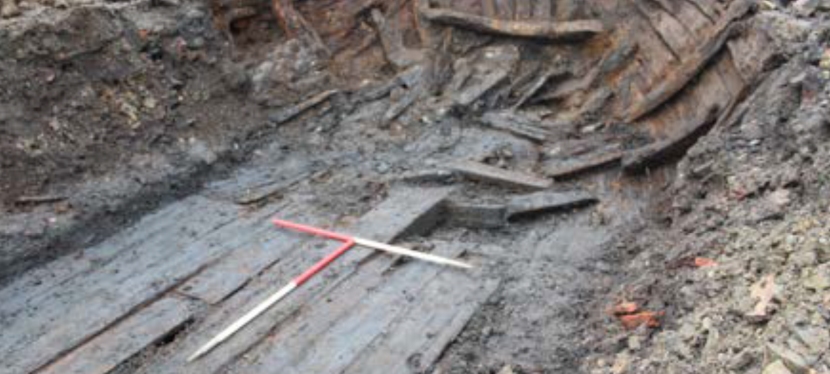
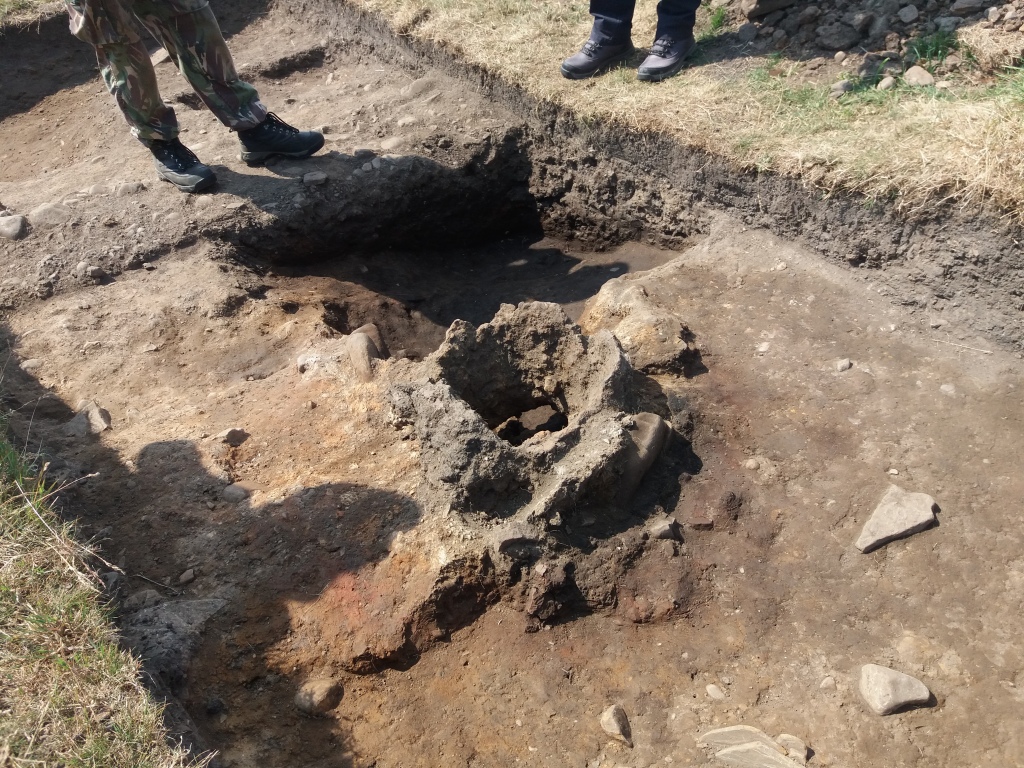
The talks will include presentations Helen Corlett talking about The Cooper at Old Bridge End: Finding a Place in Early 19c Manchester (a micro study of the experience of an artisan-tradesman family migrating to Manchester from the rural north); Neil Coldrick on Medieval Ironworking in Holcombe Valley; and Kelly Griffiths discussing Scuttled: Excavations on the Historic Canal Basin in Rochdale (looking at excavating late 19th century canal boats).
The conference is free to members of the Lancashire and Cheshire Antiquarian Society and the Manchester Local Family History Society, but donations are gratefully accepted. The fee for non members is £12.00 payable to Lancashire and Cheshire Antiquarian Society. Please email secretary@landcas.org.uk to book your place.
A canal boat being excavated at Rochdale.
Medieval bloomery during excavation at Holcombe in 2018.
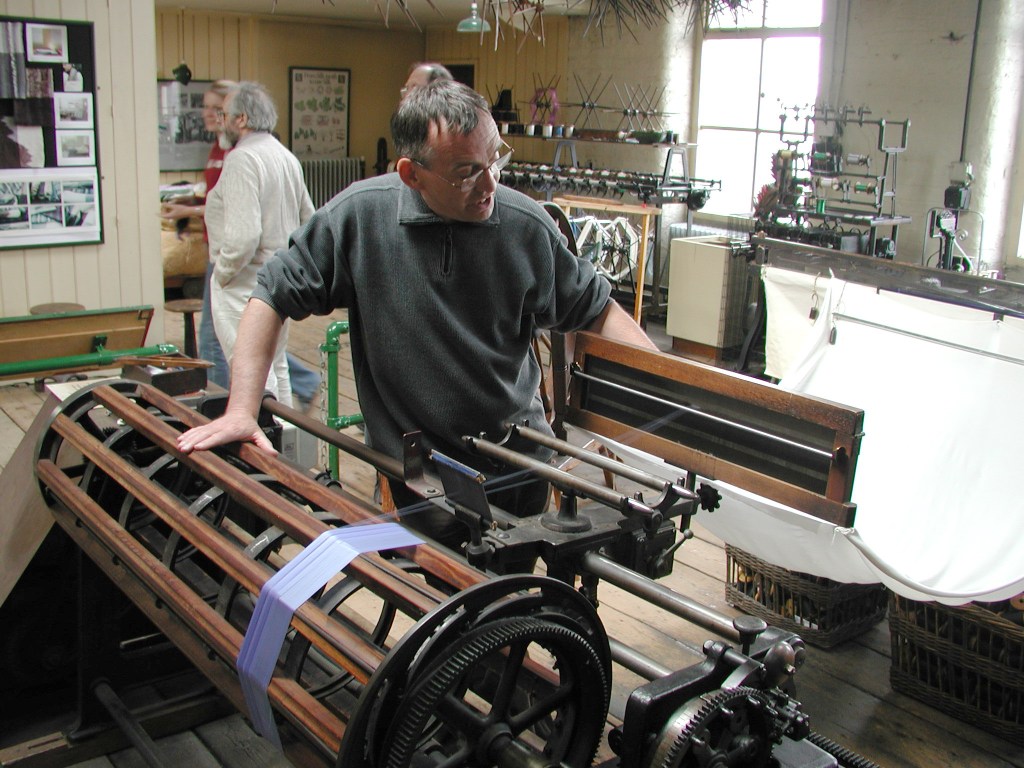
The Grade II listed Paradise Silk Mill in Cheshire reopened to the public in February 2024 after a £309k National Heritage Memorial Fund backed restoration project, supported by building owners Allmand-Smith Ltd. This grant has helped the Silk Heritage Trust acquire a 125-year lease of the top floor of the mill. Paradise Mill, which produced luxury silk goods from 1862 until 1981, will once again be home to silk production, after restoration of two of the mill’s 19th century Jacquard looms.
Silk weaving has now joined the list of Endangered Heritage Craft Skills. The Silk Museum has secured funding from The Radcliffe Trust to develop a plan for the conservation of the looms alongside creative placements for emerging craftspeople. Director of the Silk Museum, Emma Anderson, said: “The looms tell remarkable stories of silk production in Macclesfield. It is essential that they are kept in working order so that visitors can experience the incredible sights and sounds of these historically-important machines. We need to revive and expand the technical knowledge of how to operate and care for them so they can continue to inspire future generations of weavers for years to come.”
The Museum is planning to return more of its collection of 26 Jacquard handlooms to working order . Tour guides at the museum, Daniel Hearn, and Trish Halloran, alongside Rebecca Faragher, who is a trained weaver, are undertaking the conservation of the building’s handlooms, in work supported by funding from the Association for Industrial Archaeology. Hearn said the restoration had required considerable effort. “Establishing a strong foundation in acquiring these skills means we are taking the first critical steps in ensuring that this niche type of Jacquard handloom weaving remains operational within the extraordinary time capsule that is Paradise Mill.” As part of the restoration project textile students Bea Uprichard and Ruth Farris, from Manchester Metropolitan University, have designed and woven a new silk – the first one to be created at the mill in decades.
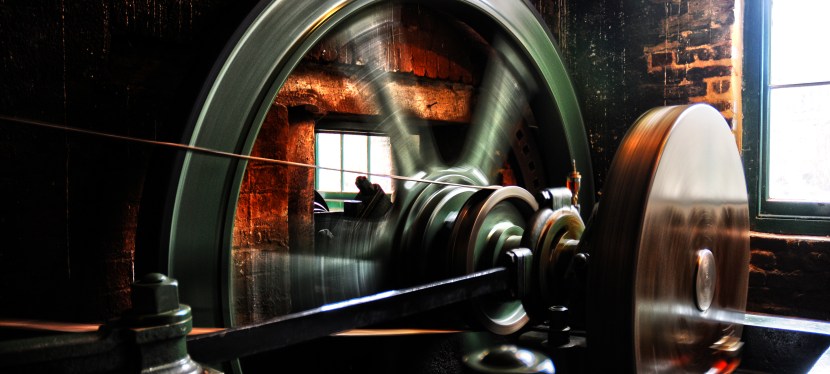
The Working Industrial & Mobile Heritage (WIMH) platform is being developed by umbrella organisations from throughout the industrial and mobile heritage sector in Europe. The European Route of Industrial Heritage (ERIH) is one of the partners in this project. The group is appealing to ERIH members and other industrial heritage sites in the UK for help in collecting evidence to protect a hugely important element of our industrial museums across Europe – their heritage in operation.Other partners currently include: TICCIH – The International Committee for Conservation of the Industrial Heritage; FEDECRAIL – Federation of European Museum & Tourist Railways; FIVA – Federation Internationale des Vehicules Anciens; and the Europa Nostra Industrial & Engineering Heritage Committee.
The working industrial and mobile heritage sector embraces historic machinery at industrial heritage sites and museums, railways, steam ships, road vehicles, and aviation. These all constitute a “social testimony” which ensures that the essential “know how” for the operation of steam powered machinery and combustion engines should not be lost for future generations. Cultural heritage enriches the lives of people and plays a role in enhancing Europe’s social capital. Our sector is also an important resource for economic growth, employment and social cohesion. Working industrial and mobile heritage depends on the continued and limited availability of fossil fuels, like coal and oil-based derivatives. Such fuels remain necessary for the dynamics of heritage machines and vehicles.
As set out in in the 2014 document “Towards an Integrated Approach to Cultural Heritage for Europe”, the European Union is committed to promoting industrial heritage. Our sector is currently facing certain challenges, such as reliance on a limited availability of fossil fuels. The European Union, and other national governments such as the UK throughout Europe, need to take a balanced approach to the almost negligible environmental impact of limited fossil fuel usage by the sector and the legitimate objective of preserving this heritage. For example, assisted also by retaining a continued source of suitable coal at a location within Europe.
A key task of the WIMH partnership is to try to gather as much data as possible of the current annual consumption of our sector, especially of coal but also historic oil based fuels. Considerable efforts have already been made in particular by the railway heritage sector in several countries, including the UK, and research is being undertaken by the historic road transport sector.
Who should respond?
Working from this foundation, the next steps are to build up a picture of at least approximate fossil fuel usage from the industrial heritage sector. This survey is for museums and heritage sites for whom fossil fuel power is needed for continued operation of pumps and industrial machines which form such an important part of the interpretation to the public at our sites. Not only coal-fired boilers and equipment, but also other machinery which operate with petrol, diesel, or other traditional oil based fuels. Follow this link to fill in the survey:
The sixth annual Post-Medieval Archaeology Congress will be hosted by Swansea University in Wales. The meeting will be supported by CHART (Centre for Heritage Research and Training) and CRAM (Conflict, Reconstruction and Memory Research Group), both part of the History, Heritage, and Classics Department (School of Culture and Communication).
The annual Congress is open to all researchers to report current and recent research on any aspect of post-medieval/later-historical archaeology. There is no geographical focus and we welcome papers from around the world. SPMA ask contributors to offer 15-minute papers, which the organisers will arrange into themed sessions, or poster displays. Organised sessions of papers set around a particular research interest or theme are also encouraged. All papers at PMAC24 will be delivered in person.
Please send paper or poster proposals with a title, abstract of up to 150 words, affiliation, and email address. Session proposals should include a title and abstract, as well as a list of speakers. Please send titles and abstracts to conference@spma.org.uk by 26 January.