Welcome to the Industrial Heritage Networks and Support website. This site is maintained and updated by the Ironbridge Gorge Museum Trust who run the project and the networks. We aim to support industrial heritage in England through networking, information exchange, guidance, and training. Please explore the website and please contribute! For more information you can … Read more Welcome to the IHNs website!
The latest round of online meetings for the Industrial Heritage Networks in England are now taking place. Members will be recieving a ‘save the date’ email this week and then links to the meetings in the following weeks. These meetings are run by the Ironbridge Gorge Musuem Trust as part of the IHSO project. The networks provide a chance for those involved in running and maintaining industrial heritage sites, archaeological monuments, or local societies to get together and discuss current issues and experiences.
One of the current themes being explored by this year’s network meetings is how industrial museums, groups, and those supporting industrial archaeology monuments work with their local authority and how that has changed over the years. Membership of the regional networks is voluntary and free. If you would like to take part please email the IHSO at: mike.nevell@ironbridge.org.uk
Dates for the 2024 Online Industrial Heritage Network meetings:
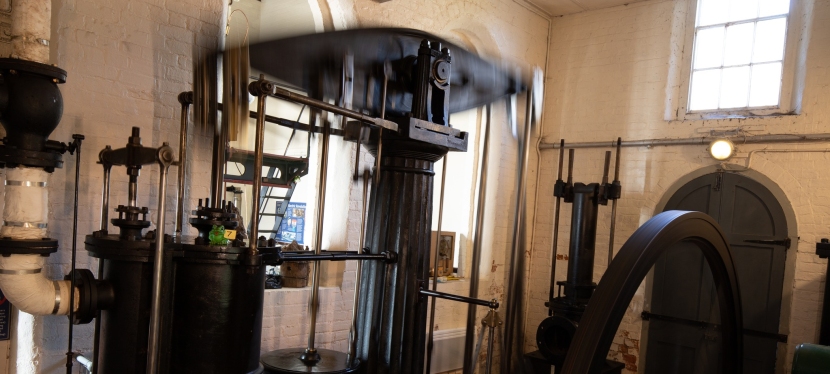
Fifty years ago, a group of heritage enthusiasts founded the Waterworks Museum at the Hereford Victorian Pumping Station, built to supply clean water for Herefordshire. Now a thriving Museum, it has one of the country’s widest collections of pumping engines, including early beam and hot-air machines.
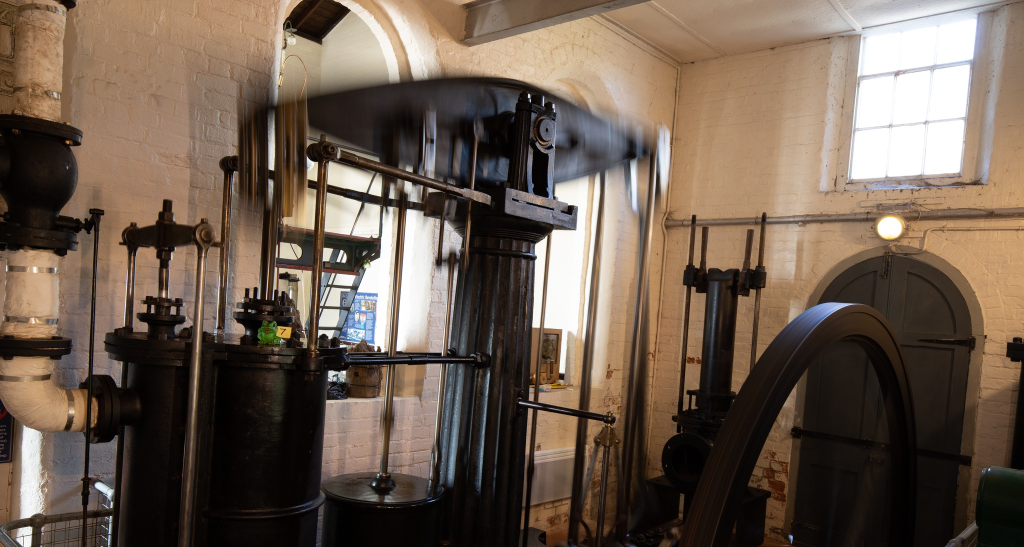
The vision of founding member Stephen Southall with colleagues William Herbert Austin, Herbert Penhale and John Townsend was all about telling the story of water supply and preserving and restoring machinery and engines for public enjoyment. The Victorian building has been restored and includes the original Worth Mackenzie steam engine which used to take water from the Wye and pump it to the adjacent treatments works
Beam engine image coutresy of The Warertwork Museum.
The Museum first opened its doors in April 1975. Ever since, we’ve been caring for the collection and welcoming visitors to this very special place. Our collection has grown to include additional water treatment exhibits and buildings and this tradition continues into 2024 with the inauguration and formal opening of two newly restored exhibits, the Sisson Engine Set and the Brockhampton Set.
Throughout this 50-year period, the museum has been supported financially by two benefactors, Dwr Cymru Welsh Water and the Southall Trust. We remain extremely grateful for the encouragement and endorsement of our benefactors and their continuing long association with the museum. The Museum is run entirely by volunteers and receives no public funding.
“What is astounding is the fact that this wonderful industrial heritage museum remains open and comes to life through its dedicated volunteers” says Jill Phillips, Chair of Trustees & Governance Director. “This was recognised in 2023 with the highest accolade for any volunteer community – the Queen’s Award for Voluntary Service. I am enormously proud and grateful to the efforts, skills and passion of volunteers both past and present. “
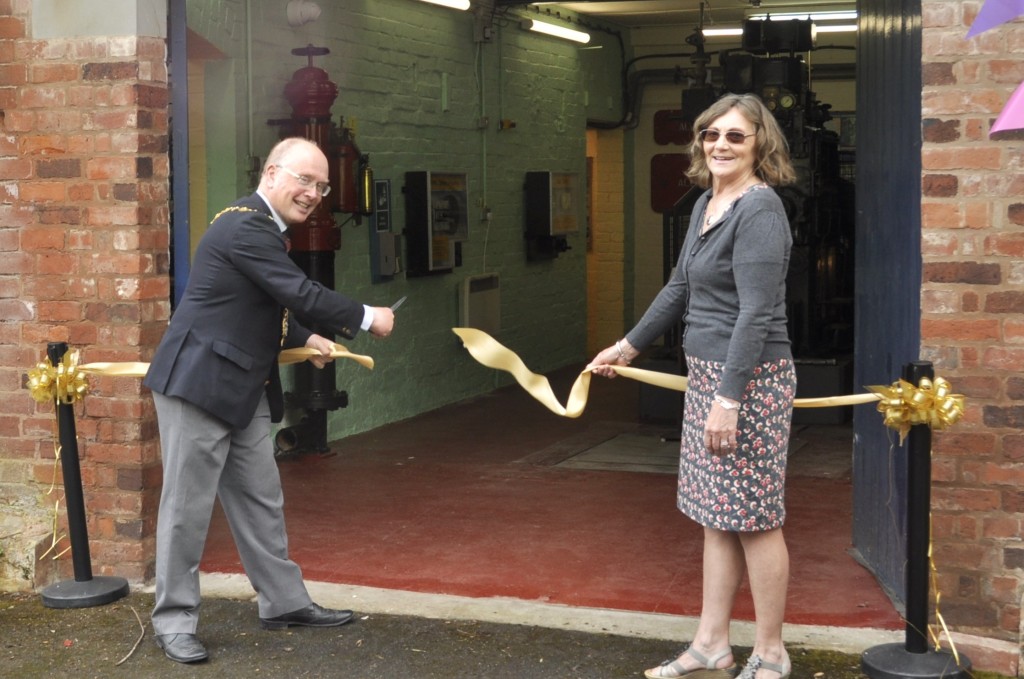
The Mayor odf Hereford opening the new engine display. Image courtesy of The Waterworks Museum
On Sunday 26th May The Right Worshipful, The Mayor of Hereford, Councillor Kevin Tillett led the celebratory opening of the magnificent Victorian building and working engines. In the afternoon, Richard Curtis, former Museum Chairman, officially opened the Sisson Engine display. It was built in 1953 for Reading Technical College (now part of Reading University) to train students and apprentice engineers in the efficient use of steam power.
On 11th August the Trust will be celebrating with visitors the opening of the Brockhampton Set display. Volunteers will be getting engines working and up to steam for opening from 11 am through to 4pm.
This year’s AIA Conference will be taking place in Cardiff from the 4th to 6th October 2024. On the Saturday there will be sessions by four nationally recognised specialists, with the first three exploring elements of Welsh industrial heritage and the fourth sharing results of a wider survey of 600 publicly accessible industrial sites. There will alos be tours of South Wales’ impressive industrial archaeology and heritage remains on the Friday and Sunday.
The speakers for the Saturday of the conference are: Steph Mastoris, former Head of Museums, National Museum Wales; Dr Peter Wakelin, former Secretary of the Royal Commission on the Ancient and Historical Monuments of Wales and now a heritage consultant; Dr David Gwyn, former editor of Industrial Archaeology Review and lead of the Govannon Consultancy; and Dr Paul Belford, CEO of Heritage Innovation.
Their one-hour sessions and the short AGM of the AIA will be streamed live, separated by a 30-minute lunch break, and the afternoon will end with presentations by this year’s Award winners ahead of the Conference Dinner and prize giving.
Conference Tours
On the Friday afternoon and Sunday there are optional tours.
Friday afternoon 4th October
Optional tours – choose either TOUR A: National Waterfront Museum, Swansea or TOUR B: Industrial tour of the Lower Swansea Valley
Sunday 6th October
Optional tours – choose either TOUR C: Big Pit, the National Coal Museum of Wales Or, TOUR D: Blaenavon Ironworks
The latest round of online Industrial Heritage Network (IHN) meetings will be taking place online over the summer. These free biannual network meetings, covering ten areas in England, began 2018. Since 2020 one meeting per year has been online. The theme for the current round of meetings will be maintenance and skills.
Funded through a grant by Historic England, and run by the Ironbridge Gorge Museum Trust (IGMT), these forums offer a chance for industrial heritage groups and museums to meet regionally and share common experinces with other sites and people in managing our rich industrial heritage. The dates for the summer round of online meetings is as follows:
Wednesday 19th June – London
Wednesday 26th June – North West
Wednesday 3rd July – South West
Monday 8th July – East Midlands
Wednesday 10th July – West Midlands
Monday 15th July – East of England
Tuesday 16th July – Yorkshire
Monday 22nd July – Cornwall & Devon
Wednesday 26th June – North East
Thursday 25th July – South East
Each meeting will start at middaly and last up to one and half hours. IHN members willbe emailed details on how to join by the networks welcome anyone intertetd in learnignmore about the industrial archaeology and heritage of a region. Contact the IHSO, Dr Michael Nevell, at IGMT for more details be email: mike.nevell@ironbridge.org.uk
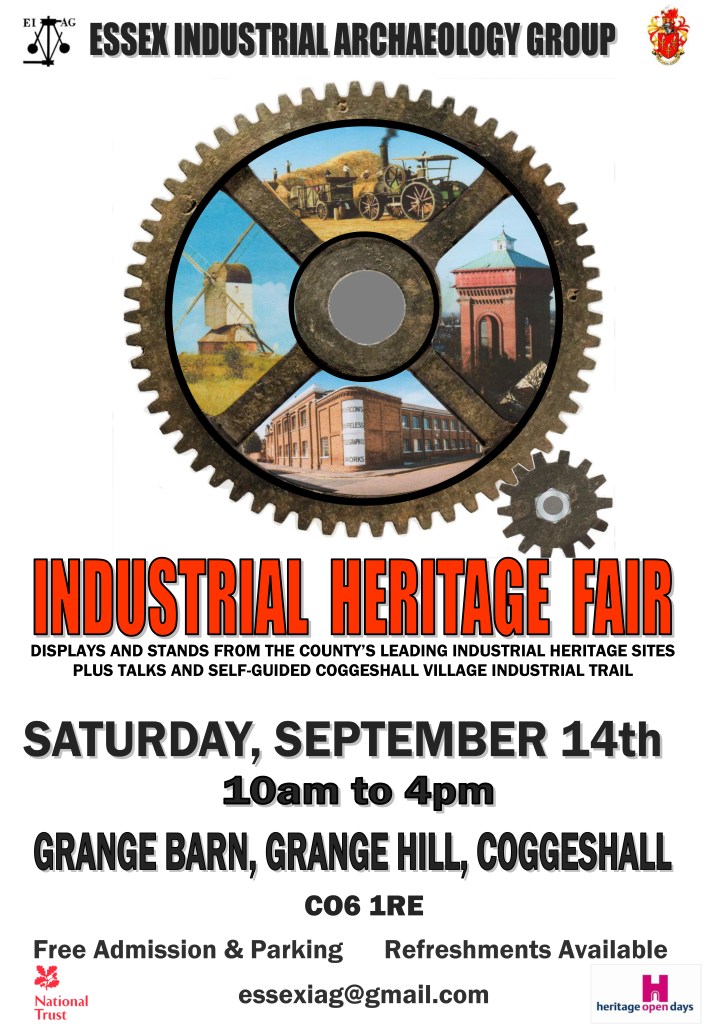
The Essex Industrial Archaeology Group biennial Industrial Heritage Fair will take place on 14th September at the Grange Barn, in Coggeshall, 10am to 4pm. This event is running in partnership with the National Trust and is part of Heritage Open Days 2024.
There will be exhibits by Essex societies and industrial sites covering such industries as: agricultural engineering; public water supply; brick-making; metal windows; company villages. There will also be an exhibition of woodcarving tools used by local master carver Bryan Saunders until his death in 1975. The Saunders Collection is a fascinating goldmine of chisels, hammers, knives, measuring devices and other carving tools.
In addition, there are four short talks on local industries including the cloth trade and metal working, and attendees can take a self-guided tour of industrial sites in Coggeshall, including former maltings & breweries, textile factories, and the isinglass factory. Coggeshall Museum, Abbey Watermill, and the Village Smithy will also be open.
The Etruria Industrial Musuem is once more running its popular, family friendly, festival on 1st and 2nd June. This year’s theme is ’50th Anniversary of the Reopening of the Caldon Canal to Navigation’. The two day festival will feature a gathering of historic and interesting narrow boats moored along the Caldon Canal, Shirley’s 1857 Potters’ Mill in steam, music, dance, arts events and more.
Open daily from 11.00am to 5.00pm daily the event includes:
Historic Canal Boats
Entertainment and Music
Street food, Tea room and Beer tent
Puppetry and Performance
Craft Demonstrations and Stalls
Children’s Games and Activities
Shirley’s Victorian Potters’ Mill in Steam (12.30 to 4.30pm)
Blacksmith Demonstrations in the Forge
Entrance to the festival is free but there is acharge for access to Shirley’s Bone and Flint Mill.
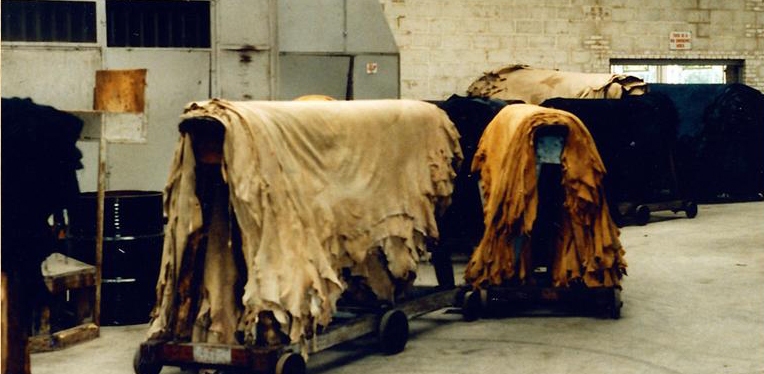
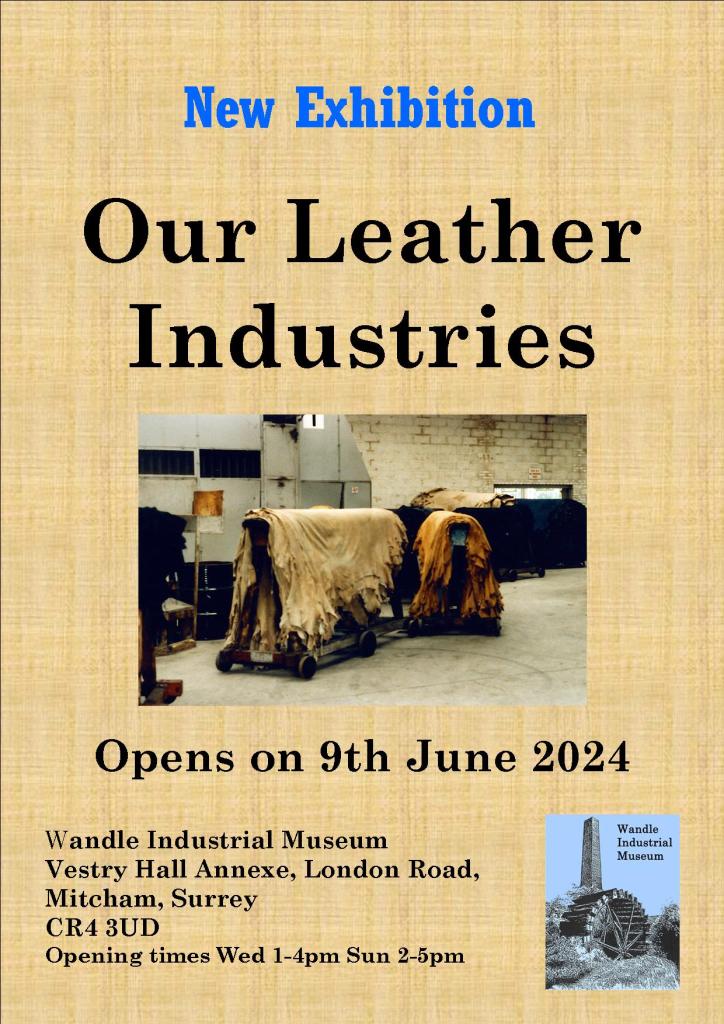
The latest exhibition by the Wandle Industrial Musuem opens on 9th June 2024. ‘Our Leather Industries’ looks at the history of leather making and some of the products produced in the Wandle Valleyin the 19th and 20th centuries.
The exhibition can be found at the Vestry Hall Annexe, London Road, Mitcham, Surrey. Open on Wednesdays, 1-4pm and Sundays 2-5pm, the exhibtion is free to enter.
The deadline for the Industrial Heritage Sites in England Survey 2024 has been extended to the 14th June. The Ironbridge Gorge Museum Trust and Heritage Innovation are undertaking this survey of the c.600 publicly accessible and protected industrial heritage sites in England. Funded by Historic England, the 2024 survey is gathering data on these sites which will be compared with similar reports undertaken in 2008 and 1998.
The original deadline for response was the 10th May, but in order to capture as many replies as possible we have decided to extend the deadline and will continue to accept responses until 14th June. We hope this will allow as many sites as possible to take part in the once-in-a- generation survey. This work is being carried out by Heritage Innovation, https://heritageinnovation.org/, and can be accessed here:
The questionnaire will take around 15-30 minutes to complete. Please do drop the project a line if you need any support to complete the survey. If you require this questionnaire in an alternative format or have any questions about the survey please let us know at IHSO@ironbridge.org.uk. For general queries contact Zoe Arthurs via email on zoearthursheritage@gmail.com or call 07581 405835.
Join textile artist and London National Park City Ranger Elly for a walk along South London’s River Wandle. The Wandle was a heavily industrialised river in the 18th and 19th centuries and was declared “dead” in the 1960s. It has been restored to life over the last 50 years and is now a beautiful chalk stream habitat and home to a wide variety of wildlife.
Travel back in time as you travel along the Wandle Trail and find out about the Wandle’s rich history as a site of textile production, and how this history is a microcosm of the global textile industry today. Learn about the challenges that the Wandle faces from single use plastic pollution and wastewater discharges, and how local activists have been working to improve this environment for years. The walk will take you from restored chalk stream to culverted urban river, from new housing developments to National Trust gardens, from modern industry to the repurposed buildings of the Liberty Print Works.
Start at 11am at Hackbridge Community Gardens, Nightingale Road, Carshalton SM5 2EN. Nearest station: Hackbridge (Southern, Thameslink)
Finish 1pm at Merton Abbey Mills, Watermill Way, London SM19 2RD. Nearest Station: Colliers Wood (Northern Line)
Access: this walk is over flat terrain, and most of the footpaths have hard surfaces. There are some sections that haven’t been surfaced and these can become muddy in wet weather so please wear appropriate footwear. There are toilets at the LIDL opposite Hackbridge station, at Morden Hall Park and Merton Abbey Mills.
The 6th East-West Workshop on Industrial Archaeology, sponsored by the Association for Industrial Archaeology, brings together historians and archaeologists from the UK, China, and Brazil to examine the ruins of industry as sources of information (archaeological evidence), inspiration and aesthetic experiences. The workshop delves into the ancient and modern ruins of industry as particular archaeological sites that allow, and demand, different explorations. It will take place online on 11 May 2024, 10.00-12.00 GMT.
The East-West series of workshops aims to exchange ideas and knowledge among Western and Eastern colleagues to build a more international and diverse industrial archaeology. The activity is organised jointly by the Institute for Cultural Heritage and History of Science & Technology (USTB, China), the UK Association for Industrial Archaeology, and its Young Members Board. The speakers will be:
Hilary ORANGE (Swansea University, Wales): “Stuff Kicked Underfoot – The Surfaces of Industrial Ruination”
Xianping GAO (University of Science and Technology Beijing, China): “Excavating the Ruins of the Chinese Porcelain Industry: The Luomachiao Kiln Site in Jingdezhen”
Guilherme POZZER (University of Sheffield, England): “Words in Ruins: Sensorial, Affective and Creative Approaches to the Ruins of Industry”











 Industrial Heritage Networks