Welcome to the Industrial Heritage Networks and Support website. This site is maintained and updated by the Ironbridge Gorge Museum Trust who run the project and the networks. We aim to support industrial heritage in England through networking, information exchange, guidance, and training. Please explore the website and please contribute! For more information you can … Read more Welcome to the IHNs website!
Historic England’s Everyday Heritage Grant programme aims to shine a light on the diversity of heritage and is part of Historic England’s commitment to ensuring that a wider range of people are able to connect with, enjoy and benefit from the historic environment. Building on the success of Historic England’s first round of Everyday Heritage Grants in 2022, they are funding an additional 56 projects that celebrate working class histories and the historic places that make up everyday life.
The grants are for creative projects that focus on heritage connecting people to historic places, specifically those people and places that are overlooked or underrepresented. The community-led projects will explore the diverse stories of people and places, such as homelessness in Waterloo, a pen factory in Newhaven, and roller-skating in Birmingham. The total amount of funding awarded by Historic England is £875,000, ranging from £6,800 to £25,000 per individual project.
Booking is now open for a major conference at Ironbridge looking at the life, work, and legacy of L T C Rolt on the 10th May 2024. L T C Rolt, also known as Tom, was a renowned practical engineer and prolific author who wrote books and articles on industrial history, canals, railways, and cars as well as fiction. Rolt was an early supporter of the work of the Ironbridge Gorge Museum Trust and is regarded as one of the founders of the 20th century waterways and railway preservation movements. He was also involved in helping to establish the Association for Industrial Archaeology.
To mark the 50th anniversary of his death, Ironbridge Gorge Museum Trust has partnered with academics from Keele University to host a conference on Friday 10th May which will celebrate his life and the continuing legacy of his work. There will also be conference-related events on the 9th and 11th May.
World Heritage UK, in conjunction with Bangor University, is delighted to be hosting the 2024 World Heritage workshop on the 10th and 11th April 2024. The workshop will explore aspects of Industrial World Heritage as well as broader topics that will be of interest to all World Heritage and heritage professionals.
The two-day workshop will cover topics such as regeneration, events, tourism, STEM, intangible heritage, slavery and more. Included are afternoon guided site visits to Dinorwig Quarry, the National Slate Museum, Penrhyn Castle and Quarry and the Slate Landscape of NW Wales WHS, refreshments and buffet lunches. There is a social event on Wednesday evening with local food and live local music. Tickets for this social night are sold separately.
In-person workshop tickets are £100 for National Trust members, £115 for non-National Trust members and £75 for digital tickets. The social night is £30 pp. Sadly there is no wheelchair access to the social night.
There you’ll also find details on how to get to Bangor, and suggestions on where to stay, including discounted accommodation at the university’s management centre.
Eleven exhibits missing from the National Waterways Museum in Cheshire are thought to have been stolen from its collection between Friday 9th and Monday 12th February 2024. The Canal and River Trust, who run the museum said that a recent ‘significant’ cataloguing exercise had allowed it to quickly spot that exhibits were missing. The museum’s Island Warehouse room, where smaller objects are displayed and where the thefts are thought to have taken place, has been temporarily closed.
A security review is now being completed and the museum is working with police to recover the items. The Canal & River Trust, which operates the museum, has released a document which details the missing exhibits. Included is a model boat, along with several small model engines and three large ‘Tilly’ lamps.
The Canal & River Trust said that “We understand that a closure of part of our museum is disappointing for visitors and thank everyone affected for their patience and support. We hope people appreciate how serious such a theft is and the importance of the investigation and security review currently taking place.”
Anyone with information into the missing items is being urged to speak to police.
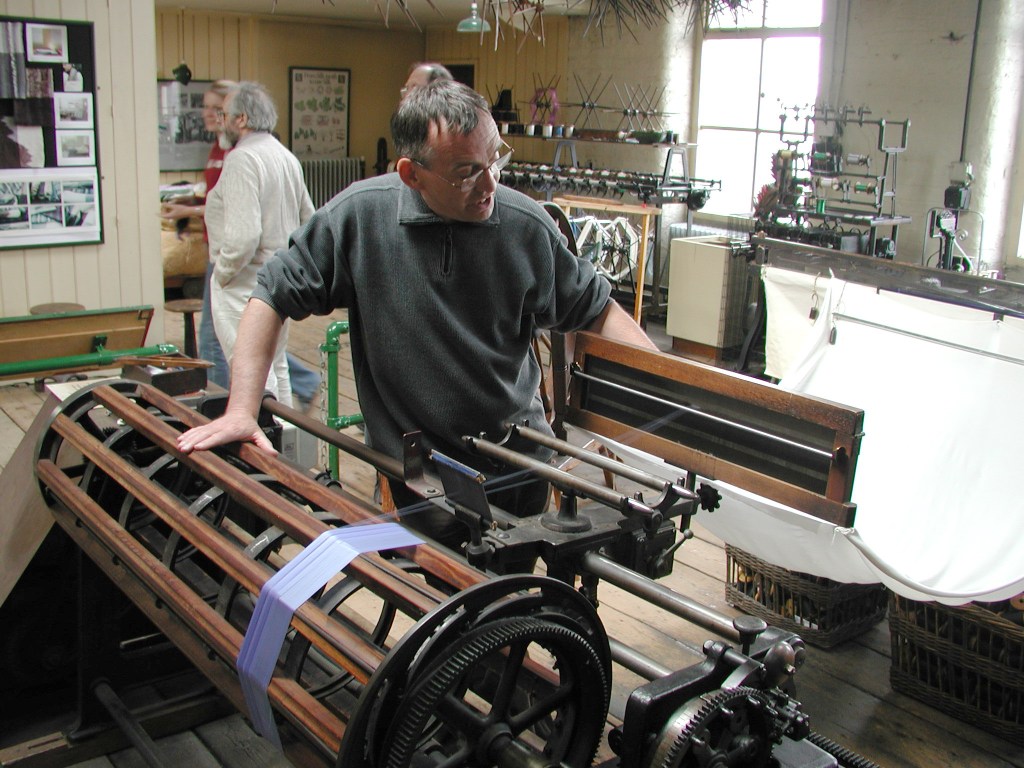
The Grade II listed Paradise Silk Mill in Cheshire reopened to the public in February 2024 after a £309k National Heritage Memorial Fund backed restoration project, supported by building owners Allmand-Smith Ltd. This grant has helped the Silk Heritage Trust acquire a 125-year lease of the top floor of the mill. Paradise Mill, which produced luxury silk goods from 1862 until 1981, will once again be home to silk production, after restoration of two of the mill’s 19th century Jacquard looms.
Silk weaving has now joined the list of Endangered Heritage Craft Skills. The Silk Museum has secured funding from The Radcliffe Trust to develop a plan for the conservation of the looms alongside creative placements for emerging craftspeople. Director of the Silk Museum, Emma Anderson, said: “The looms tell remarkable stories of silk production in Macclesfield. It is essential that they are kept in working order so that visitors can experience the incredible sights and sounds of these historically-important machines. We need to revive and expand the technical knowledge of how to operate and care for them so they can continue to inspire future generations of weavers for years to come.”
The Museum is planning to return more of its collection of 26 Jacquard handlooms to working order . Tour guides at the museum, Daniel Hearn, and Trish Halloran, alongside Rebecca Faragher, who is a trained weaver, are undertaking the conservation of the building’s handlooms, in work supported by funding from the Association for Industrial Archaeology. Hearn said the restoration had required considerable effort. “Establishing a strong foundation in acquiring these skills means we are taking the first critical steps in ensuring that this niche type of Jacquard handloom weaving remains operational within the extraordinary time capsule that is Paradise Mill.” As part of the restoration project textile students Bea Uprichard and Ruth Farris, from Manchester Metropolitan University, have designed and woven a new silk – the first one to be created at the mill in decades.
Judged by families, this award celebrates museums, galleries, and heritage attractions that go the extra mile to provide an excellent family friendly experience. Nominations open on 19 March 2024 and close on 3 June 2024.
Each year Kids in Museums awards the prize to one museum, gallery, historic home, or heritage site that has made outstanding efforts to welcome children and families and respond to their feedback. It is the only museum award in the UK to be judged by families. The overall winner of the Family Friendly Museum Award 2023 was Craven Museum in Skipton Town Hall, with five other categories celebrating family friendly museums.
In late 2023 the Arts Council England (ACE) commissioned a report on public investment in English museums. The report, published in January 2024, shows that local authority funding per capita in museums during the 14 years from 2009-10 to 2022-23 reduced by 23%. It also shows that the East of England has above average spend per capita, whilst Northern and South West England have the highest levels of local authority funding for museums.
The research was commissioned with the aim of producing a comprehensive set of data that can support museums, local authorities, and stakeholders with budget planning, and encourage a strategic and collaborative approach to considering the funding challenges facing both museums and local government. The report concludes with a set of potential actions in response to changes in local authority funding, highly relevant to industrial heritage museums and sites, focussing on:
The Working Industrial & Mobile Heritage (WIMH) platform is being developed by umbrella organisations from throughout the industrial and mobile heritage sector in Europe. The European Route of Industrial Heritage (ERIH) is one of the partners in this project. The group is appealing to ERIH members and other industrial heritage sites in the UK for help in collecting evidence to protect a hugely important element of our industrial museums across Europe – their heritage in operation.Other partners currently include: TICCIH – The International Committee for Conservation of the Industrial Heritage; FEDECRAIL – Federation of European Museum & Tourist Railways; FIVA – Federation Internationale des Vehicules Anciens; and the Europa Nostra Industrial & Engineering Heritage Committee.
The working industrial and mobile heritage sector embraces historic machinery at industrial heritage sites and museums, railways, steam ships, road vehicles, and aviation. These all constitute a “social testimony” which ensures that the essential “know how” for the operation of steam powered machinery and combustion engines should not be lost for future generations. Cultural heritage enriches the lives of people and plays a role in enhancing Europe’s social capital. Our sector is also an important resource for economic growth, employment and social cohesion. Working industrial and mobile heritage depends on the continued and limited availability of fossil fuels, like coal and oil-based derivatives. Such fuels remain necessary for the dynamics of heritage machines and vehicles.
As set out in in the 2014 document “Towards an Integrated Approach to Cultural Heritage for Europe”, the European Union is committed to promoting industrial heritage. Our sector is currently facing certain challenges, such as reliance on a limited availability of fossil fuels. The European Union, and other national governments such as the UK throughout Europe, need to take a balanced approach to the almost negligible environmental impact of limited fossil fuel usage by the sector and the legitimate objective of preserving this heritage. For example, assisted also by retaining a continued source of suitable coal at a location within Europe.
A key task of the WIMH partnership is to try to gather as much data as possible of the current annual consumption of our sector, especially of coal but also historic oil based fuels. Considerable efforts have already been made in particular by the railway heritage sector in several countries, including the UK, and research is being undertaken by the historic road transport sector.
Who should respond?
Working from this foundation, the next steps are to build up a picture of at least approximate fossil fuel usage from the industrial heritage sector. This survey is for museums and heritage sites for whom fossil fuel power is needed for continued operation of pumps and industrial machines which form such an important part of the interpretation to the public at our sites. Not only coal-fired boilers and equipment, but also other machinery which operate with petrol, diesel, or other traditional oil based fuels. Follow this link to fill in the survey:
Historic England has added an interactive map to its Historic Gas Industry webpages. The new feature allows researchers to search for manufactured gas sites in England from the 19th and 20th centuries and to view summary details about each site. This new feature expands the resources already available for those wishing to research the local manufacture of gas, which already includes a detailed overview report on the history of the manufactured gas industry in England, a heritage assets guide, and advice on recording such sites.
The new interactive map shows the location of hundreds of sites including listed gasworks buildings and gasholders, non-designated surviving gasworks buildings and gasholders, possible surviving structures related to the industry, sites with only below ground evidence, and sites only known from map evidence. The map also has links to the relevant Aerofilms Collection of aerial photographs where these show these gas industry sites, a database which is held by Historic England.
The base of the the 1864-5 gasholder at Quarry Bank Mill, Cheshire. Gas manufacture on the site ceased in 1904, but the gasholder was retained for several years thereafter to cope with periods of peak demand. Image copyright: Dr Michael Nevell.
Arts Council England have announced the next stage of funding from the Cultural Development Fund. This is part of the wider Cultural Investment Fund which is funded by the Department for Media, Culture, and Sport and delivered by Arts Council England. In the past three rounds several industrial heritage sites and museums have been successful in applications, such as Elsecar Heritage Centre in Barnsley.
Stage Four has a total of £15.2 million on offer, with grants ranging between £2 million and £5 million. In order to be eligible for Round Four, you must be either a local partnership led by a local authority, a Local Enterprise Partnership, or another appropriate body. The Cultural Development Fund aims to ‘unlock local growth, productivity and regenerate communities through capital investment in culture’. This money will act as a ‘boost’ for cultural venues across the country and improve access to culture. The Arts Council encourages applications from ‘Places that have a strategic vision for their development and can demonstrate both cultural maturity and commitment to culture-led growth but need investment in physical and/or digital infrastructure or other assets to accelerate and maximise their impact.’
The window for expression of interest for these grants opened on Monday 5th February 2024. The deadline for expressions of interest closes at 12pm on Friday 15th March 2024. Thereafter, applications open on Monday 8th April 2024, and the final deadline for submission will be at 12pm Friday 17th May 2024. To view the full announcement and to check your eligibility visit the Arts Council England website.