Welcome to the Industrial Heritage Networks and Support website. This site is maintained and updated by the Ironbridge Gorge Museum Trust who run the project and the networks. We aim to support industrial heritage in England through networking, information exchange, guidance, and training. Please explore the website and please contribute! For more information you can … Read more Welcome to the IHNs website!
In the summer of 2021 theForncett Industrial Steam Museum launched an urgent funding appeal. This was for£14,000 to cover the cost of replacing the old steam pipework feeding some of the 18 full-sized steam engines on display, and getting this new system certificated.
The IHN East of England member launched an on-line appeal in June 2021 and this has now (October 2021) reached its target, with support coming from the friends of the museum and various other supporters. These funds will allow the steam pipeline system to be replaced over the winter, giving time for it to be certificated for full steaming in Spring 2022.
Hick Hargreaves engine, manufacture din Bolton, on display the Forncett Industrial Steam Museum.
The National Trust are looking for a Consultant to write a Conservation Plan for the Levant Mine and Beam Engine, Cornwall. The tin and copper mine is part of the Cornish Mining World Heritage Site. Like its neighbour Botallack, Levant Mine lies dramatically draped over nearly a kilometre of cliff. Established around 1748 from an amalgamation of three earlier mines, it was worked until 1930. The National Trust has been involved with its care since 1967.
The National Trust owns the western third of the mine including the Levant Engine. Cornwall Council owns the rest of the surface remains of the mine. The Engine Houses and Headframes are Grade II Listed structures, as is the Pumping Engine House. The Skip Shaft Headfame is also Grade II listed. The steam winding engine is the world’s oldest Cornish-type beam engine still in its original engine house.
Queries about the Conservation Management Plan brief can be emailed to: Amanda.Day@nationaltrust.org.uk. The deadline for tender submissions is 31 October 2021.
Mining spoil heaps in North Yorkshire. Copyright Historic England.
For the first time ever, Historic England has made the results of over30 years of aerial photograph mapping projects freely available online. The public can use the new research tool to explore heritage from ancient settlements to secret Cold War military installations, or to see the complex archaeological landscapes of Hadrian’s Wall, Stonehenge, and industrial landscapes.
The Aerial Archaeology Mapping Explorer lets you explore the layers of archaeology in and around your local place. You can browse the map and zoom in to the location you’re interested in or search by postcode, address or place name. Follow this link to explore the website: https://historicengland.org.uk/research/results/aerial-archaeology-mapping-explorer/
The map brings together the results of numerous projects undertaken by specialists at Historic England and its predecessor organisations since the late 1980s, as well as many partner organisations. Hundreds of thousands of aerial photographs, ranging in date from the 1920s to the present, have been studied. More recently, innovative technologies such as lidar – airborne laser scanning – and web-based sources, such as Google Earth, have been added to the sources used. Every site has a simple description with links to the full Historic Environment records held online. For most of the areas there is also a free report detailing the highlights and new discoveries encountered in each project.
The Aerial Archaeology Mapping Explorer, alongside complementary resources such as Historic Environment Records available via Heritage Gateway, offers a springboard to further investigation, whether for research purposes or simply curiosity about the area where you live. It should be especially useful for researching industrial archaeology and heritage sites.
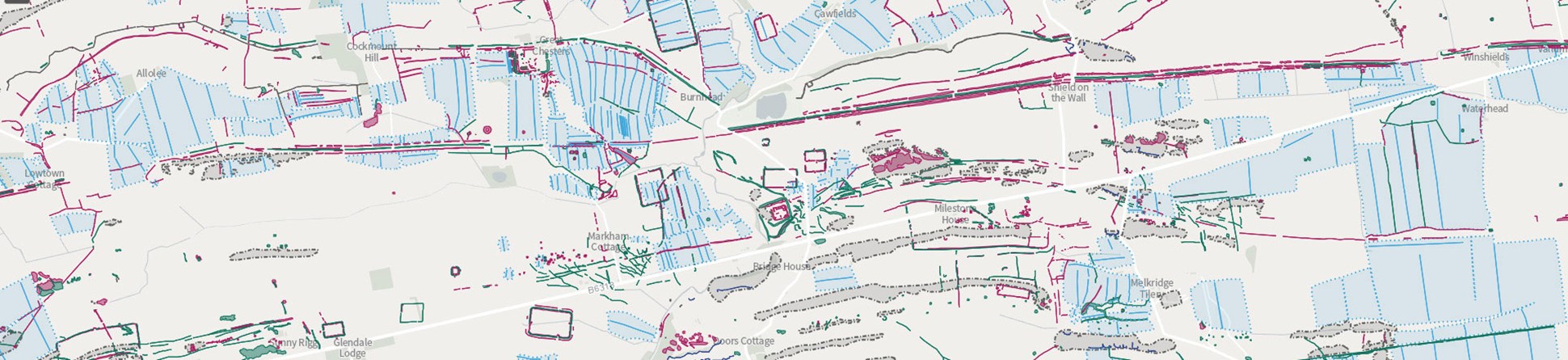
An example of how the aerial photographs and LIDAR data are interpreted on the new Historic England mapping explorer.
Historic England has published a new report exploring the potential of under-used and vacant mills. It identifies their possible contribution to rebalancing the country’s economy and improving environmental stability, and highlights regeneration success stories since 2017.
Textile mills were the original Northern Powerhouse. From the late 18th century onwards, they drove forward the industrial revolution. They triggered technical innovation, stimulated new trade and transformed the transport network. Silk, cotton, and woollen production shaped the landscape, economy, and communities of Greater Manchester, Lancashire, and Yorkshire. However, with the 20th century decline in national textile manufacturing, many of these monumental and characterful buildings face uncertain futures.
‘Driving Northern growth through repurposing historic mills’ re-assesses the re-use potential of under-used and vacant mills, identifies their possible contribution to rebalancing the country’s economy, and improving environmental sustainability, and highlights regeneration success stories since 2017.
The Forncett Industrial Steam Museum, established in 1981 by Dr Rowan Francis, tells the story of the development of steam power in Great Britain from 1698 to the present day. 18 full-sized engines spanning the industrial revolution have been rescued and restored to working order on the site. They are demonstrated to the public on steam days including one of the steam engines that was used to open Tower Bridge in London. Based in southern Norfolk, this small, independent, volunteer-run museum became a Charitable Incorporated Organisation in 2018.
A boiler inspection in June 2021 concluded that the whole pipeline system would have to be replaced with mill certified seamless steam pipe and certified wrought iron fittings and valves, in order to obtain renewed public liability insurance. Consequently, the museum volunteers have had to strip out the entire pipe system from boiler to each engine for replacement with new piping.
Not only does this mean that the museum will not be in full steam until May 2022, but the museum also needs to raise the £14,000 it will cost to replace the old pipework with the new material. The museum has set up on online appeal, with the aim of getting the engines back in steam for next spring. To donate follow this link: https://www.forncettsteammuseum.co.uk/
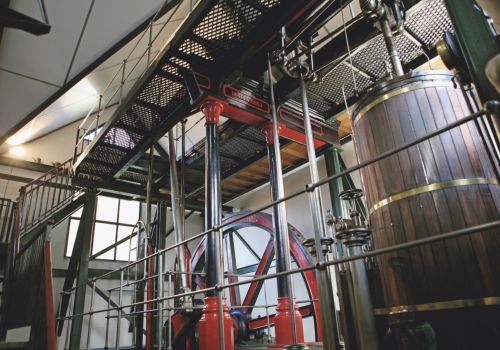
The Hopwas Beam Engine ‘Spruce’, installed at the Tamworth Pumping Station in 1879
Following the success of the Heritage Digital project, the National Lottery Heritage Fund ‘Digital Skills for Heritage’ funding stream is now supporting the new Heritage Digital Academy. Dot Project has joined the Heritage Alliance, Charity Digital, Naomi Korn, and Media Trust to further the consortium’s vision of growing the heritage sector’s skills and increasing the adoption of digital through this new initiative.
Heritage Digital Academy will provide all types of heritage organisations with the tools they need to make effective use of digital within strategic and operational planning. Over the next 12-months (2021-2022), heritage organisations will have the opportunity to work with each other and expert trainers in a number of different training cohorts, modules, events, and webinars focusing on the biggest organisational challenges shared by the sector.
Applications for the first cohorts of the Heritage Digital Academy are now open. These cohorts give you access to four modules based on some of the sectors biggest challenges. With expert trainers, live and pre-recorded sessions and private forums, you’ll also be able to continue learning in a way that suits you best and alongside like minded heritage professionals.
To learn more and keep up-to-date with Heritage Digital Academy or to sign up follow this link: https://heritage-digital.org/
Crofton Beam Engines is one of a handful of sites in England which still runs its stationary beam engines on steam and still performs its original function in its original location. Built over 200 years ago it keeps the top levels of the Kennet and Avon Canal supplied with water.
The two engines and engine house are maintained by the Kennet and Avon Canal Trust and run by dedicated volunteers bringing a wide range of skills to keep Crofton steaming. Although entry charges meet many of their day-to-day costs, the Charity needs to fundraise to meet the cost of major repairs and projects.
The boiler at Crofton is inspected annually to make sure that it is safe to operate. A full survey was undertaken in May 2021 to identify all the work likely to be needed to enable the boiler to continue in operation for the next ten years. If the Charity is to keep the engines in steam during 2022 and beyond, then essential maintenance is needed on the boiler this winter. This will cost around £30,000 and should secure the future of the boiler for a decade. With the impact of COVID still being felt, the charity has launched an appeal to help raise these funds.
WhitchurchSilk Mill has launched a Crowdfunder appeal for £6,000 for urgent and unexpected repairs to the waterwheel that powers the site. The mill is the last example in the country of a silk mill that is still producing silk using historic machines and training highly skilled weavers to use these pieces of living history. Built in 1813, it is Britain’s oldest working silk mill and each year is visited by thousands of people who discover its role in the nation’s industrial silk revolution.
Last restored in 2014, the eighteen months of COVID lockdown and inactivity has hastened the deterioration of many of the wooden parts of the cast-iron waterwheel. The ‘starts’ which attach the planks to the iron frame need replacing, as do the ‘floats’ which make up the paddles. Replacing the timber is a significant undertaking as each piece had to be specifically cut to fit the old wheel – no socket is identical, so each of the 90 oak starts has to be individually shaped. Similarly, each float (paddle) has to be modified to accommodate the drop-in ceiling height over time. It will also be necessary to replace the bronze bearing which supports the end of the axle of the wheel and allows it to turn freely.
The waterwheel provides a vital insight into water power and the industrial heritage of Whitchurch, the River Test, and Hampshire. It powers the historic machines used to weave the silk fabric. To ‘keep the wheel turning’ follow this link to donate:
The 2021 Heritage Open Days season runs from the 10th to the 19th September and this year sees the return of live visits. Billed as England’s largest festival of history and culture, every September thousands of volunteers across England organise events to celebrate this rich legacy from the past. With around 5,500 events, it’s your chance to see hidden places and try out new experiences – all of which are FREE to explore.
Established in 1994, Heritage Open Days is England’s contribution to the European Heritage Days and has since grown into the country’s largest community heritage festival. Further details here: https://www.heritageopendays.org.uk/
There are over 90 industrial heritage sites in England offering activities from lectures and walking tours to food events and virtual experiences, or you could just walk around industrial sites that have not been open, in some cases, for 18 months. Industrial Heritage sites opening for this year’s Heritage Open Days include 21 watermills, 18 windmills, 13 textile sites, ten railway sites, eight metal working sites, and five pumping stations. These tend to be smaller industrial sites that are largely volunteer led.
So now is your opportunity to visit the world’s largest tidal mill at Home Mill in London, the only eight-sailed windmill at Heckington in Lincolnshire, take a behind the scenes tour of the workshops at the Stephenson Railway Museum in North Shields, gaze at the huge horizontal steam engine that once powered the Leigh Spinners cotton spinning mill in Leigh, Greater Manchester, or explore the buildings and machinery of the Westonzoyland Pumping Station at Bridgwater in Somerset. Or explore one of the many other industrial heritage sites available this year.
Since its launch in 2010, the Shipshape Network has connected historic vessel owners, skilled craftsmen, businesses, heritage organisations, training bodies and maritime enthusiasts. At the heart of the Network is the National Directory of Skills & Services which provides an online database of practitioners who have worked on boat projects of all types and size, whilst the Crew Bank and Job pages offer free advertising space for both paid and voluntary opportunities across the sector.
Featuring more than 100 external maritime projects from across the UK, the Network also provides a dedicated web space and social media coverage to promote their activities and achievements. More details by following this link: https://www.nationalhistoricships.org.uk/shipshape-network
The Network is divided into eight zones, encouraging local organisations and individual vessel projects to work together. Within each zone, Shipshape Hubs are being nominated by NHS-UK to act as local ambassadors who can champion their area, whilst having the infrastructure and capacity to offer support and guidance to other nearby organisations. Our current Shipshape Network Hubs include: ss Great Britain Trust; Lynher Rive Barge CIC; Windermere Jetty Museum; and the Scottish Fisheries Museum.