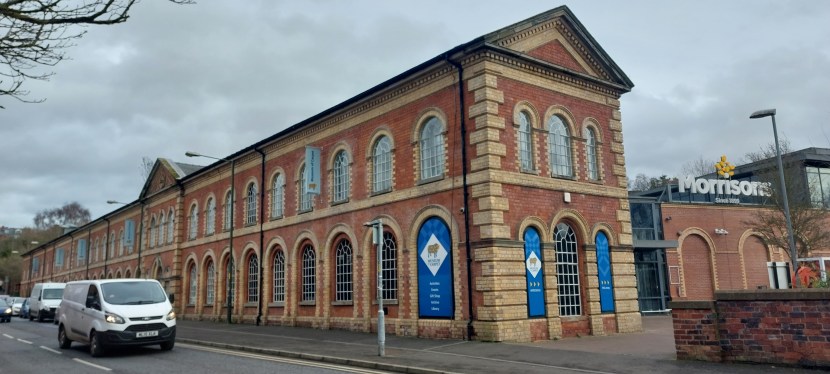
Museum of Carpet, Kidderminster, Latest Industrial Site to Close in 2025

The Museum of Carpet in Kidderminster has announced that it will close on the 20th December 2025. The announcement earlier this month by the Chair of the Board of Trustees of the Carpet Museum Trust, adds another industrial heritage site in England to the closure list for 2025. For the Museum of Carpet, this was the culmination of a several years of rising energy prices, maintenance costs, loss of tenants, and reduced footfall.

The Kidderminster carpet museum is the latest industrial site to announce its closure in 2025. Other museums and heritage sites to close this year, or announce imminent closure, include Alford Windmill, Cannock Chase Mining Museum, Castleton Museum, Otterburne Textile Mill, and the Walsall Leather Museum.

The full closure statement from the Museum of Carpet is below:

“It is with deep regret that the Carpet Museum Trust announces the closure of the Museum of Carpet, Stour Vale Mill, Kidderminster, on the 20th December 2025. After 13 years serving the public as a centre of learning, culture and heritage the museum has, like many similar institutions, faced significant financial challenges in recent years.

Despite the dedication of staff, volunteers, Friends, Trustees, Corporate Partners and supporters the combination of rising energy prices, maintenance costs, loss of tenants and reduced footfall have made it unsustainable to continue operations at its present site. Efforts to secure additional long term funding have been explored extensively with the help of Museums Development Midlands and the Arts Council. Unfortunately, no sustainable solutions have been found to overcome these financial challenges.

The Carpet Museum Trust, will continue to be responsible for the management of its archives, displays and collections. Arrangements are being made to preserve and relocate the Museum’s collection for future generations as necessary and they will be made public once details are finalized .In the meantime access to these collections and archive will remain a priority for the Trust – please make enquiries via email to collections@museumofcarpet.org.uk

If you feel you are able to help or assist in any way please get in touch with me as below. In the meantime up to December 20th we hope that the people of Kidderminster and Wyre Forest will take the opportunity to show their support and appreciation of what we have accomplished by visiting us along with their families.

Geoffrey Gilbert.

Chair of the Board of Trustees, Carpet Museum Trust

Email. gilberga51@gmail.com”
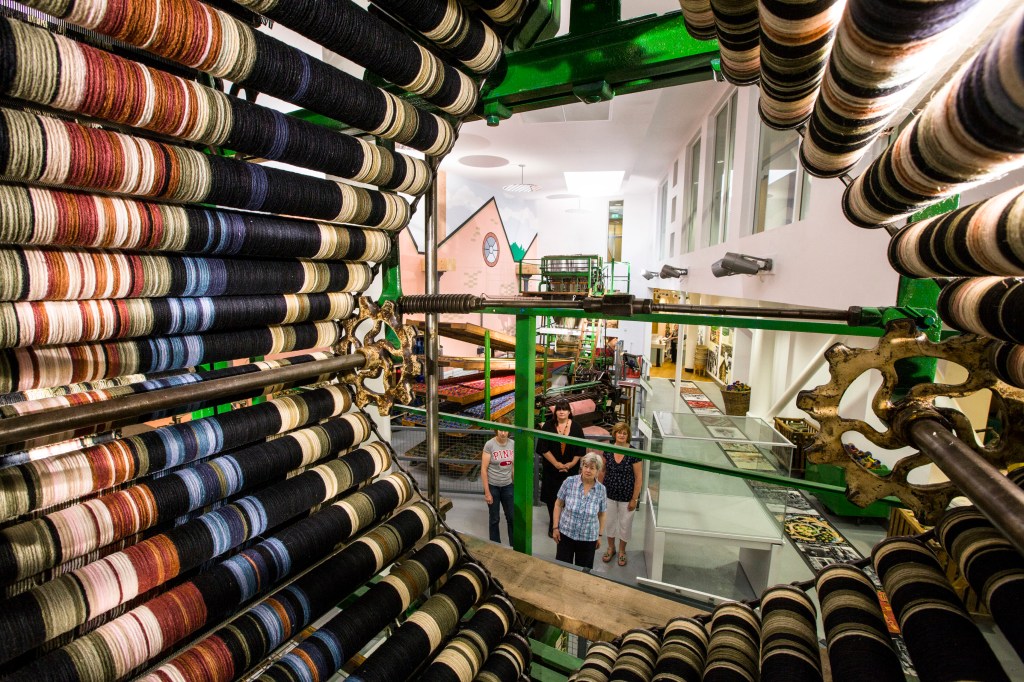
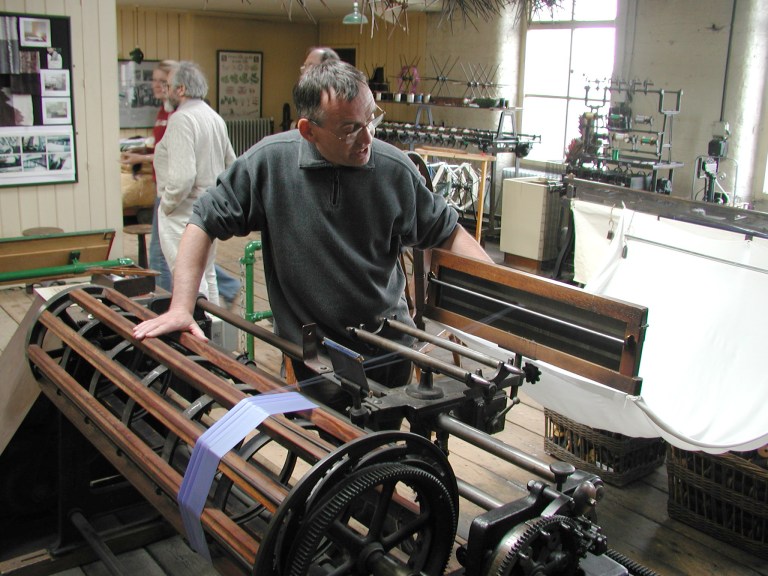
Kidderminster Museum of Carpet staff, volunteers, and weaving machine. Image coursey of Museum of Carpet.

Museum of Making, Derby, Installs Flood Barriers

New flood defences have been installed at Museum of Making, Derby. The protective barriers have been placed inside the old Silk Mill, now the Museum of Making, which was flooded by waters from the River Derwent to a depth of 0.7m during Storm Babet in 2023.

Alex Rock, director of commercial and operations at Derby Museums Trust, said “We’re delighted to add further protection to our building, and very grateful for the support of Derby City Council’s planning team and their engineering colleagues. Both departments have been crucial in securing the relevant permissions and funding from DEFRA for this work. It adds another layer of protection to two key operational areas, which means that should a flood event occur again – and it is worth bearing in mind that Storm Babet was forecast as a once-in-a-century event for Derby – then we’ll be able to shorten the period of closure. It protects the two areas of the ground floor that are most impacted by flood events.”

As part of Derby City Council’s ‘Our City Our River’ scheme, flood defences are also to be improved around the museum. Work is underway to demolsih disused office buildings on the eastern bank of the river, close to the museum, at Stuart Street and Phoenix Street. This will allow the construction of a new flood wall, floodgates, and a riverside green area to provide a controlled corridor for flood waters fromt eh River Derwent to pass through the city.

More details here: https://www.msn.com/en-gb/news/world/derbys-museum-of-making-gets-flood-defence-boost-after-closure-cost-six-figure-sum/ar-AA1PA7v1?ocid=BingNewsSerp

and here: https://www.derby.gov.uk/environment-and-planning/regeneration-and-economic-growth/our-city-our-river/our-city-our-river-project-overview/

The Museum of the Making (the Old Silk Mill), Derby. Image copyright Dr Michael Nevell.

Building Resilience: Sustaining Macclesfield’s Silk Heritage to Protect, Share, and Enjoy Stories of Working Lives

Silk macinery in operation, Paradsie Mill. Image courtesy of Paradise Mill.

This spring, the National Lottery Heritage Fund awarded £227,000 to The Silk Heritage Trust to develop Paradise Mill and the Silk Museum in Macclesfield into a vibrant campus of economic activity, skills development, and heritage participation. This grant will help keep alive the stories of Macclesfield as the centre of the nation’s silk heritage.

The three year project ‘A Stronger Future: Developing the Silk Heritage Trust’s vision for culture and heritage in Macclesfield’ aims to improve the training of the museum’s staff and volunteers. It also intends to help preserve endangered collections, the museum’s silk weaving skills, and extend the museum’s audience reach.

Paradise Mill, Macclesfield. Image copyright Dr Michael Nevell

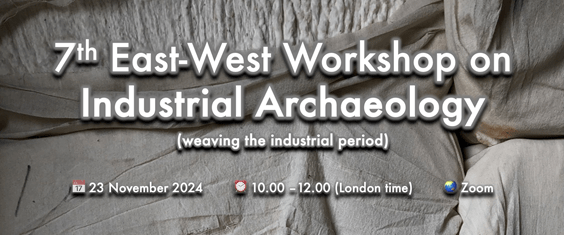
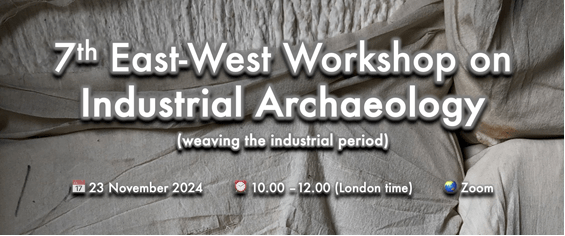
7th East-West Workshop on Industrial Archaeology: Weaving the Industrial Period

The production of fabric and its transformation into clothes was worldwide one of the first sectors to embrace modern industrialisation, even though continuities (of domestic working spaces, traditional production processes, manual technologies, etc.) often coexisted with changes (the factory, the factory system, the power loom). The 7th East-West Workshop on Industrial Archaeology revisits the capital importance of the textile sector in the development of the industrial period.

The East-West series of workshops aims to exchange ideas and knowledge among Western and Eastern colleagues to build a more international and diverse industrial archaeology. This edition focuses on the heritage and archaeology of the textile industry from the East, the West, and the world to explore its commonalities (transfer of technology, building materials, typologies, etc) and singularities (chronological disparities, heritage practices, etc.)

The event is organised jointly by the Institute for Cultural Heritage and History of Science & Technology (USTB, China), and the UK Association for Industrial Archaeology with its Young Members. IOt will trake place on Staurday 23rd Novemebr, between 10am and 12pm (GMT). The speakers are:

  • Yiping Dong (Xi’an Jiaotong-Liverpool University, China): “Complexity of the Conservation of Textile Heritage in China”
  • Ian Miller (The University of Salford, Britain): “Salford Twist Mill: Uncovering an Iconic Textile Factory”
  • Mark Watson (Historic Environment Scotland, Britain): “Global Textile Industries and their Built Heritage”

To register for FREE workshop and to get the Zoom link for the event, follow this link:
https://www.eventbrite.co.uk/e/7th-east-west-workshop-on-industrial-archaeology-tickets-1072988229679
 

Restoration Work is Helping to Preserve Craft Skills at Paradise Mill in Macclesfield

The Grade II listed Paradise Silk Mill in Cheshire reopened to the public in February 2024 after a £309k National Heritage Memorial Fund backed restoration project, supported by building owners Allmand-Smith Ltd. This grant has helped the Silk Heritage Trust acquire a 125-year lease of the top floor of the mill. Paradise Mill, which produced luxury silk goods from 1862 until 1981, will once again be home to silk production, after restoration of two of the mill’s 19th century Jacquard looms.

Silk weaving has now joined the list of Endangered Heritage Craft Skills. The Silk Museum has secured funding from The Radcliffe Trust to develop a plan for the conservation of the looms alongside creative placements for emerging craftspeople. Director of the Silk Museum, Emma Anderson, said: “The looms tell remarkable stories of silk production in Macclesfield. It is essential that they are kept in working order so that visitors can experience the incredible sights and sounds of these historically-important machines. We need to revive and expand the technical knowledge of how to operate and care for them so they can continue to inspire future generations of weavers for years to come.”

The Museum is planning to return more of its collection of 26 Jacquard handlooms to working order . Tour guides at the museum, Daniel Hearn, and Trish Halloran, alongside Rebecca Faragher, who is a trained weaver, are undertaking the conservation of the building’s handlooms, in work supported by funding from the Association for Industrial Archaeology. Hearn said the restoration had required considerable effort. “Establishing a strong foundation in acquiring these skills means we are taking the first critical steps in ensuring that this niche type of Jacquard handloom weaving remains operational within the extraordinary time capsule that is Paradise Mill.” As part of the restoration project textile students Bea Uprichard and Ruth Farris, from Manchester Metropolitan University, have designed and woven a new silk – the first one to be created at the mill in decades.

Guided tours of the Silk Mill resumed in February. For more information follow this link: https://www.thesilkmuseum.co.uk/

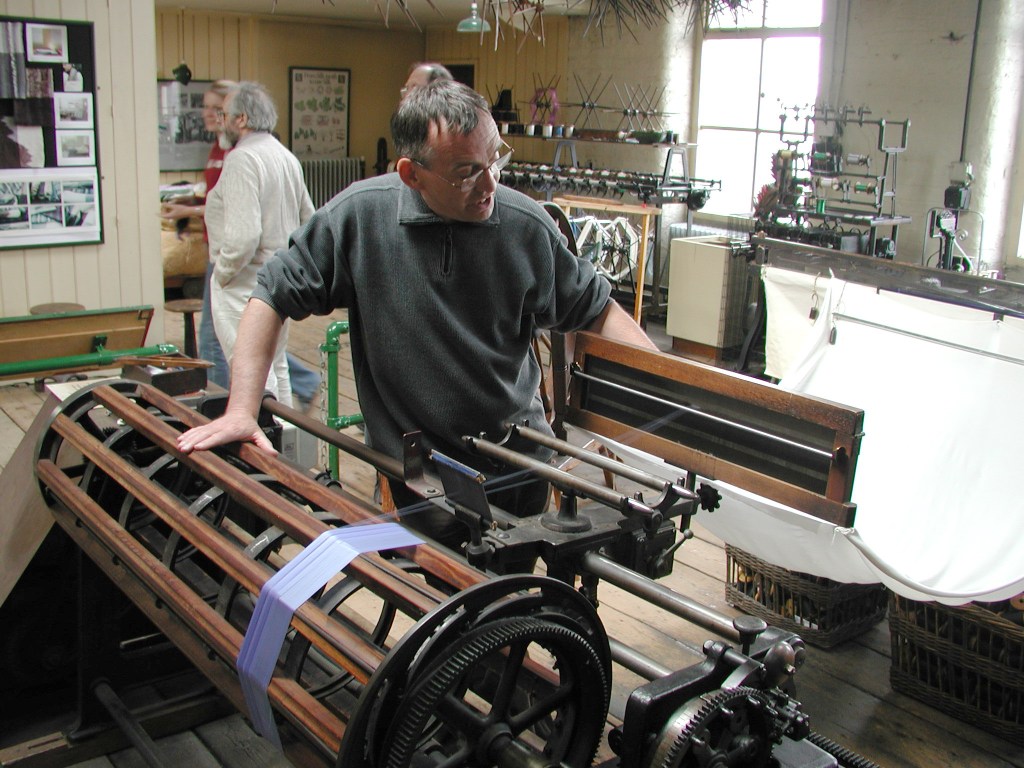
Warping drum for silk thread, Paradise Mill. Image copyright Dr Michael Nevell