Welcome to the Industrial Heritage Networks and Support website. This site is maintained and updated by the Ironbridge Gorge Museum Trust who run the project and the networks. We aim to support industrial heritage in England through networking, information exchange, guidance, and training. Please explore the website and please contribute! For more information you can … Read more Welcome to the IHNs website!
The next round of online Industrial Heritage Network (IHN) meetings is taking place this Spring. The IHN networks are a chance to meet those working, volunteering, or researching in the industrial heritage sector.
Four lunchtime IHN meetings will be held in late March, and will run from 12noon to 1pm, and there will be an IHSO update followed by news and updates from members. The first round of 2025 IHN meetings will take place on the following dates and will include the following groups:
21 March – East of England
25 March – South East
26 March -North East
31 March – London
Zoom links for the meetings will be sent to each region nearer the dates. If you would like to join any of these Industrial Heritage Networks as a member please email the IHSO here: mike.nevell@mikenevell
Avoncroft Museum has published their 2025 craft workshops programme. These workshops include a number of subjects relevant to industrial heritage sites, including blacksmithing, traditional signwriting, and basket weaving.
The workshop programme runs from Febraury through to November. During the workshops you’ll get expert guidance, all the materials needed, and free museum entry. No experience is needed. Costs vary, and there is a discount for Members of Avoncroft Museum. Follow this link for more details:
The early new year is often a time for charities and musuems to undertake staff training and maintenance in the ‘off season’. Online, several organisation offer free training and briefing videos relevant for industrial heritage sites. Some of the recent offerings listed below provide an opportunity for armchair training.
The East-West Workshops on Industrial Archaeology aim to exchange ideas and knowledge among Western and Eastern colleagues to build a more international and diverse industrial archaeology. The workshops are organised jointly by the Institute for Cultural Heritage and History of Science and Technology (USTB, China), and the Association for Industrial Archaeology (AIA) together with its Young Members Board. Videos of all the workshops are available on the AIA’s YouTube Channel, including the latest event from November 2024 on ‘Weaving the Industrial Period’. Follow this link to view the workshops: https://www.youtube.com/channel/UCILr2TkRAOIfk_NKchshwZQ
On Thursday 21st November 2024 the ‘Craft of the Miller’ network held an online conference on ‘Managing Health & Safety Risks in Your Mill’. Jon Cook gave an introduction to highlight a number of key risks in a working mill, including hygiene, flour dust, vacuum equipment, and fire risks. Jippe Kreuning explored how to work with a stone crane and how to operate it safely to lift a set of millstones. You can catchup with the recordings from the conference here: https://network.molens.nl/
Finally, Historic England have a range of heritage webinars to watch with topics from flooding, embodied carbon, and renewabler energy, to heritage building skills, roofs, and windows. The Historic Environment Webinars strand includes a session on the role and work of the Canal & River Trust form November 2024. Follow this link to view the webinars: https://historicengland.org.uk/services-skills/training-skills/training/webinars/recordings/#technicaltuesdays
Museum Development Midlands (MDM) is running an evening online training session in January 2025 around how Museum Trustees can recruit volunteers.
Many of the Midland region’s museums rely on volunteers and since the Covid-19 pandemic it’s been increasingly tough for industrial museums across England to recruit and retain the volunteer capacity they need to operate. This reflects a wider picture across the voluntary sector with surveys suggesting that the majority of organisations are finding volunteer recruitment difficult. In this tough climate, what can museums do to attract and retain the committed, skilled, volunteers that they need?
This practical session of ideas and approaches to volunteer recruitment will be held on 20 January 2025, online, 6pm to 8.30pm. More details here.
Join SPAB on Saturday 30 November, 10am – 4.45pm , for a day of online talks about windmills and watermills that are currently or have been in the past listed on the Heritage at Risk Register.
What happens when a mill is added to the Heritage at Risk Register? What steps can you take to protect a mill from different risks? And why do some restored mills remain at risk? This is a unique opportunity to hear from a range of mill professionals – including volunteers and millwrights. You’ll have a chance to have your questions answered and will receive a recording of the talks after the event.
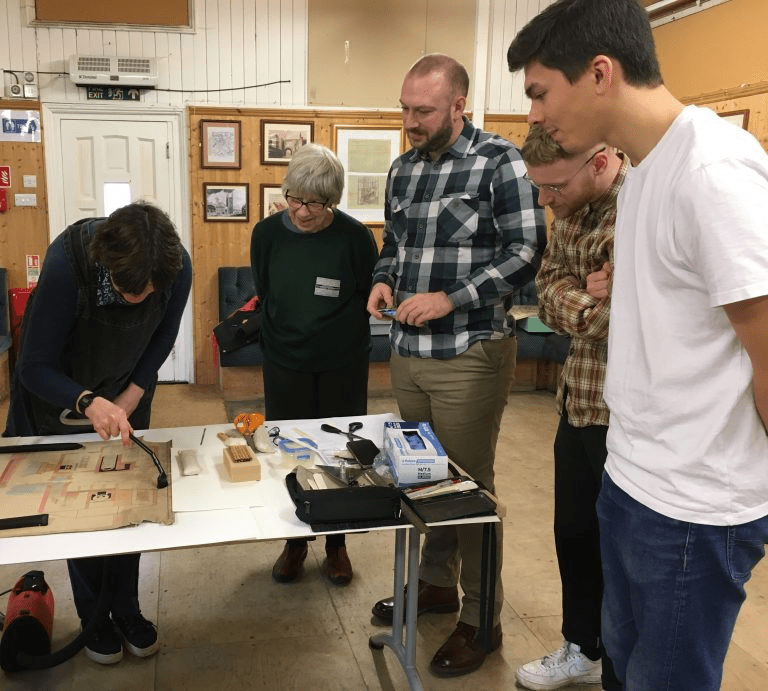
Milsl Archive Trust volunteers learning new archibing skills. Image couresy fo the Mills Archive Trust.
The Mills Archive Trust’s ‘Living Heritage’ appeal is designed to keep alive the legacy of millers and millwrights found within the Trust’s archives, sharing this knoweldge with the public and providing life-changing experiences for their volunteers.
The Mills Archive Trust is a permanent repository for the documentary and photographic records of traditional and contemporary mills and milling, as well as similar structures dependent on traditional power sources, in the UK and beyond. It makes that material freely available for public inspection and use in research and learning.
Their latest appeal is designed to help volunteers acquire the skills needed to catalogue archives relating to specific millers and wind and watermill restorers and experts, such as David Nicholls (1938-2020), and Alan Stoyel. Not only does that help to save these archives and improve public access to them, but the skills acquired help many volunteers to find work within the hertiage sector.
The Mills Archive is one of the world’s great mill collections. It has rescued over three million documents and images that might otherwise have ended up in a landfill site. It is an Aladdin’s cave filled with memories and is free to use. The collections show the rich and diverse crafts, buildings, machinery, equipment, and people involved with mills in the UK and around the world. There is an urgent need to record and make public the technical details of these crafts and the potential impact of the loss of this aspect of our shared cultural heritage.
Join Museum Development Midlands (MDM) and Anita Hollinshead for this session exploring extreme environments and their impact on conditions in museums, collections, visitors, and staff on 5th November. The free workshop will include a number of case studies and measures that can be put in place to minimise risks.
Delegates will be encouraged to share their own experiences of extreme weather conditions, including high temperatures, flooding, and storms and the impact of climate change on collections management, all issues familiar on for industrial heritage sites. This workshop is part of MDM’s Emergency and Risk Management Network, helping museums prepare for emergency situations and develop skills in risk management and mitigation.
Places are limited to a maximum two delegates per organisation. Priority will be given to delegates from non-NPO and non-National museums in the Midlands which are Accredited or officially Working Towards Accreditation. You’re welcome to book a place if you are not from a priority museum, including non-Accredited museums, on the understanding we may ask you to release your place if the event becomes oversubscribed. Fololow this linbk to book the free trainbign session: https://www.eventbrite.co.uk/e/emergency-and-risk-management-network-extreme-environments-tickets-1028753909637?aff=oddtdtcreator
The Mills Archive Trust are hosting a two-part webinar on fundamental archiving skills on Saturday 23 and 30 November, between 2:00 pm and 4:00 pm GMT. Whether you are an individual collector or part of an organisation, caring for old documents or digital files, their professional archivist will guide you through protecting and sharing your records.
The Mills Archive Trust is an accredited Archive and award-winning educational charity dedicated to caring for the history of mills and milling. They care for records ranging from centuries-old manuscripts to digital files. Their professional archivist, along with their archival volunteers, will help your industrial heritage site do the same in these two webinars.
Icon is hosting an industrial heritage conservation accreditation workshop at Imperial War Museum Duxford on 28 October. If you work in industrial conservation and are interested in finding out more about Icon accreditation, then this is the workshop for you.
This free workshop event will cover:
Learn about the basics of Icon accreditation, what it involves and how it can benefit your you and your organisation.
Listen to real examples of Industrial conservation projects and understand how these meet the Icon assessment criteria.
Discuss the unique challenges of industrial conservation and explore how these can be presented in an Icon assessment.
The next round of in-person Industrial Heritage Network (IHN) regional meetings will be taking place this autumn. These regional network meetings take place twice a year in the spring (online) and in the autumn (in-person). They are a chance to bring together volunteers and professionals from industrial heritage sites around England to exchange experiences, catch up with the latest news and practices, and make or renew contacts. There are ten regional networks in England run by the IHSO project at the Ironbridge Gorge Museum Trust, and funded by Historic England, with the support of the Association for Industrial Archaeology.
The first four in-person IHN meetings will be held this autumn for the following regions:
North West England, Catalyst Museum, 25th October 2024.
Cornwall & Devon, East Pool Mine, Redruth, 7th November 2024.
South West, Westonzoyland, 8th November 2024.
West Midlands, Claymills, 22nd November, 2024
Further dates for other regions will be published in October. Regional network members will be emailed details of the venues and how to attend. For further details contact the Industrial Heritage Support Officer for England: mike.nevell@ironbridge.org.uk










 Industrial Heritage Networks