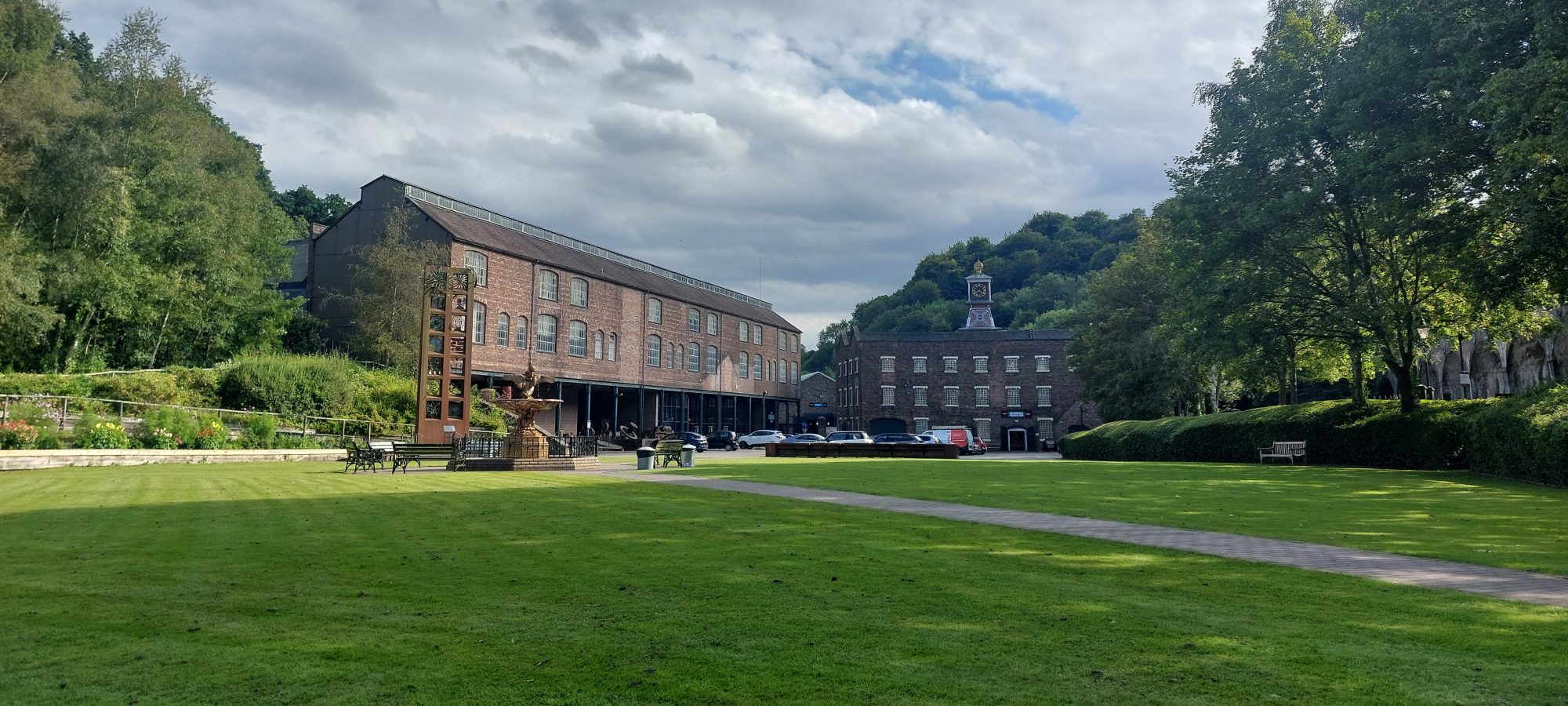
Welcome to the Industrial Heritage Networks and Support website. This site is maintained and updated by the Ironbridge Gorge Museum Trust who run the project and the networks. We aim to support industrial heritage in England through networking, information exchange, guidance, and training. Please explore the website and please contribute! For more information you can … Read more Welcome to the IHNs website!
North West Leicestershire District Coucnil has agreed to provide £160,000 of extra funding to repair the Moira Furnace museum buildings. Repairs are due to begin later in February and are expected to take around 22 weeks.
Moira Furnace is one of the best preserved iron blast furnaces in England. Built in 1806 the site is now a Scheduled Monument owned by the local council. Initial plans to repair the structure and museum pre-date the COVID-19 pandemic. In that time the cost of the repairs has risen from £3330,000 to £490,000. The short fall is being made up from council reserves and £65,000 from the UK Shared Prosperty Fund. More details here: https://www.bbc.co.uk/news/articles/cp3j71141v5o
The current site comprises a museum of iron making and social history, a vintage 100+-year-old narrowboat for trips along the canal, fishing along its banks, and woodlands for exploring. More details here: https://www.moirafurnace.org/
Moira furnace. Image courtesy of MoiraFurnace museum & country park.
In 2025 the Anderton Boat Lift celebrates 150 years of use. Designated one of the Seven Wonders of the Waterways, the boat lift was designed by engineer Edwin Clark to connect the Trent & Mersey Canal with the River Weaver Navigation fifty feet below and opened on 26 July 1875. Although it has been re-engineered several times, the lift has successfully carried boats between the two waterways for most of its 150 years, with only a couple of decades out of action in the 1980s and 1990s due to safety concerns caused by corrosion. At the turn of the Millenium, more than £7 million was raised to fund a major restoration and the boat lift began operating again on 26 March 2002.
The Canal and River Trust, who now run the Lift, will be transporting visitors back in time to 1875 by hosting a spectacular Victorian Fair over the anniversary weekend of July 25-27. During the rest of the summer season, as well as boat trips through the Lift, visitors will be able to enjoy other events, including Steam at the Lift (May 10/11), Pirates Weekend (June 21/22), Old Time Sailors Concert (July 4), and Steampunk Lift Off Weekender (September 27/28).
A generation on from the 2002 re-opening, the Lift needs a major upgrade to keep it operational. The Canal and River Trust are thus currently working to develop an ambitious ‘Engineering the Future’ project to revitalise the Anderton Boat Lift and Visitor Centre, supported by the National Lottery Heritage Fund. The whole structure requires blast cleaning, repairing and re-painting, the timber control cabin replacing, and IT operating system updating. This is expected to take 12 to 18 months, with a total estimated cost of £13.5 – £15 million.
The Canal and River Trust (CRT) is looking at gathering oral histories about the people who were involved in the post-Second World War restoration of canals in Birmingham and the Black Country.
The aim is to record this important period in the history of Britain’s canals by talking to the people who worked on the restoration projects. CRT are looking to record personal stories to find out which canals people worked on, what they did to restore the canals, their motivations for being involved, the impacts the restoration work had on them, and information about restoration techniques.
This work is being undertaken with inHeritage. inHeritage is a heritage interpretation consultancy delivering innovative and accessible opportunities to communicate your key messages to your target audiences through a range of traditional and new media. They also manage interpretation, community archaeology, and oral history projects.
If you would like to get involved with this project please email Bill Bevan at: bill@inheritage.co.uk
Birmingham canals post restoration. Image courtesy of CRT.
For several years Historic England has been running a very successful lunchtime learning webinar training series. The latest industrial heritage webinar case study on the work of the Canal & River Trust, held earlier this autumn, can now can be viewed online.
One example of the re-use and conservation of canal-related industrial heritage mentioned in the webinar was The Roundhouse, Sheepcote Street, Birmingham. This former horse-shoe shaped stables and stores was built as a mineral and coal wharf, around 1840. Listed Grade II* the site was removed from the Heritage at Risk Register in 2021, renovated with the help of NHLF and CRT, and is now being run as a heritage enterprise by the charity Roundhouse Birimgham providing office space, a visitor centre, and canal-related leisure and outreach activities.
The Roundhouse, Sheepcote Street, Birmingham. Image courtesy of Historic England.
In September the Ironbridge Gorge Museum Trust (IGMT) launched a recruitment drive to find new volunteers to help them complete the second phase of the project to conserve two Sentinel locomotives at Coalbrookdale. IGMT found them through a range of outlets, including the Shropshire Star, the Telford Journal, and BBC Radio Shropshire, and they started work omn 18 October.
The two Sentinel Shunting Locomotives (left), which date from the 1860s, are historically important parts of the Trust’s collection. They were used by the Coalbrookdale Company on their internal railway system. In the 1920s, to reduce running and material costs, the Sentinel Waggon Works Ltd. modernised and converted locomotives from a boiler and cylinder system to a boiler with chain drive to both axles, and the locomotives within this project are the oldest locomotive conversions by Sentinel that are known to have been preserved. They are now on permanent display beneath the arches of the viaduct that passes through Coalbrookdale for museum visitors and passersby to see.
In 2023 the Trust secured funding from the Association for Industrial Archaeology to carry out work to conserve the engines, whose condition had deteriorated over time due to weather conditions. While the engines will not run again, the aim of the project is to stabilise their condition and conserve them so they can continue to be enjoyed by future visitors to the Ironbridge Gorge and its museums.
Under the guidance of Trevor Barraclough, the team began work on this second phase in October 2024. The work will involve wet and dry cleaning; priming bare iron; painting; and if appropriate carrying out some minor repairs. Volunteers also regularly receive questions from members of the public interested in their work and will be asked to take photographs to help record the progress of the project. The hope is to complete the project by Christmas, but this is dependent on the weather.
Picture shows volunteers Peter Taylor, Matthew Fletcher, Alan Watson, Steven Downton, Phil Garbett and Mike Sprason with Trevor Barraclough (centre). Image courtesy of IGMT.
The National Musuem Directors’ Council (NMDC) has published the findings of a series of case studies looking at the actions and costs required to decarbonise museum buildings. It worked with a consulting engineer and a construction consultancy on a study of potential improvements to the energy performance of six different museum sites across the country, identifying where changes could be made to make buildings more efficient and reduce carbon emissions.
The National Museum Directors’ Council represents the leaders of the UK’s national collections and major regional museums. Aware that many museums haven’t yet carried out baseline surveys or carbon audits due to capacity and affordability, and that some who have done so can’t share results widely due to commercial sensitivities, six museums agreed to share their findings publicly to increase sector literacy about potential improvements and outline costs. Each case study considers three categories: quick wins, maintenance, and capital projects, and within these demonstrates a range of potential carbon savings for individual measures – ranging from reviewing boiler controls or time schedules, to more ambitious interventions such as upgrading roof insulation, window repairs, or replacing gas boilers with Air Source Heat Pumps.The detailed case studies can be read by clicking the link here.
The importance of baseline carbon surveys to identify such measures cannot be overstated, as implementing these may mitigate potentially larger costs of more advanced maintenance or capital work, for which considerably more external funding is necessary.
*all carbon savings and costs are estimates. See case study document for full details.
In February 2024, the West Somerset Railway Heritage Trust completed the purchase of the shed at track at Washford from the Somerset and Dorset Railway Trust and agreed a new 10 year lease of the site with the West Somerset Railway PLC. Since then, work has been continuing to bring all the heritage stock owned by the Trust to the Washford site, which is now the base for all the Trust’s restoration activities.
The planned move of the three carriages previously stored at Dunster sidings to Washford was successfully completed on Monday 9 September by a WSR PLC specialist team, while the railway was closed to passenger traffic. Carriages 5131, 7740 and 2578 have been located in a siding near Dunster station for many years awaiting restoration, leaving them exposed to the sea air despite being covered with tarpaulin covers. Coastal storms have periodically caused further deterioration to the carriages.
Given the poor condition of the carriages, a comprehensive risk assessment was prepared in advance of the move. This included a 3 meter hard hat exclusion zone around the move, and even a camera wired up to one of the shunters, pointing underneath the carriages to check if anything fell between the tracks during the move. The whole exercise was professionally executed by the PLC team, using two top and tail shunters, without incident.
The following day, the Trust’s horse box was brought by road from its previous location at Bishops Lydeard. During the First World War, horses and mules were used extensively by the British army – nearly one million by 1918 – and were transported by rail, and it is believed that this is the only one horse box of the era to survive. It was built for the LNWR and found on a farm at Pershore. Following the move to Washford, restoration of the horse box will be completed.
The Washford Engineerign Shed was open to visitors on 14tth & 15th September, as part of the Heritage Open Days and the WSR 1940s weekend.
Carriage 7740 on the move at Blue Anchor platform. Copyright WSRHT.
Before (left) and after (right) shots of one of the conserved Sentinel locomotive, Coalbrookdale. Image copyright: Ironbridge Gorge Museum Trust.
The Ironbridge Gorge Museum Trust (IGMT) is looking for volunteers to help us complete the second phase of their project to conserve two Sentinel locomotives at Coalbrookdale. The two Sentinel Shunting Locomotives, which date from the 1860s, are historically important parts of the Trust’s collection. They were used by the Coalbrookdale Company on their internal railway system, were modernised and converted by the Sentinel Waggon Works Ltd in the 1920s and are now the oldest locomotive conversions by Sentinel that are known to have been preserved.
In 2023 IGMT secured funding from the Association for Industrial Archaeology to carry out work to conserve the engines, whose condition had deteriorated over time due to weather conditions. Work on one of the Sentinel locomotives has already been completed and new volunteers are now needed to complete the second stage of the project.
Requirements:
Volunteers who can commit to a half-day on Fridays between September and December.
The role will require a reasonable amount of physical activity and working outside (though under some cover) in all weather.
No specific qualifications are required but the work will involve wet and dry cleaning; priming bare iron; painting; and if appropriate carrying out some minor repairs.
Volunteers regularly receive questions from members of the public interested in their work and will be asked to take photographs to help record the progress of the project.
This is a great opportunity to learn new skills and meet new people. If you would like to volunteer with us or know someone who you think would like to be involved get in touch with me or with Sharon Sinclair, Volunteer Officer, volunteering@ironbridge.org.uk.
The two Sentinel shunting locomotives at Coalbrookdale, Ironbridge. Image copyright: Dr Michael Nevell.
Historic England and Civic Voice are collaborating in the launch of a survey to understand the impact of different local plaque schemes across England and the organisations behind them. As Historic England receives nominations from the public as a part of a new blue plaque scheme, they are seeking views from civic organisations on how to set up and develop them. You can fill out the Blue Plaques survey here
This survey comes as Historic England (HE) runs a new national blue plaque scheme on behalf of the Department for Culture, Media and Sport (DCMS). This summer, from mid-May to mid-July, you can submit your own nominations for a blue plaque. There will be advice on what HE are looking for in the nomination process, an online application form, and details on how it will be decided who gets a plaque. The unveiling of Historic England’s latest blue plaque, in April, to Clarice Cliff celebrated her enduring influence on the world of pottery. Born 125 years ago, Cliff’s journey from a young apprentice to a globally renowned ceramic artist is a testament to her talent and innovation. Her vibrant and unconventional “Bizarre-ware” designs captured the imagination of buyers worldwide, earning her a place among the most influential ceramic artists of the 20th century.
The Canal and River Trust (CRT) have announced how they are trialling an innovative AI CCTV system on the Lancaster Canal to catch hit-and-run motorists damaging 200-year-old stone bridges. Annually, vehicle strikes on CRT bridges cost up to £1 million in repairs, diverting vital funds away from work waterway conservation.
The new system is controlled by AI using a mobile phone signal and doesn’t continuously record but takes a few photos when it detects vehicle movement. The AI then assesses if the bridge has been impacted. If there is no strike, the photos are deleted and if damage has been caused, Trust staff receive a notification, allowing them to identify number plates to track down the offenders and claim full repair costs on their insurance.
Andy Dobson, CRT asset engineer, said: “Hump-back bridges, an iconic part of Britain’s canal network, were built for the passage of horse-drawn carts, not for today’s modern vehicles and HGVs. Due to the large number of rural, narrow roads crossing the Lancaster Canal, it has more bridge strikes than any other. The bridges are part of the canal’s special character and heritage, and each time one is hit a small piece of history is lost.”