Welcome to the Industrial Heritage Networks and Support website. This site is maintained and updated by the Ironbridge Gorge Museum Trust who run the project and the networks. We aim to support industrial heritage in England through networking, information exchange, guidance, and training. Please explore the website and please contribute! For more information you can … Read more Welcome to the IHNs website!
In 1974 Essex Record Office published John Booker’s ground breaking Essex and the Industrial Revolution. This highlighted the fact that significant industrial activity was going on in Essex, and not just those areas of the country traditionally associated with the Industrial Revolution, such as Ironbridge. To mark the 50th anniversary of its publication, Essex Record Office is running a series of short talks on various aspects of the industrial past of the county as well as celebrating this significant anniversary.
This event is run in conjunction with the Essex Society for Archaeology & History, Essex Industrial Archaeology Group, and Anglia Ruskin University. It is hoped that John Booker will be able to present one of the talks.
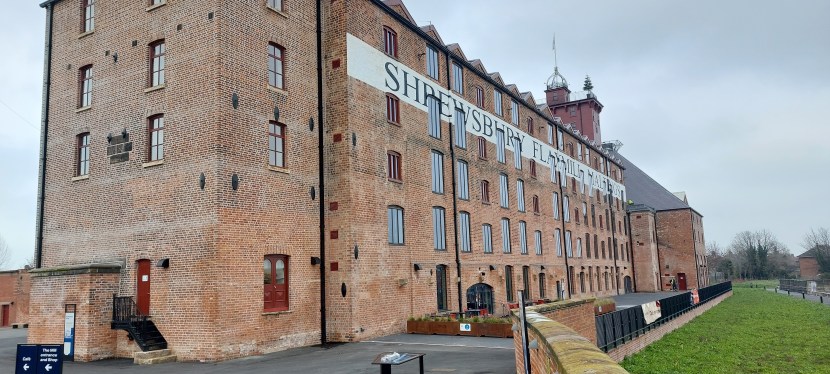
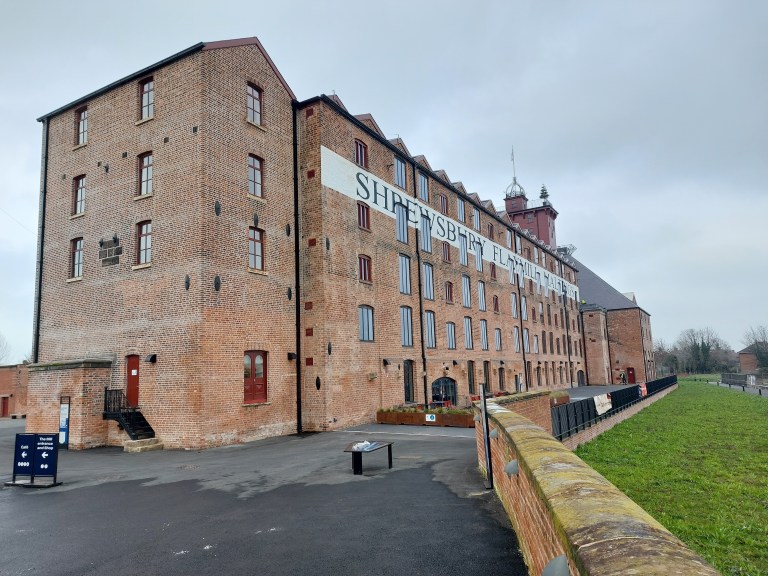
As English Heritage prepares to welcome visitors to the Flaxmill Maltings building in Shrewsbury, Shropshire, a hunt for the missing bell has been launched.Matt Thompson, the curatorial director of English Heritage, commented that “we believe the bell went missing in the late 1980s or early 1990s, when Shrewsbury Flaxmill Maltings was left derelict. Whilst it is possible that the bell could have been melted down, it is more likely that someone took it as a souvenir of this imposing, historic building which – at the time – looked close to ruin”
The empty bellcoate at Shrews Flaxmill Maltings. Image copyright Dr Michael Nevell.
Shrewsbury Flaxmill Maltings is known as the grandparent of the skyscraper, the building being the world’s first multistorey, iron-frame building, with the design paving the way for modern high-rise buildings. The site opened in 1797 as a flax mill and then, from 1897 to 1987, was used as a maltings. It also served as a temporary army training unit and barracks during the second world war. A third of the 800 workers at the flax mill were under 16 and some as young as nine. Shrewsbury itself was too small to provide that number, so children were brought in from as far afield as London and Hull, mostly from the workhouses. Often orphans, the children were given housing, food and clothes but not paid wages. The missing bell would have called the children in from the apprentice house nearby.
Originally operated by a pull rope, the bell changed to an electric chiming mechanism after the second world war, but was lost when the building was left derelict after the closure of the business in 1987. Believed to be around 60cm (24in) high, the bell is cast with the year “1797” on it. The bellcote has been restored but remains, for the moment, empty.
Shrewsbury Flaxmill Maltings opened on 1st April 2025 as English Heritage’s first new paid-for site in 21 years.
King Edward Mine Museum (KEM), a volunteer-led charity within the UNESCO Mining World Heritage Area of Cornwall, is looking for more tour guides when it re-opens for the new season on 20 April.
The site saw a significant rise in visitor numbers last year, many of whom travelled from overseas to explore the mine complex. The museum, which is dedicated to sharing the history of mining on the Great Flat Lode, and is Grade II* listed, lies in the village of Troon, near Camborne.
The mine tells the stories of Cornish miners and maintains a collection of historic mining equipment, including an operational Cornish tin mill, and a Holman winding engine. Originally worked under the name of Old Tye it was opened in 1844 together with Great Condurrow about 300m to the north, finally closing in 1921. However, the surface buildings continued in use for the teaching of mining, ore dressing, and surveying skills until 1974. In 1987 a volunteer group was formed with the aim of conserving the site as an educational resource for the future and the local community.
The National Trust, Cornwall Rural Community Charity, and Cornwall Voluntary Sector Forum are in discussions with Cornwall Council over the future of the Heartlands mining heritage site at Pool in Cornwall.
The site opened in 2012 after more than £20m in lottery funding was used to regenerate the derelict mining area and retsore the listed mining pumping engine house and surrounding buildings as a visitor attraction with retail units. It was run by the Heartlands Trust, and leased from Cornwall Council, before it ran into financial difficulty, closing in January 2024. The Trust was wound up and the Council has took over the maintenance of the site, and has been seeking a partner to lease the entire site from it.
The National Trust said: “The National Trust, with partners, Cornwall Rural Community Charity (CRCC) and Cornwall Voluntary Sector Forum (VSF) are in discussions with Cornwall Council to look at how a sustainable future could be secured for Heartlands, an important cultural heritage and community site in Cornwall.”
Walthamstow Pumphouse Museum and Markfield Beam Engine and Museum have merged under a new umbrella organisation, the Heritage and Communities Trust. The merger, which was finalised on 31st January 2025, brings together two of Greater London’s well-known industrial heritage sites.
Both museums will retain their individual names and distinct identities while benefiting from shared resources, expertise, and a unified governance structure. This strategic partnership creates the largest dedicated industrial heritage charity within Greater London in terms of public benefit and multi-site operation.
The flywheel of the pumping engine at Markfield. Image courtesy of Heritage & Comunities Trust.
The merger builds upon years of collaboration between the two listed Victorian-era sewage pumping stations, which are located approximately 45 minutes apart on foot along the River Lea. Both museums will continue to offer free entry to visitors, maintaining their commitment to accessibility and community engagement. “By joining forces, we’re creating a stronger, more resilient organisation that can better preserve and celebrate our shared industrial heritage,” said Abdullah Seba, Chief Executive of the Heritage and Communities Trust. “Our visitors will benefit from enhanced programming, improved facilities, and a more comprehensive understanding of London’s industrial past.”
The newly formed Heritage and Communities Trust will oversee both museums as well as two attractions at the Walthamstow Pumphouse Museum: The Tool House (a community maker space) and Supperclub.tube (a pop-up dining experience in a decommissioned Victoria Line carriage), with plans for further growth in the future. The Board of Trustees for the Heritage and Communities Trust includes representatives from both original museums to ensure continuity and balanced governance. Both museums will remain free to enter, continuing their position as the only free-entry industrial heritage museums in Greater London.
Walthamstow Pumphouse was built for Walthamstow Urban District Council and extended in 1896 to accommodate the current engine. It was closed around 1970. The museum opened in 1997 when a group of local enthusiasts came together to restore the Grade II listed Marshall engines and form the Friends of the Pumphouse. Markfield Beam Engine was built by the Tottenham Local Health Board in the 1880s and began its working life in 1888. It closed in 1964. In 1984 a Trust took on responsibility for the engine. In 2007 Haringey Council regenerated Markfield Park and restored the Grade 2 listed Engine Hall. The Trust restored the beam engine to full working order in 2008.
The Walthamstow Pumphouse Museum is open every Sunday from 10:30 am to 16:00 pm. Visit the website here. Markfield Beam Engine is open on selected Sundays and Bank Holiday Mondays. Visit the website here.
The Walthamstow Pumphouse. Image courtesy of Heritage & Communities Trust.
Woodbridge Tide Mill Museum, in Suffolk, is appealling for online donations to raise money for major restoration of the exterior of the listed mill. The museum, in Suffolk, has said the effects of being on the riverfront has meant weatherproof paint needs applying. Museum trustees are hoping that online donations will help them reach a £60,000 fundraising target for the restoration project by September.
John Carrington, Tide Mill Charitable Trust Chairman, said: “Visitor income is insufficient to maintain the Mill and so the trustees must use grant applications and fundraising.” The tide mill, built in 1793, is the fourth to be located on the site. The earliest date for a mill building is from 1170. The structure is one of only a handful of working tide mills left in Britain.
Due to the high demand for their latest webinar on the myths and misconceptions around heat pumps, Historic England is running an additional session on the 8th April 2025.
In this free webinar, Dan McNaughton and Sehrish Wakil, Senior Building Services Engineers at Historic England, will share practical advice and case studies to help participants plan and implement a successful heat pump installation project. The session will be followed by a Q&A. Book your free place here.
The Heritage Open Days team are offering two new micro-grants to support heritage sites and/or groups for the 2025 Festival. These are for the creation of new events that share stories highlighting under-represented histories, and to encourage people from under-represented backgrounds to participate.
These micro-grants are worth £350 each and come with one-to-one support from the national team. So, if your industrial archaeology or heritage site or group are planning a Heritage Open Day event why not consider widening its appeal with these support grants.
Applications are open to existing organisers who have participated for the last three years in HoDs, and to new organisers from under-represented backgrounds participating in the festival for the first time. The deadline for the micro-gants is Friday 4th April.
Full details and eligibility criteria can be found on the Heriotage open days website here
The Industrial Heritage Support Officer (IHSO) role, occupied by Dr Mike Nevell, has been awarded further funding to enable it to continue its work to preserve England’s industrial heritage. IGMT is delighted that our partners at Historic England and the Association for Industrial Archaeology have agreed to fund the post, which is vital for the support of the wider Industrial Heritage sector and a mark of the importance of IGMT as a leading Industrial Heritage organisation.
The IHSO project is funded by Historic England and the Association for Industrial Archaeology (AIA), and began in September 2012. It is managed by the Ironbridge Gorge Museum Trust. The project aims to support the approximately 600 industrial heritage sites preserved and open to the public in England by developing partnerships and promoting best practice, among other things.
In 2024 the project supported more than 400 sites through one-to-one advice, network meetings, site visits, seminars, websites, and social media. At the end of March the first round of Industrial Heritage Network meetings for 2025 will take place online, and on 25 April, Mike will be talking at an event hosted in Coalbrookdale, organised by the Boiler and Engineering Skills Training Trust, about the need for trained engineers to run industrial heritage sites.
Project highlights for 2025 to 2026 include a major report on the industrial heritage sector in England; more online training seminars to support the sector; and the continuation of the Industrial Heritage Networks. These are key to bringing together people working at industrial sites so that they can exchange experience and best practice.
Manchester’s Science and Industry Museum has revealed plans for new permanent galleries and a new railway visitor experience as part of the next phases of its redevelopment. The museum plans to create a new Wonderlab gallery, similar to that in other Science Museum Group museums, such as the Science Museum in London and the National Science and Media Museum in Bradford.
The new gallery will explore Manchester’s history of science and invention, drawing on the architectural features and history of the site to reflect the city’s creativity and innovation. It will be aimed at a target audience of ages four to ten, plus access for early years. An open competition to design the gallery has already opened.
In addtion, feasibility work will begin this year on a new free Technicians interactive gallery for 11-16-year-olds. The museum said it is looking to ascertain whether there is potential for the gallery to open towards the end of the decade. It would be housed within the arches of the museum property’s viaduct, and would mark the first time this space would be used as public galleries.
The museum is also planning a new gallery and static rail experience at the 1830 station, which is set to re-open in 2030 in time for the 200th anniversary of the opening of the Liverpool & Manchester Railway.
Finally, feasibility work is also set to commence “in the near future” on landscaping and improving access in and around the museum’s Lower Yard, to create a new science playground and open the museum site, providing more access from other Manchester locations and attractions.
Phase One of the Museum’s Transformation Plan, improvements and extensive repairs to the Power Hall, will be completed this summer. By the end of 2025, half of the museum’s site will have been restored over the last five years, following an investment of more than £40m from national government, charitable trusts and foundations, and philanthropists. The second phase will be completed in 2027.