Welcome to the Industrial Heritage Networks and Support website. This site is maintained and updated by the Ironbridge Gorge Museum Trust who run the project and the networks. We aim to support industrial heritage in England through networking, information exchange, guidance, and training. Please explore the website and please contribute! For more information you can … Read more Welcome to the IHNs website!

The Shipley Glen Tramway, near Saltaire in West Yorkshire, is launching a fundraising appeal for £89,000, to pay for vital repairs to the trackway after prolonged damage by the weather. It opened in 1895 linking Baildon with Saltaire and is Britain’s oldest working cable tramway. The tramway has two tracks and a pair of tram cars and runs every Sunday between midday and 16:00.
The site has been run by a charitable trust since 2002. Trustee John Pitcher, speaking to the BBC, said that the electrically-powered funicular had been assessed as safe to continue to operate. However, for the works to be carried out it would have to be temporarily closed. “What has happened, over the years, is that the damp has washed away underneath the tracks actually into the track bed, so the track bed is now a little bit unstable. Over the years we’ve maintained it, and you can stick patches on for so long, but there comes a time when you need a little bit more than an Elastoplast.”
The next round of online Industrial Heritage Network (IHN) meetings will provide a lunchtime opportunity to connect in Spring 2026. The IHNs are a vital part of the Industrial Heritage Support Project (IHSO), providing an opportunity for individuals, both professional and volunteer, working at Industrial Heritage sites in England to get together to exchange experiences and catch up with the latest trends in the sector.
This Spring’s online Industrial Heritage Network meetings will be taking place during later February and March at a midweek lunchtime, 1pm to 2pm. Those attending are very welcome to bring a drink and a sandwich whilst we spend an hour talking about updates from individual sites, as well as current trends. The date for the 10 IHN online meetings are as follows:
24 February – West Midlands IHN
25 February – East Midlands IHN
3 March – East of England IHN
4 March – London IHN
11 March – Yorkshire IHN
12 March – South East IHN
17 March – North West IHN
18 March – Cornwall & Devon IHN
26 March – South West IHN
27 March – North East IHN
Network members will be emailed joining details nearer the time. For queries about joining the Industrial Heritage Networks, please email the IHSO, Dr Michael Nevell, at: mike.nevell@mikenevell.org.uk
The IHSO project, which runs the IHNs, is funded by grants from Historic England and the Association for Industrial Archaeology, and is based at the Ironbridge Gorge Museums in Shopshire, England.
To celebrate the National Mills Weekend 2026, 9th and 10th May, the SPAB Mills Section wants to build up a new and comprehensive picture of mills of all types throughout the UK and Ireland. This year’s theme, ‘Now and Then’, invites owners, volunteers, millwrights or anyone interested in the history of a mill to write about how one has evolved.
SPAB would like to understand a mill’s origins and how the structure and uses have changed over its lifetime. This can be a post mill, smock or tower mill, a watermill or tidemill, or an industrial mill. The mill must be located in the UK or Ireland. Up to four photos or drawings can accompany the text.
All submissions must be the writer’s own work, and photographs to be accompanied by the date and name of the photographer and their permission. Or, if it is a historic photo, permission of the copyright holder. Drawings to be similarly annotated.
Entries may be edited, and selected submissions will be incorporated into a SPAB Mills Section publication in 2026. Entrants will need to grant copy and reproduction rights to SPAB in print or online.
The chosen entrants will receive a copy of the publication, which will be available for sale through the SPAB.
The deadline for submissions is Thursday 30th April 2026. All entries to be submitted via email to: nmwsubmissions@spab.org.uk
Heckington Windmill, Lincolnshire. Image copyright Dr Michael Nevell.
World Heritage UK’s most popular series of webinars to date was 2024’s Industrial Heritage. Over a series of seven talks, six Industrial World Heritage Sites and one roundtable discussion drew in the highest number of attendees any series has achieved. It was noted that not all of the UK’s Industrial World Heritage Sites were featured, and WHUK’s first series of 2026 seeks to address this. The three remaining industrial Sites will each have their own webinar, followed by the launch of the upcoming and new Industrial Heritage Trail.
• Tuesday 20th January – New Lanark WHS, with Head of Heritage Kate Lapping • Tuesday 03rd February – Pontcysyllte Aqueduct WHS, with Claire Farrell, Canal & River Trust • Tuesday 10th March – Blaenavon Industrial Landscape WHS, speaker tbc • Tuesday 21st April – Launch of the Industrial Heritage Trail, with Saltaire’s Brandi Hall-Crossgrove and Derwent Valley Mills’ Sukie Khaira
The Webinar will take place at 7-8pm UK time and all webinars will run on the Zoom platform. Webinars will be recorded and uploaded to WHUK’s private YouTube account. Single tickets are £5 and a series ticket for all four talks is £15. All ticket holders will be provided the link after the webinar.
Kempton Steam Museum has been awarded a £90,000 grant from The National Lottery Heritage Fund (NLHF) to connect people of all ages with the role of clean water in London’s past and present. The project will enable an Audience Development Consultant to develop a strategy to increase visitor numbers and attract new audiences from the local community and beyond. It will also enable a Learning Consultant to develop digital learning materials targeted at Key Stage 1 and 2 that are accessible to all.
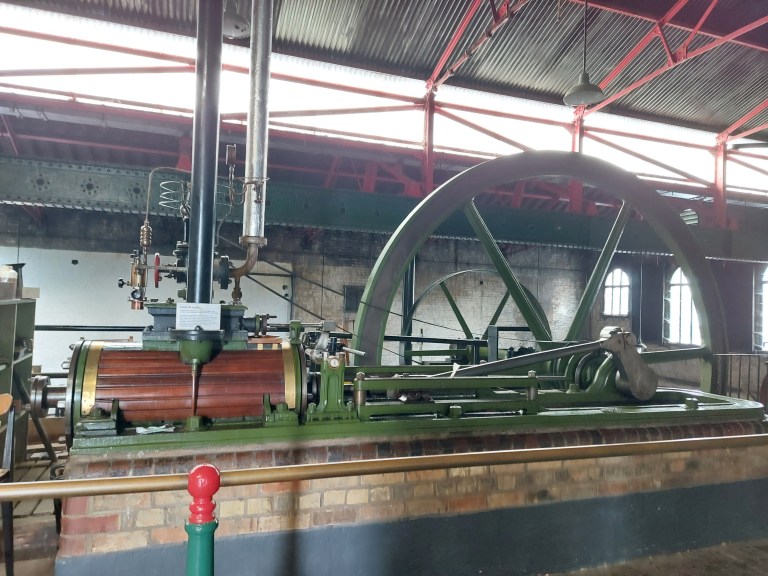
Kempton Steam Museum, located at the Kempton Park Pumping Station in southwest London, showcases the world’s largest operational triple-expansion steam engine and a rich collection of historical artifacts and technical drawings. Without this funding from the Heritage Fund, its stories would remain undiscovered by many.
Three new part-time members of staff will build capacity across the museum in a variety of ways. Firstly, to achieve Museum Accreditation by summer 2026, secondly, to implement strategies to increase visitor numbers and attract new audiences, and thirdly to manage volunteers. This initiative will expand our visitor demographic and foster stronger connections with underrepresented groups, local organisations, schools and families. In the long-term, the project will build a resilient and sustainable museum, strengthen the network of groups and organisations working together for the benefit of the local community in Hounslow and raise public awareness of the importance of clean water. Valerie Mills from Kempton Steam Museum said: “We are thrilled to have received this support from The National Lottery Heritage Fund to build a museum fit for the future!”
Kempton Steam Museum is an independent museum in London governed by the Kempton Great Engines Trust. The Trust, a registered Charity, was formed in 1995 with the aim to preserve the historic steam pumping engines at Kempton Park Pumping Station and make them accessible to the public. All restoration work and the running of the museum is undertaken entirely by a team of volunteers.
Kempton Steam Museum will be running Steam Weekends throughout the project. The museum is open from March to December offering special events throughout the year. You can follow @Kempton Steam Museum on Facebook, Instagram, and TikTok and or visit their website at https://kemptonsteam.org/
A survey of industrial heritage organisations in England during the second half of 2025 has indicated that a majority of sites have still not seen visitor numbers return to pre-pandemic 2019 levels, that volunteer recruitment remains difficult, and that a record number of sites have closed. The survey of industrial heritage organisations was carried out by the industrial Heritage Survey project during the regional industrial heritage network meetings run as part of the project.
71 industrial heritage organisations attended 10 in-person regional network meetings between June and December 2025. All the organisations reported an increase in visitor numbers, but a majority reported that these numbers had not returned to pre-pandemic 2019 levels. This trend was noted in the wider museum sector in England, in the Annual Museum Survey undertaken by Museum Development England with support from Arts Council England. Worryingly, 2025 saw a rise in industrial museum closures to eight sites, compared to 2024, a record number of closures since the project started tracking these in 2020, with industrial sites being particularly vulnerable to closure compared to the wider museum sector.
Furthermore, industrial heritage sites reported that the recruitment of volunteers remained difficult for many sites, although numbers a majority of sites have recovered to pre-pandemic levels, a trend in line with the Annual Museum Survey. All the industrial heritage organisations attending the regional network meetings noted that the continuing rise in the costs of fuel, heating, and maintenance was putting a strain on day-to-day finances and reserves.
The Museum of Cannock Chase, which closed in April 2025. Image copyright Dr Michael Nevell.
The UK Government has launched a call for submissions to the UK’s first-ever national inventory of Intangible Cultural Heritage (ICH). Also known as Living Heritage, the resulting inventory will help to celebrate cultural traditions and highlight their contribution to communities and the economy. It is the first major step following UK ratification of the 2003 UNESCO Convention for the Safeguarding of the Intangible Cultural Heritage.
DCMS said living heritage encompasses practices passed down through generations, with examples ranging from tartan weaving and dry-stone walling, to cèilidh dancing or Gloucestershire’s cheese-rolling, Eisteddfodau, or Burn’s night suppers. It could also include traditions brought to the UK by immigrant communities, such as the Notting Hill Carnival and steel-drumming, it said.
Heritage Minister Baroness Twycross said activities such as Highland Dancing, and the carving of Welsh love spoons “from the rich tapestry of UK culture and identity. These crafts, customs and celebrations are often what makes people feel proud of who they are, where they come from and where they live. They also boost local economies and businesses. Whatever living heritage communities value, we want to hear about it. I encourage people to get together and share their traditions through this national conversation. “
Submission must be made by the communities practicing the living heritage under the following seven categories:
Culinary Practices
Oral expressions
Performing Arts
Social Practices
Nature, Land and Spirituality
Crafts
Sports and Games
Details on how to submit, including support and advice, can be found at http://www.livingheritage.unesco.org.uk. Submissions for the inventory close Friday 27 March 2026. If you would like to attend a DCMS information session to learn more about making a submission to the inventory, click here.
The Stroudwater Textile Trust are looking for volunteers at their two museums near Stroud. There are many ways of getting involved in volunteering with the Stroudwater Textile Trust. From welcoming visitors to their mills to sparing a few hours to work at home or to help restore historic machine, your support is really important to the Trust, and you will find volunteering both enjoyable and rewarding.
The Trust offers training in using both hand looms and power looms, as well as wider training. The museums are open from April to September on weekends and occasional weekdays. Information about the Trust is on our website, or e-mail chair@stroudtextiletrust.org.uk.
The Stroudwater Textile Trust is a Registered Charity run entirely by volunteers. The Trust was established in 1999 by local people wanting to promote awareness of the historic woollen industry in the Stroud valleys, to preserve some of its important machinery and to celebrate contemporary textiles. The Trust runs a fully-accredited museum at Dunkirk Mill in Nailsworth with a working waterwheel, and also a weaving shed at Gigg Mill nearby, which has a recently-restored vintage power loom. We also arrange visits to St Mary’s Mill in Chalford from time to time, where there is a Tangye steam engine. Dunkirk Mill and Gigg Mill are open regularly through the spring and summer months.
Volunteers at Stroudwater Textile Trust. Image courtesy of Stroudwater Textile Trust.
The Friends of Chain Bridge Forge have lunched a crowd-funding appeal to teach traditional Blacksmithing to young individuals aged 13-16, blending heritage craftsmanship with cutting-edge virtual innovation. Through collaboration with the National Saturday Club, and led by experienced Blacksmith Ryan Atkin, participants will develop foundational skills in metalwork and have the chance to craft unique handmade items.
This new project follows on from 2024’s successful National Saturday Club, where Chain Bridge Forge trained young people in blacksmithing. To donate to the new VR project follow this link: https://www.spacehive.com/forging-futures-skills–vr-fusion.
Chain Bridge Forge is a short walk from Spalding town centre, alongside the Welland river and is open for bespoke commissions or blacksmithing workshops. The Forge has its origins in the mid-1700s, but the current building was constructed in the early nineteenth century. In the 1980s, nearing retirement and with the building in a poor state of repair, the then blacksmith, Mr Dodd, approached the South Holland District Council (SHDC) to take on the forge. After two years of discussions the site was purchased from him by SHDC for the nominal fee of £1, on September 20th 1988. In 2011 The Friends of Chain Bridge Forge were formed and took over the Forge on a 25 year lease. The Heritage Lottery Fund subsequently awarded the Forge £50,000 to restore the site and make it accessible, which opened in 2012. This award was followed by a further £10,000 to record the history of the community.
The next in-person North East Industrial Heritage Network meeting will be held at Hopetown Museum, Darlington, on Tuesday 9th December 2025, from 11am to 1pm. This will be followed, after lunch (there is a cafe on site), by a tour of the site (2pm to 3pm). The themes for the 2025-26 IHN meetings are conservation and maintenance.
All IHN members and friends are very welcome to attend. To book a free place follow this link:
Hopetown Musuejm encompasses the original North Road Station in Darlingotn, which opened in 1842 on the route of the Stockton & Darlington Railway. The listed station was purchased in the 1970s by a consortium consisting of the local council and tourist board, Darlington museum’s service and local businesses. It was transformed into a railway museum, the North Road Station Museum, which opend in 1975. The museum was refurbished in 2007, and reopened in 2008 as the Head of Steam – Darlington Railway Museum. After securing £35 million of funding, between 2022 and 2024 the museum, and surrounding heritage buildings across 7.5 acres, were transformed into a brand new visitor attraction, Hopetown Darlington. The name takes inspiration from the old Hopetown foundry works associated with the railways.
The station at Hopetown, Darlington. Image courtesy of Historic England.