Welcome to the Industrial Heritage Networks and Support website. This site is maintained and updated by the Ironbridge Gorge Museum Trust who run the project and the networks. We aim to support industrial heritage in England through networking, information exchange, guidance, and training. Please explore the website and please contribute! For more information you can … Read more Welcome to the IHNs website!
The listing of the submarine telephone cable hauler and gantry at Enderby’s Wharf in Greenwich this year, is a reminder of the area’s rich industrial heritage.The gantry dates from between 1897 and 1907, whilst the cable hauler was installed in 1954 specifically to assist in the loading of TAT-1, the first successful transatlantic telephone cable, which went into operation in 1956.According to Historic England, it laid the foundations for internet communication, helping to connect England with the rest of the world.
You can read more about the world class industrial heritage and archaeology of the area by exploring a series of books on industrial Greenwich by local historian Mary Mills. These publications cover shipbuilding, telecommunications, the gas industries, and many other industries.
The UK Government has launched a call for submissions to the UK’s first-ever national inventory of Intangible Cultural Heritage (ICH). Also known as Living Heritage, the resulting inventory will help to celebrate cultural traditions and highlight their contribution to communities and the economy. It is the first major step following UK ratification of the 2003 UNESCO Convention for the Safeguarding of the Intangible Cultural Heritage.
DCMS said living heritage encompasses practices passed down through generations, with examples ranging from tartan weaving and dry-stone walling, to cèilidh dancing or Gloucestershire’s cheese-rolling, Eisteddfodau, or Burn’s night suppers. It could also include traditions brought to the UK by immigrant communities, such as the Notting Hill Carnival and steel-drumming, it said.
Heritage Minister Baroness Twycross said activities such as Highland Dancing, and the carving of Welsh love spoons “from the rich tapestry of UK culture and identity. These crafts, customs and celebrations are often what makes people feel proud of who they are, where they come from and where they live. They also boost local economies and businesses. Whatever living heritage communities value, we want to hear about it. I encourage people to get together and share their traditions through this national conversation. “
Submission must be made by the communities practicing the living heritage under the following seven categories:
Culinary Practices
Oral expressions
Performing Arts
Social Practices
Nature, Land and Spirituality
Crafts
Sports and Games
Details on how to submit, including support and advice, can be found at http://www.livingheritage.unesco.org.uk. Submissions for the inventory close Friday 27 March 2026. If you would like to attend a DCMS information session to learn more about making a submission to the inventory, click here.
The Association for Industrial Archaeology have a variety of grants and awards for industrial archaeology and heritage available for 2026. These are to encourage improved standards of recording, research, conservation, and publication within the sector.
The grants support industrial heritage and archaeology conservation projects in the UK, and research projects on industrial archaeology. They are open to non-members as well as members of the Association.
The awards are presented to an individual or groups who have made a significant contribution to industrial archaeology, for example in research, publication, recording or conservation. The awards attract local and national publicity, and the recipients are encouraged to publish their projects. Most awards have cash prizes and are usually presented annually at the AIA Conference, at which winners will be encouraged to talk about their work and present posters or displays on it if appropriate.
The deadline for the following categories is 31st January 2026 (more details in the links):
The Midlands Mills Group is hosting a free online talk on 9 December 2025 by Millwright Paul Sellwood. He will be discussing his work as a millwright. Paul and his firm have been involved in many wind and water mill projects over the years, most recently in the Midlands, putting up the sails on Chesterton Windmill.
The Midland Mills Group invites anyone interested to join the event. The link and other relevant details are:
The Stroudwater Textile Trust are looking for volunteers at their two museums near Stroud. There are many ways of getting involved in volunteering with the Stroudwater Textile Trust. From welcoming visitors to their mills to sparing a few hours to work at home or to help restore historic machine, your support is really important to the Trust, and you will find volunteering both enjoyable and rewarding.
The Trust offers training in using both hand looms and power looms, as well as wider training. The museums are open from April to September on weekends and occasional weekdays. Information about the Trust is on our website, or e-mail chair@stroudtextiletrust.org.uk.
The Stroudwater Textile Trust is a Registered Charity run entirely by volunteers. The Trust was established in 1999 by local people wanting to promote awareness of the historic woollen industry in the Stroud valleys, to preserve some of its important machinery and to celebrate contemporary textiles. The Trust runs a fully-accredited museum at Dunkirk Mill in Nailsworth with a working waterwheel, and also a weaving shed at Gigg Mill nearby, which has a recently-restored vintage power loom. We also arrange visits to St Mary’s Mill in Chalford from time to time, where there is a Tangye steam engine. Dunkirk Mill and Gigg Mill are open regularly through the spring and summer months.
Volunteers at Stroudwater Textile Trust. Image courtesy of Stroudwater Textile Trust.
The Friends of Chain Bridge Forge have lunched a crowd-funding appeal to teach traditional Blacksmithing to young individuals aged 13-16, blending heritage craftsmanship with cutting-edge virtual innovation. Through collaboration with the National Saturday Club, and led by experienced Blacksmith Ryan Atkin, participants will develop foundational skills in metalwork and have the chance to craft unique handmade items.
This new project follows on from 2024’s successful National Saturday Club, where Chain Bridge Forge trained young people in blacksmithing. To donate to the new VR project follow this link: https://www.spacehive.com/forging-futures-skills–vr-fusion.
Chain Bridge Forge is a short walk from Spalding town centre, alongside the Welland river and is open for bespoke commissions or blacksmithing workshops. The Forge has its origins in the mid-1700s, but the current building was constructed in the early nineteenth century. In the 1980s, nearing retirement and with the building in a poor state of repair, the then blacksmith, Mr Dodd, approached the South Holland District Council (SHDC) to take on the forge. After two years of discussions the site was purchased from him by SHDC for the nominal fee of £1, on September 20th 1988. In 2011 The Friends of Chain Bridge Forge were formed and took over the Forge on a 25 year lease. The Heritage Lottery Fund subsequently awarded the Forge £50,000 to restore the site and make it accessible, which opened in 2012. This award was followed by a further £10,000 to record the history of the community.
The Trustees of the Foxton Inclined Plane Trust have launched an urgent crowdfunding appeal to raise £20,000 by February so that the museum and site can open in 2026. A combination of rising costs, the long-term impact of COVID-19, and recent operational challenges—including lock closures that reduced visitor numbers this year—has left the Foxton Canal Museum, the beating heart of Foxton Locks and a vital guardian of Britain’s canal heritage, under threat. As a consequence, income has not kept pace with escalating expenses, making sustainability increasingly difficult.
The Museum tells the story of the Foxton Inclined Plane – a Victorian engineering marvel and a scheduled monument – and the people who shaped our waterways. Since its founding by the Foxton Inclined Plane Trust in 1982, the Museum has grown from a volunteer-led dream into a nationally recognized institution. It has hosted award-winning exhibitions, educational programs, and community events, becoming a hub for history, creativity, and learning.
From its humble beginnings – volunteers clearing overgrown inclines and rebuilding the boiler house – to achieving official museum status and welcoming thousands of visitors annually, Foxton Canal Museum has always been powered by passion and perseverance. Recent projects include Foxton Creates, a co-curated exhibition with local schools, and Ingenuity & Vision, exploring the 1950 Market Harborough Festival & Rally of Boats. The Museum also runs STEM workshops, artist residencies, and oral history projects, ensuring canal heritage remains relevant for future generations.
However, the Museum faces mounting financial pressure and without urgent support the Museum cannot guarantee opening in 2026.
The next in-person North East Industrial Heritage Network meeting will be held at Hopetown Museum, Darlington, on Tuesday 9th December 2025, from 11am to 1pm. This will be followed, after lunch (there is a cafe on site), by a tour of the site (2pm to 3pm). The themes for the 2025-26 IHN meetings are conservation and maintenance.
All IHN members and friends are very welcome to attend. To book a free place follow this link:
Hopetown Musuejm encompasses the original North Road Station in Darlingotn, which opened in 1842 on the route of the Stockton & Darlington Railway. The listed station was purchased in the 1970s by a consortium consisting of the local council and tourist board, Darlington museum’s service and local businesses. It was transformed into a railway museum, the North Road Station Museum, which opend in 1975. The museum was refurbished in 2007, and reopened in 2008 as the Head of Steam – Darlington Railway Museum. After securing £35 million of funding, between 2022 and 2024 the museum, and surrounding heritage buildings across 7.5 acres, were transformed into a brand new visitor attraction, Hopetown Darlington. The name takes inspiration from the old Hopetown foundry works associated with the railways.
The station at Hopetown, Darlington. Image courtesy of Historic England.
Opened in 1820 and listed Grade I (https://historicengland.org.uk/listing/the-list/list-entry/1042214), the Chain Bridge is the world’s oldest vehicular bridge and connects England and Scotland spanning the River Tweed. A second webinar dealing with the refurbishment scheme will be held on the 9 December 2025.
Union Chain Bridge, spanning the River Tweed. Copright Leon Walsh.
The Museum of Carpet in Kidderminster has announced that it will close on the 20th December 2025. The announcement earlier this month by the Chair of the Board of Trustees of the Carpet Museum Trust, adds another industrial heritage site in England to the closure list for 2025. For the Museum of Carpet, this was the culmination of a several years of rising energy prices, maintenance costs, loss of tenants, and reduced footfall.
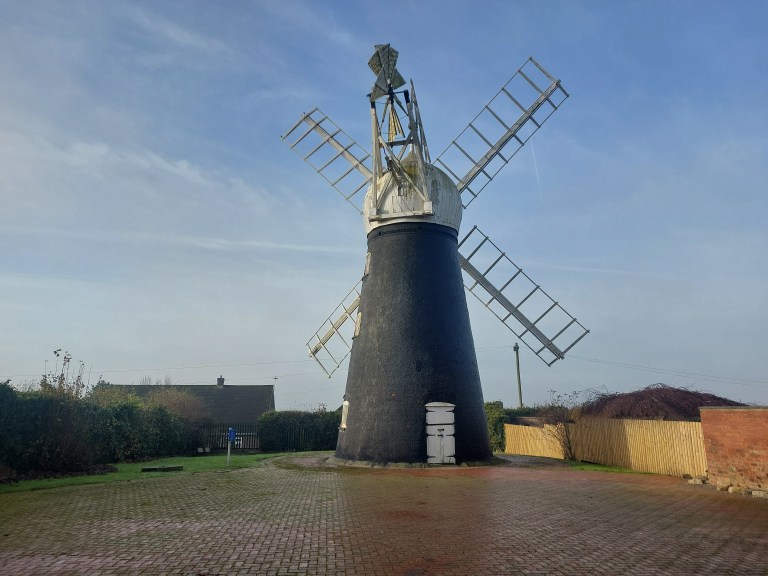
The Kidderminster carpet museum is the latest industrial site to announce its closure in 2025. Other museums and heritage sites to close this year, or announce imminent closure, include Alford Windmill, Cannock Chase Mining Museum, Castleton Museum, Otterburne Textile Mill, and the Walsall Leather Museum.
“It is with deep regret that the Carpet Museum Trust announces the closure of the Museum of Carpet, Stour Vale Mill, Kidderminster, on the 20th December 2025. After 13 years serving the public as a centre of learning, culture and heritage the museum has, like many similar institutions, faced significant financial challenges in recent years.
Despite the dedication of staff, volunteers, Friends, Trustees, Corporate Partners and supporters the combination of rising energy prices, maintenance costs, loss of tenants and reduced footfall have made it unsustainable to continue operations at its present site. Efforts to secure additional long term funding have been explored extensively with the help of Museums Development Midlands and the Arts Council. Unfortunately, no sustainable solutions have been found to overcome these financial challenges.
The Carpet Museum Trust, will continue to be responsible for the management of its archives, displays and collections. Arrangements are being made to preserve and relocate the Museum’s collection for future generations as necessary and they will be made public once details are finalized .In the meantime access to these collections and archive will remain a priority for the Trust – please make enquiries via email to collections@museumofcarpet.org.uk
If you feel you are able to help or assist in any way please get in touch with me as below. In the meantime up to December 20th we hope that the people of Kidderminster and Wyre Forest will take the opportunity to show their support and appreciation of what we have accomplished by visiting us along with their families.
Geoffrey Gilbert.
Chair of the Board of Trustees, Carpet Museum Trust
Email. gilberga51@gmail.com”
Kidderminster Museum of Carpet staff, volunteers, and weaving machine. Image coursey of Museum of Carpet.